

When you see something wrong at work-unsafe conditions, financial fraud, illegal dumping, or cover-ups-it’s not just a moral dilemma. It’s a legal right. Whistleblower laws exist to protect you if you speak up. But knowing your rights isn’t enough. You need to know how those protections work, what they cover, and where they fall short.
What Counts as Protected Reporting?
Whistleblower protections aren’t about gossip or personal grudges. They kick in when you report violations of laws or regulations. In California, under Labor Code Section 1102.5, you’re protected if you disclose information to a supervisor or government agency when you reasonably believe your employer is breaking state or federal law. That includes things like falsifying safety records, hiding environmental violations, or manipulating financial reports. Federal laws are more specific. The Sarbanes-Oxley Act protects employees of public companies who report fraud involving securities, mail, or wire. The False Claims Act covers fraud against government programs-like billing Medicare for services never rendered. The Dodd-Frank Act even offers financial rewards: if your tip leads to a recovery of over $1 million, you could get 10% to 30% of the money back. But these laws don’t cover everything. If you work in a non-public company and report a violation that doesn’t involve fraud, you’re likely only protected under your state’s law.What Counts as Retaliation?
Retaliation doesn’t always mean getting fired. It can be quieter, but just as damaging. Employers might:- Reduce your hours or cut your pay
- Deny you a promotion or raise
- Move you to a worse shift or location
- Give you unfair performance reviews
- Isolate you from meetings or team projects
- Create a hostile work environment
State vs. Federal: What’s the Difference?
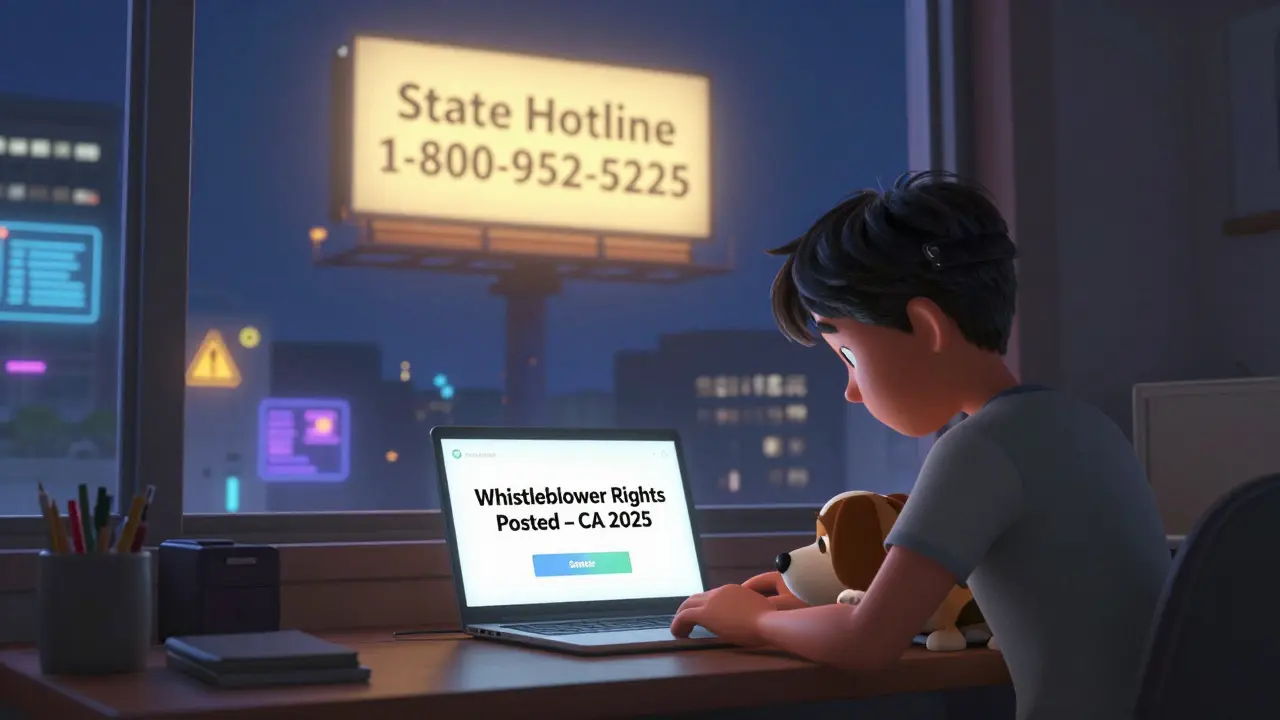
California’s whistleblower law is broader than most federal laws. It protects reports of violations of any state or federal law-not just specific industries or crimes. Federal laws usually target narrow areas: aviation safety, environmental hazards, financial fraud. California’s law covers everything from wage theft to data privacy breaches. But federal law has its advantages. Under the Dodd-Frank Act, whistleblowers can file directly with the SEC and get cash rewards. Under some federal statutes, you can sue in federal court. California’s law doesn’t let you do that-you’re stuck in state court or through the Division of Labor Standards Enforcement (DLSE). One big change is coming in 2025. Starting January 1, every employer in California must post a notice about whistleblower rights in a visible place, in at least 14-point font. The notice must include the Attorney General’s whistleblower hotline: 1-800-952-5225. Failure to post it? That’s a civil penalty of up to $10,000 per violation. No other state has a requirement like this. It’s a game-changer for awareness.
Deadlines Matter-And They’re Short
Time limits are one of the biggest traps. If you wait too long, your case dies-even if you’re completely in the right.- 30 days: Clean Air Act, CERCLA (Superfund)
- 90 days: Anti-Money Laundering Act, Asbestos Hazard Emergency Response Act
- 180 days: Consumer Financial Protection Act
What You Need to Do Before You Speak Up
Don’t go in blind. Here’s what works:- Document everything. Save emails, texts, performance reviews, and notes about conversations. California requires “clear and convincing evidence” of retaliation. Without paper trails, you’re out of luck.
- Know your law. Are you covered by California law? Federal law? Both? The National Whistleblower Center says 78% of successful cases involved a lawyer. You don’t need to hire one immediately-but get advice before you report.
- Use official channels. Reporting to HR isn’t always safe. Some HR departments work for the company, not the employee. Going directly to a government agency (like OSHA or the SEC) often gives you stronger protection.
- Know your resources. California’s hotline: 1-800-952-5225. OSHA’s whistleblower line: 800-321-6742. The National Whistleblower Center offered free legal help to over 1,200 people in 2024.
Real Problems, Real Gaps
The system isn’t perfect. On Reddit’s r/antiwork, people describe being pushed out after reporting safety issues. One user said they were moved to graveyard shifts after reporting OSHA violations-forcing them to quit. That’s retaliation disguised as scheduling. There’s also a growing blind spot: artificial intelligence. In May 2025, Senator Grassley introduced the AI Whistleblower Protection Act. Why? Because employees who report unethical AI practices-like biased algorithms or secret data collection-are currently unprotected. No federal law covers it. No state law either. It’s a legal vacuum. And then there’s enforcement. OSHA is understaffed. The DLSE is overloaded. Many whistleblowers say their cases get ignored or delayed. A 2024 Glassdoor analysis found that 37% of reviews mentioning whistleblower concerns included phrases like “hostile work environment after reporting.”What’s Next?
The future of whistleblower protections is being shaped right now. California’s 2025 posting requirement is a model others may follow. The Department of Labor is working on new rules to cut investigation times from 90 days to 60. The SEC paid out $637 million to whistleblowers in 2023-a 27% jump from 2022. More people are using these laws. But progress isn’t automatic. The National Whistleblower Center has seven major campaigns for 2025, including closing loopholes in airline safety laws and giving federal whistleblowers the right to sue in federal court. Without public pressure, these changes stall. The truth? Whistleblower laws exist to protect the public-not to make life easy for the person who speaks up. But if you’re prepared, informed, and documented, you stand a real chance. The system is flawed, but it’s not broken. And for every person who speaks up, it gets a little stronger.Can I be fired for reporting a violation?
No. Federal and state whistleblower laws make it illegal to fire, demote, harass, or otherwise retaliate against someone for reporting violations. If you are fired after reporting, you may have grounds for a legal claim. California law, for example, protects employees even if their report turns out to be wrong-as long as they had a reasonable belief that a violation occurred.
Do I need a lawyer to report a violation?
You don’t legally need one, but it’s strongly advised. The National Whistleblower Center found that 78% of successful whistleblower cases involved legal representation. Lawyers help you navigate deadlines, choose the right agency, and avoid mistakes that could weaken your case. Many offer free initial consultations.
What if I report anonymously?
Under federal laws like Dodd-Frank, you can report anonymously through a lawyer. But under California law, anonymous reports don’t qualify for protection. To be protected, your identity must be known to the employer or government agency you report to. If you’re worried about retaliation, talk to a lawyer before reporting-there are ways to protect your identity while still staying legally covered.
Are remote workers protected?
Yes. California’s whistleblower law applies to remote workers as long as they’re employed by a California-based company or their work affects California residents. However, the new 2025 posting requirement only applies to physical workplaces, so remote workers won’t see the notice. Employers must still comply with the law for remote employees-they just can’t rely on a poster.
How long do I have to file a complaint?
It depends on the law. For federal claims, deadlines range from 30 to 180 days. For example, you have 90 days to file with OSHA under the Clean Air Act, but 180 days under the Consumer Financial Protection Act. In California, there’s no strict deadline to file with the DLSE, but delays hurt your case. The longer you wait, the harder it is to prove retaliation. Don’t wait.
Can I get paid for reporting fraud?
Yes-if you report under the federal False Claims Act or the Dodd-Frank Act. The SEC pays whistleblowers 10% to 30% of the money recovered if their information leads to a successful enforcement action over $1 million. In 2023, the SEC paid out $637 million to 131 people. These rewards are not available under state laws like California’s.
What if my employer says I’m not protected because I didn’t follow company policy?
That doesn’t matter. Whistleblower laws protect you even if you violate internal reporting procedures. The law says your protection comes from reporting illegal activity-not from following your company’s HR process. If you reported to a government agency or supervisor and had a reasonable belief a law was broken, you’re covered-even if you went outside the company’s chain of command.
Jessica Klaar
February 8, 2026 AT 18:38I’ve been in HR for 15 years, and let me tell you - most companies don’t even know what whistleblower protections they’re legally required to post. I’ve seen managers panic when an employee cites Cal. Lab. Code 1102.5 like it’s a magic spell. The real win? That 2025 posting rule. It’s not just about compliance - it’s about culture. When people know they’re protected, they speak up before things get ugly. I’ve watched toxic environments turn around just because someone finally said, ‘Wait, isn’t that illegal?’
And yeah, documentation is everything. I had a case where a warehouse worker saved every text, every shift change notice, every ‘accidental’ missed paycheck. When he reported unsafe forklifts? He had a paper trail thicker than a phone book. Won him $180k in back pay and reinstatement. No lawyer needed - just smart, quiet persistence.
PAUL MCQUEEN
February 8, 2026 AT 21:04So… you’re telling me if I report my boss for using the company credit card for his kid’s soccer camp, I’m protected? That’s not fraud. That’s just being a bad dad. I feel like these laws are being stretched thinner than cheap tights at a yoga studio.
glenn mendoza
February 9, 2026 AT 17:37It is with profound respect for the integrity of our labor protections that I acknowledge the remarkable evolution of whistleblower statutes in the United States. The California model, particularly the 2025 mandatory posting requirement, represents a paradigmatic shift toward institutional transparency. Such measures not only affirm the dignity of the individual employee but also reinforce the foundational principles of democratic accountability within private enterprise. The fact that these protections extend to remote workers - regardless of physical location - is a testament to the adaptability of modern jurisprudence.
Moreover, the financial incentives under Dodd-Frank, while controversial, serve as a necessary corrective mechanism in markets where systemic risk is underreported. One must not confuse the messenger with the message - the whistleblower is not the problem. The silence is.
Chima Ifeanyi
February 10, 2026 AT 13:13Let’s deconstruct this narrative with some real-world systemic critique. The notion that whistleblower protections are ‘robust’ is a neoliberal myth perpetuated by regulatory capture. OSHA’s 63% missed deadline rate? That’s not inefficiency - that’s intentional under-resourcing. The state’s DLSE? Overloaded because they’re underfunded by design. The ‘10-30% reward’ under Dodd-Frank? A carrot to lure rats out of the corporate attic while the cheese remains poisoned.
And let’s not forget: these laws protect against retaliation, but they don’t prevent social death. You report? You’re labeled ‘troublemaker.’ Your LinkedIn gets ghosted. Your references vanish. Your mental health? Irrelevant. The system isn’t broken - it’s working exactly as intended. To protect capital, not conscience.
Tori Thenazi
February 12, 2026 AT 02:47Okay, but what if… the company is secretly using AI to monitor your Slack messages and flag you as a ‘potential whistleblower’ BEFORE you even say anything? I read this one Reddit thread where a guy said his manager kept saying ‘we’re all family’ right after he got a warning from the AI system. And then he got moved to the basement storage room… which, by the way, is where they keep the old servers that are still recording audio?!?!?!
And don’t even get me started on HR departments. They’re not your friends. They’re corporate spies with Excel sheets and performance review templates. I think they have a secret database called ‘Whistleblower Watchlist v3.1’ and it auto-sends alerts to the CEO’s phone. I’m not paranoid - I’ve seen the signs. The way they smile too much when you ask about ‘company policy’? That’s not kindness. That’s a trap.
Also - did you know? If you report anonymously through a lawyer, the SEC can still trace you via your WiFi router’s MAC address. I read this article. It’s real. I’m not making this up. I’ve started using public libraries to email my reports. I’m not safe. I’m not safe. I’m not safe.
Angie Datuin
February 13, 2026 AT 20:58My cousin reported a safety violation at her factory job. They didn’t fire her - they just stopped calling her in. After six months, she had to take a job at a gas station. She says it was worth it. But she still cries when she talks about it.
Ashlyn Ellison
February 14, 2026 AT 10:13Document everything. Seriously. I had a coworker who started keeping a notebook. Every time someone said ‘we’re just following procedure,’ she wrote it down. Date. Time. Who said it. What they said. Even the coffee stain on the memo. When she reported the chemical spill cover-up? That notebook was her shield. She didn’t win a million bucks. But she got her job back. And her name cleared. Sometimes that’s enough.
Also - that hotline number? Save it. On your phone. On your laptop. In your wallet. In your notes app. In your grandma’s address book. You never know when you’ll need it. And you won’t have time to Google it when you’re shaking in your car after work.
Jonah Mann
February 14, 2026 AT 16:50so i just wanna say - i reported my boss for falsifying time sheets and he totally retaliated by ‘reorganizing’ my desk to the corner by the bathroom. like. literally. next to the paper towel dispenser. i had to wear headphones just to hear myself think. and then they started giving me ‘mandatory team-building’ sessions at 7am on saturdays. i’m not even mad. i’m just… really tired.
also i think the 2025 poster thing is kinda dumb. like, who’s gonna read it? the janitor? he’s probably the one who’s been cleaning up the ‘accidental’ chemical spills.
Alex Ogle
February 15, 2026 AT 01:04Let me tell you about the night I sat in my car after work, staring at the dashboard, crying because I didn’t know if I’d be fired by morning. I’d just reported the lead contamination in the water system. They said it was ‘within acceptable limits.’ But the data didn’t match the EPA’s public reports. I had screenshots. I had emails. I had a recording of my manager saying, ‘We’ll fix it after the audit.’
Three weeks later, I got a letter. Not termination. Not demotion. Just a note: ‘Your performance has been noted. We encourage you to consider alternative employment opportunities.’
That’s the quietest kind of violence. No screaming. No headlines. Just… erasure.
And now? I work at a coffee shop. I still have nightmares about the smell of chlorine. And I still keep those emails. Every. Single. One.
John McDonald
February 16, 2026 AT 18:25Look - I know it sounds scary. But speaking up? It’s the bravest thing you can do. And you’re not alone. I’ve seen people get crushed. But I’ve also seen them rise. One woman I know reported her company for dumping toxic waste. They tried to make her look crazy. She got a lawyer. Filed with the EPA. Got a reward. Now she runs a nonprofit helping others do the same.
Don’t wait for someone else to do it. Don’t hope it’ll get fixed. Don’t assume ‘someone else’ will report it. If you see it - say it. Document it. Reach out. Call the hotline. Text a friend. Send an email. Do something. The system’s flawed - but it bends toward justice… if you push it.
Andrew Jackson
February 18, 2026 AT 11:09It is a national disgrace that the United States has become a nation of whistleblowers. We once had character. We once had loyalty. We once had trust in our institutions. Now? We reward informants. We incentivize betrayal. We turn the workplace into a theater of suspicion.
These laws are not protections - they are invitations to distrust. They encourage employees to spy on their colleagues, to record conversations, to file complaints over minor infractions. This is not strength. This is decay. A society that requires posters on every wall to remind people not to lie… is a society that has already lost its soul.
And yet - I suppose I must concede: if one must speak, one must do so within the framework of the law. But do not mistake legal compliance for moral virtue.
Joseph Charles Colin
February 18, 2026 AT 22:59From a compliance standpoint, the critical gap lies in jurisdictional alignment. Most organizations operate under a hybrid regulatory regime - state-level protections (e.g., Cal. Lab. Code §1102.5) intersect with federal statutes (e.g., Sarbanes-Oxley, Dodd-Frank), creating a fragmented compliance architecture. The absence of a unified reporting framework leads to inconsistent documentation standards, misaligned timelines, and jurisdictional arbitrage by employers.
Furthermore, the definition of ‘reasonable belief’ under California law remains ambiguously adjudicated. Case law (e.g., Yanowitz v. Stein) establishes a subjective standard, yet employers routinely exploit procedural gaps - particularly in non-public companies - to argue lack of statutory applicability.
Recommendation: Implement a centralized whistleblower portal under the DOL, synchronized with state agencies, with automated deadline tracking and real-time legal guidance. This would reduce latency, enhance evidentiary integrity, and eliminate the current patchwork.