
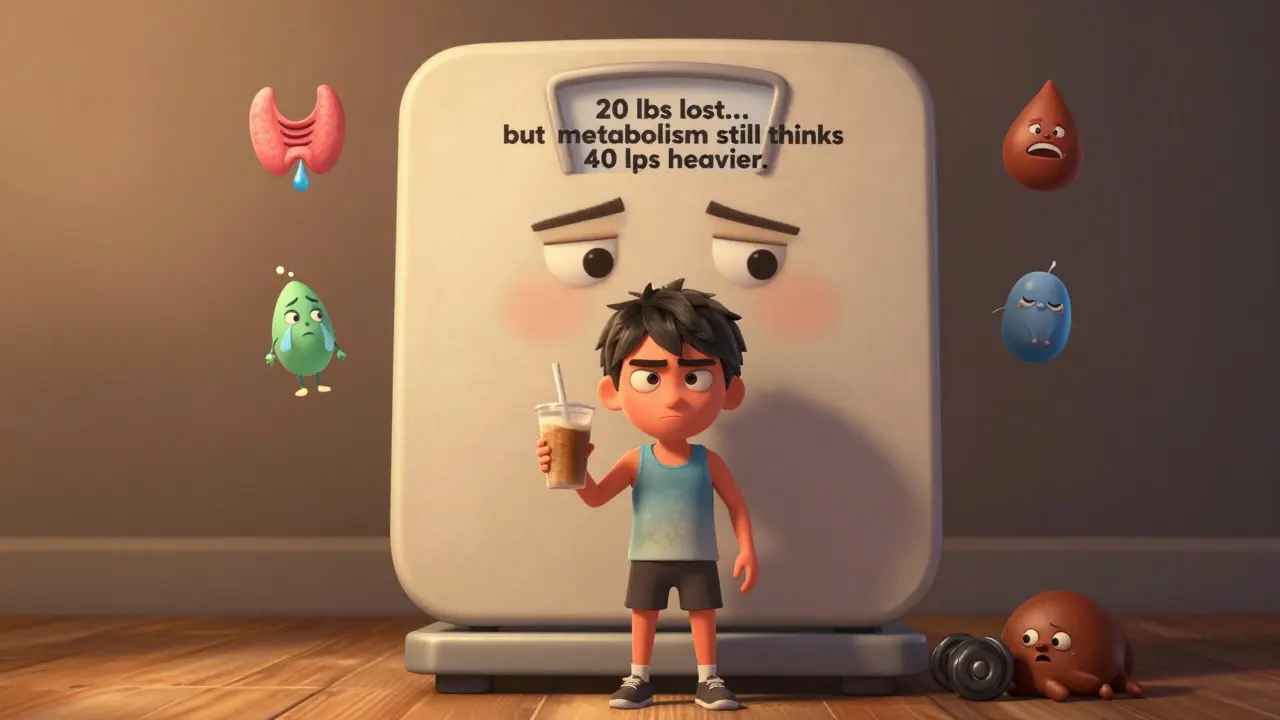
Ever hit a wall after losing 20 pounds? You’re eating less, working out more, and yet the scale won’t budge. It’s not laziness. It’s not failure. It’s your body doing exactly what evolution designed it to do: defend your weight.
Why Your Metabolism Slows Down After Weight Loss
When you lose weight, your body doesn’t just shrink - it rewires itself. This isn’t a glitch. It’s a survival mechanism. Researchers call it adaptive thermogenesis. In simple terms, your body burns fewer calories than it should for your new size. You might have lost 30 pounds, but your metabolism is acting like you still weigh 40 pounds more.
This isn’t just theory. Back in the 1940s, the Minnesota Starvation Experiment showed that men who lost 25% of their body weight saw their metabolic rate drop by 40% - way beyond what their new weight should have caused. Fast forward to 2022, and a study from the University of Alabama at Birmingham confirmed it: people who lost weight burned 92 fewer calories per day than predicted, even after accounting for muscle and fat loss. That’s like eating a whole bag of chips every day without gaining weight - except you’re not eating more. Your body just got better at using less.
Here’s what’s happening inside:
- Your thyroid hormone levels drop - slowing down your entire system.
- Leptin, the hormone that tells your brain you’re full, plummets by up to 70%. Suddenly, you’re hungry all the time.
- Cortisol, the stress hormone, rises - which can increase belly fat storage.
- Your brown fat, which burns calories to make heat, becomes less active. Women, who naturally have more of it, see an even sharper drop.
And here’s the kicker: this doesn’t go away after a few weeks. Studies show these changes last for years. Even people who’ve kept off weight for over a year still burn fewer calories than someone who never lost weight. Your body is holding on to the old version of you.
Why Calorie Counting Fails After the First Few Weeks
You start with 2,000 calories a day. Lose 10 pounds. You drop to 1,600. Lose another 10. You cut to 1,300. Then - nothing. You’re eating less than most people’s lunch, and the scale won’t move. You feel defeated. But here’s the truth: you’re not doing anything wrong. You’re just using the wrong math.
Most diet plans assume your energy needs shrink linearly with weight loss. They don’t account for metabolic adaptation. That’s why you hit a wall. A 1,500-calorie diet that worked at 200 pounds might be 300 calories too low at 170 pounds - not because you’re weak, but because your body now needs 400 fewer calories than it did before.
Research from the Mayo Clinic confirms this: initial weight loss is mostly water from glycogen depletion. That’s why people lose 5-10 pounds in the first week. Then the real work begins - and most plans don’t prepare you for it.
When people on Reddit’s r/loseit community hit plateaus, 78% said they dropped to 1,200-1,500 calories. Yet 65% reported constant hunger. That’s not a lack of discipline. That’s your body screaming for fuel. When your leptin drops, your brain thinks you’re starving. And it will do everything to get you to eat more - including making food seem more tempting, and making you feel exhausted.

How to Break Through: Science-Backed Strategies
Breaking a plateau isn’t about eating less. It’s about working smarter with your metabolism. Here’s what actually works, based on real studies:
1. Take a Diet Break
Instead of grinding through 1,200 calories for months, try this: after 8-12 weeks of restriction, eat at your maintenance calories for 1-2 weeks. No counting. No guilt. Just eat normally.
Why? A 2018 study found diet breaks reduce metabolic adaptation by up to 50%. Your leptin levels rebound. Your thyroid resets. Your energy comes back. When you go back into deficit, your body doesn’t fight as hard. Think of it like rebooting your system.
2. Lift Weights - Not Just Cardio
Cardio burns calories. Weight training preserves muscle. And muscle burns more calories at rest than fat. Studies show people who lift weights 3-4 times a week during weight loss lose 8-10% less of their resting metabolic rate than those who only do cardio.
You don’t need to go heavy. Bodyweight squats, push-ups, dumbbell rows - anything that challenges your muscles works. Keep your lean mass high, and your metabolism stays higher.
3. Eat More Protein
When you’re cutting calories, your body starts breaking down muscle for fuel. Protein protects against that. Aim for 1.6 to 2.2 grams of protein per kilogram of body weight. For a 180-pound person, that’s about 130-180 grams of protein daily.
A 2013 study found people on high-protein diets during weight loss lost 3.2 more pounds of fat and 1.3 fewer pounds of muscle than those on lower-protein diets. That’s not just about looking better - it’s about keeping your metabolism from crashing.
4. Try Reverse Dieting
If you’ve been on a low-calorie diet for months, your metabolism may be sluggish. Reverse dieting means slowly adding calories - 50-100 per week - until you reach maintenance. This doesn’t mean gaining weight. It means gently retraining your body to burn more without storing fat.
It takes patience. But people who do it report fewer plateaus later and more sustainable results. It’s like slowly turning up the thermostat after a long winter.
What Doesn’t Work (And Why)
Some people think the answer is to cut calories even more. Or to do more cardio. Or to try another fad diet. None of these work long-term.
Very low-calorie diets (under 1,000 calories) trigger the strongest metabolic adaptations. The body goes into survival mode. Your metabolism drops harder. Your hunger spikes. Your energy crashes. You’re more likely to quit - or binge later.
And no, supplements claiming to “boost metabolism” don’t fix this. Caffeine might give you a temporary energy boost, but it won’t reverse a 90-calorie-per-day metabolic deficit. Nor will green tea, fat burners, or detox teas. The science doesn’t back them. The placebo effect does.

What’s Changing in Weight Loss Today
The weight loss industry is finally catching up. WW (Weight Watchers) updated its Points system in 2021 to personalize calorie targets based on metabolic needs. Noom added a “metabolic reset” feature in 2022. And pharmaceutical companies are investing over $1 billion in drugs that target the hormones behind adaptation - like GLP-1 agonists (semaglutide, tirzepatide), which help reduce hunger and increase fullness.
But the most effective solution still isn’t a drug. It’s behavior. Bariatric surgery reduces metabolic adaptation by 60% compared to dieting alone - not because it’s magic, but because it physically changes how your gut talks to your brain. It resets hunger signals. That’s why it works so well.
And the future? Researchers are testing cold exposure to activate brown fat. Early studies show people who sit in 60°F rooms for two hours a day burn 5-7% more calories. It’s not practical for everyone - but it shows we’re moving beyond just “eat less, move more.”
What You Need to Know Now
Plateaus aren’t punishment. They’re progress markers. If you’re stuck, it doesn’t mean you’ve failed. It means your body is working exactly as it should - defending your old weight. The solution isn’t to fight harder. It’s to work smarter.
Here’s what to do next:
- If you’ve been dieting for over 8 weeks and the scale stopped: take a 1-2 week break at maintenance calories.
- Make sure you’re getting enough protein - at least 1.6g per kg of body weight.
- Add 3-4 strength sessions a week. Even light weights help.
- Stop obsessing over daily numbers. Look at trends over 4-6 weeks.
- Don’t cut calories below 1,200 for women or 1,500 for men unless under medical supervision.
Weight loss isn’t a straight line. It’s a zigzag. Plateaus aren’t roadblocks - they’re rest stops. And if you know how to use them, they’ll get you farther than any crash diet ever could.
Why does my weight loss stop even though I’m eating less?
Your body adapts to lower calorie intake by burning fewer calories - a process called metabolic adaptation. This isn’t about willpower. It’s biology. Your thyroid hormone drops, leptin (the fullness hormone) plummets, and your resting metabolism slows down more than expected for your new weight. This is why simply eating less stops working after a while.
How long does a weight loss plateau last?
Most plateaus last 4-12 weeks, but they can stretch longer if you keep cutting calories. The good news? Plateaus aren’t permanent. Taking a 1-2 week diet break - eating at maintenance calories - can reset your metabolism and break the stall in as little as 7-10 days.
Should I eat more to break a plateau?
Yes - but not to gain weight. Eating at maintenance calories for 1-2 weeks (called a diet break) helps restore your metabolism and hormone levels. Afterward, you can return to a deficit with more energy and less hunger. This is called reverse dieting, and it’s backed by research to reduce metabolic adaptation by up to 50%.
Does exercise help break plateaus?
Not all exercise is equal. Cardio burns calories during the workout, but it doesn’t protect your metabolism. Strength training does. Lifting weights 3-4 times a week preserves muscle mass, which keeps your resting metabolism higher. Studies show people who lift weights lose 8-10% less of their metabolic rate than those who only do cardio.
Are weight loss drugs the answer to plateaus?
Drugs like semaglutide (Wegovy) help by reducing hunger and increasing fullness - which counteracts the hormonal changes from metabolic adaptation. They’re effective, especially for people with obesity, but they’re not a fix for everyone. Lifestyle changes - protein, strength training, diet breaks - still form the foundation of long-term success. Medications work best when combined with behavior change.
Will my metabolism recover after I stop losing weight?
Partially. Some metabolic slowdown reverses after weight stabilization, but not all. Studies show people who’ve lost weight still burn 15-20% fewer calories than people who never lost weight - even years later. That’s why maintaining weight after loss is harder than losing it. That’s why strategies like protein intake, strength training, and occasional diet breaks are critical for long-term success.
Philip Blankenship
February 17, 2026 AT 09:22Man, I hit that plateau hard last year. Thought I was doing everything right - tracking calories, lifting, even sleeping like a monk. Then I found out my body was basically running on low-power mode. Took a two-week break, ate like I used to, and when I went back in, the scale started moving again. No magic, just biology. It’s wild how your body holds onto fat like it’s the last slice of pizza at a party.
Also, protein. I didn’t believe it until I started hitting 150g a day. Suddenly, I wasn’t starving at 9pm, and my energy didn’t feel like a dying phone battery. If you’re not eating enough protein, you’re basically asking your body to eat itself. Not cool.
Liam Earney
February 18, 2026 AT 20:05Oh, here we go again - the ‘metabolic adaptation’ lecture. I’ve read this exact post three times now. And yet, people still think they can outsmart evolution with a spreadsheet and some protein powder. Your body isn’t ‘glitching.’ It’s surviving. You’re not a machine. You’re a living, breathing, hormone-screaming, cortisol-dumping organism that’s been fine-tuned over millennia to NOT starve. And yet, here we are, trying to ‘hack’ it with ‘reverse dieting’ like it’s some kind of firmware update.
It’s not about calories. It’s about identity. You think you’re losing weight? No. You’re losing yourself. And when you finally stop - when you eat a bagel without guilt - you’ll realize the real plateau was never on the scale. It was in your head.
Adam Short
February 19, 2026 AT 18:22Right. So let me get this straight - after centuries of human evolution, we’ve now got a bunch of Americans in gym shorts telling their bodies to ‘reset’ like it’s a Windows PC? This is why the world is falling apart. You don’t need a ‘diet break.’ You need discipline. You need to stop listening to Reddit gurus and start listening to your granddad, who worked two jobs and ate one meal a day because that’s how you survived.
We used to lose weight by working harder, not by taking breaks. The fact that you need a ‘reboot’ to lose 10 more pounds says everything about the softness of modern life. Lift heavier. Eat less. Stop whining.
Sam Pearlman
February 20, 2026 AT 14:24Bro. I did the diet break. I ate pizza. I ate ice cream. I even had a burrito with extra cheese. And guess what? I didn’t gain 10 pounds. I gained 2. And then, after two weeks, I went back to my deficit - and lost 8 pounds in 3 weeks. Like, what? My body was just waiting for me to stop being a martyr.
Also, I tried the protein thing. 180g a day. I was eating chicken, eggs, whey, cottage cheese - I felt like a bodybuilder in a cereal commercial. But I stopped feeling like I wanted to cry every time I saw food. That’s not a coincidence. That’s science. And I’m not even that into fitness. I just wanted to stop hating my reflection.
Steph Carr
February 20, 2026 AT 21:50So we’ve turned weight loss into a cult of metabolic engineering - complete with reverse dieting, protein quotas, and ‘metabolic resets’ - while ignoring the fact that 70% of us are stressed, sleep-deprived, and emotionally eating because capitalism turned food into a trauma trigger.
Maybe the real plateau isn’t in your metabolism. Maybe it’s in your life. Maybe you’re not hungry for fewer calories. Maybe you’re hungry for peace. For rest. For not having to earn your right to exist in your own body.
Don’t get me wrong - the science here is solid. But if you’re doing this because you think you’re broken, you’re already losing. The scale doesn’t measure worth. It measures physics. And physics doesn’t care how hard you cried in the shower last Tuesday.
Brenda K. Wolfgram Moore
February 22, 2026 AT 01:21I’ve been at this for 18 months. Lost 42 pounds. Plateaued for 6 months. Tried everything. Then I stopped weighing myself. Just stopped. I started focusing on how I felt - energy, sleep, mood. And slowly, without trying, the weight came off again. It wasn’t about calories or protein or breaks. It was about stopping the war with myself.
You don’t need to ‘hack’ your metabolism. You need to stop fighting it. Your body isn’t your enemy. It’s your home. Treat it like one.
Linda Franchock
February 23, 2026 AT 05:18Oh sweet summer child. You think you’re the first person to hit a plateau? Honey, I’ve been doing this since 2012. I’ve tried keto, intermittent fasting, carnivore, vegan, low-fat, high-fat, liquid diets, and one time I ate nothing but pickles for a week because I read it ‘boosts metabolism’ (it didn’t).
Here’s the truth: if you’re not lifting, you’re losing muscle. If you’re not eating protein, you’re eating your own organs. And if you’re not taking breaks, you’re just training yourself to binge later.
Also - stop using the word ‘hack.’ You’re not a computer. You’re a human. And humans need rest. Not spreadsheets.
Prateek Nalwaya
February 23, 2026 AT 23:14Metabolic adaptation? Yeah, that’s real. But let’s be honest - the real reason people plateau is because they’re still eating too much. Not because of hormones. Not because of leptin. Because they think ‘maintenance’ means ‘I can have dessert every night.’
I’ve seen people do diet breaks and gain 5 pounds. Then they blame ‘metabolism.’ No. You ate 3000 calories a day thinking it was ‘maintenance.’ It wasn’t. It was a vacation. And now your body’s like, ‘Oh, you’re just gonna live like this? Cool. I’m gonna store it.’
Stop romanticizing the plateau. It’s not a reset. It’s a wake-up call. Eat less. Move more. Stop listening to influencers.
Agnes Miller
February 24, 2026 AT 19:27I tried the diet break. Ate at maintenance. Thought I’d gain weight. Instead, I felt less anxious. My sleep improved. My cravings dropped. I didn’t even realize how much I was stressing over every bite. Maybe the real fix wasn’t the food. It was the peace.
Also, I’m not great with numbers. I just eat until I’m full, then stop. And I lift three times a week. And I lost 20 pounds. No tracking. No apps. Just… listening.
Geoff Forbes
February 25, 2026 AT 15:05Let’s cut through the fluff. You don’t need a ‘break.’ You need to stop being lazy. You don’t need ‘reverse dieting.’ You need to eat less. You don’t need protein supplements. You need to stop eating processed garbage. Your body doesn’t need a ‘reset.’ It needs a boot in the ass.
People who say this is ‘biology’ are just making excuses. My grandfather lost 60 pounds in 1958 by eating oatmeal, walking 5 miles a day, and never once checking a calorie counter. He didn’t have a ‘metabolic adaptation’ - he had discipline.
This isn’t science. It’s whining with footnotes.
Jonathan Ruth
February 26, 2026 AT 16:26Plateau? Yeah. I hit mine at 180 pounds after losing 50. I cut to 1300. Nothing. Then I started lifting. 3x a week. Squats, deadlifts, rows. Protein. 170g. Didn’t change my calories. Just added weight training. Lost 10 pounds in 3 weeks. Simple. No magic. No breaks. Just strength.
Cardio is for people who hate their bodies. Strength is for people who want to own them.
Oliver Calvert
February 27, 2026 AT 02:47For anyone who thinks this is just about calories - go read the Minnesota Starvation Experiment. People lost 25% of their body weight and their metabolism dropped 40%. That’s not laziness. That’s survival. Your body isn’t broken. It’s doing its job.
And yes - diet breaks work. I’ve used them. They’re not a cheat. They’re a recalibration. Like changing oil in a car. You don’t drive forever without it. Why treat your body differently?
Philip Blankenship
February 28, 2026 AT 03:48Replying to myself because I just realized something - the thing that helped me most wasn’t the protein or the breaks. It was stopping the daily weigh-ins. I started tracking weekly averages instead. And suddenly, I stopped obsessing. My anxiety dropped. My hunger dropped. And the weight… just… kept going.
Maybe the real plateau wasn’t in my metabolism. Maybe it was in my mind. And once I stopped trying to control every gram… my body finally trusted me.
Brenda K. Wolfgram Moore
February 28, 2026 AT 09:23This. This right here. The daily weigh-in is the real enemy. I stopped weighing myself for 3 months. Just focused on how my clothes fit. And when I finally stepped on the scale - I’d lost 7 pounds without trying. Your body doesn’t need surveillance. It needs trust.