
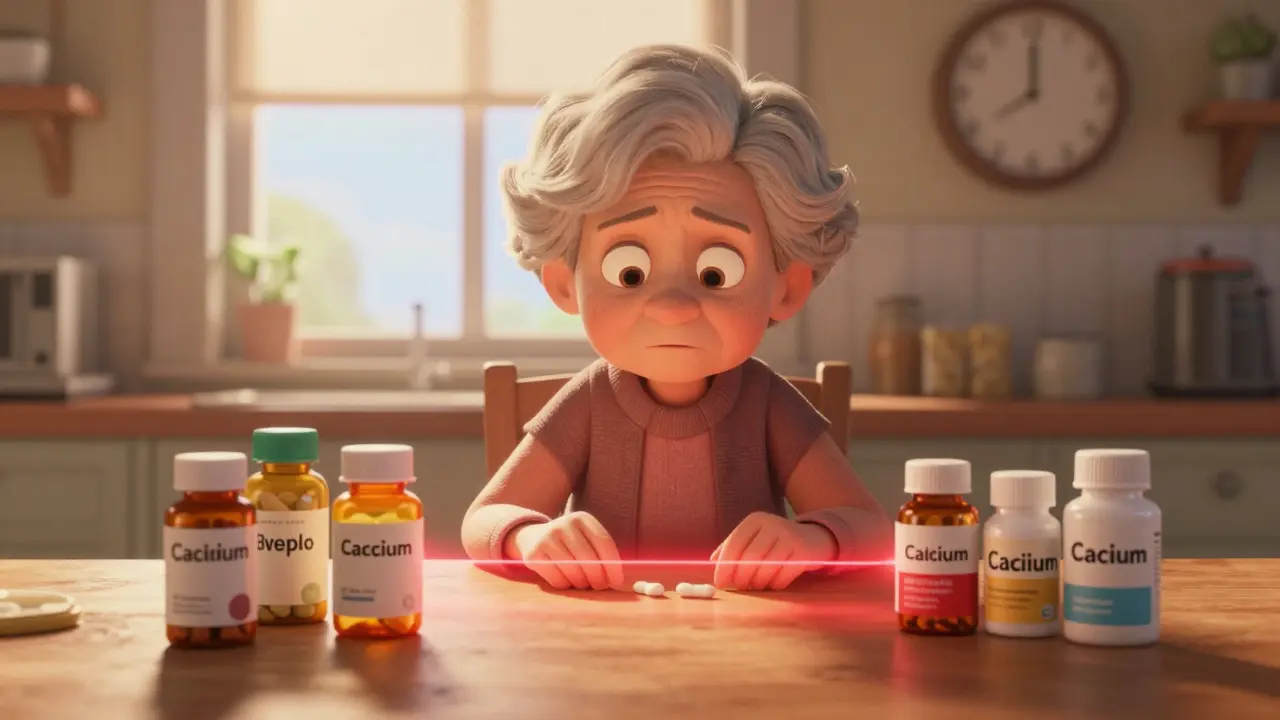
Every year, millions of people take multiple medications - some for high blood pressure, others for thyroid issues, arthritis, or diabetes. But what if taking your pills at the wrong time could make them less effective - or even dangerous? It’s not just about forgetting a dose. Sometimes, when you take your medicine matters just as much as what you take.
Why Timing Matters More Than You Think
Most people assume drug interactions happen because two medications are incompatible. That’s partly true. But there’s another layer: timing. Some interactions aren’t about chemistry - they’re about physics and biology. When one drug blocks another from being absorbed in your gut, or changes how fast your liver breaks it down, the effect can be dramatic.Take ciprofloxacin, an antibiotic used for infections. If you take it with an antacid like Tums or Maalox, your body absorbs up to 90% less of the antibiotic. That means the infection might not clear - and could come back stronger. But if you wait two hours between the antacid and the antibiotic, absorption returns to normal. No change in dosage. No switching drugs. Just a simple time gap.
This isn’t rare. About 20-30% of all documented drug interactions can be avoided just by spacing out doses. The FDA’s 2022 report on preventable adverse reactions found that nearly one in five hospitalizations from drug issues could have been stopped with better timing.
How Timing Interactions Actually Work
Not all interactions are the same. There are two main types that timing can fix:- Absorption interference: One drug sticks to another in your stomach or intestines, trapping it so it can’t enter your bloodstream.
- Food or pH interference: Certain foods, supplements, or stomach acid levels change how well a drug dissolves and gets absorbed.
For example, levothyroxine - the most common thyroid medication - needs an empty stomach. If you take it with calcium, iron, or even coffee, absorption drops by over 50%. Studies in the Journal of Clinical Endocrinology & Metabolism show you need at least four hours between levothyroxine and iron supplements to keep 95% of the dose working. That’s why doctors tell you to take it first thing in the morning, before breakfast.
Bisphosphonates like alendronate (Fosamax), used for osteoporosis, are even pickier. They need to be taken with a full glass of water, 30 minutes before anything else - even water. If you eat or drink anything else too soon, the drug won’t absorb properly. And if it doesn’t absorb, it won’t strengthen your bones.
Then there’s tetracycline. This antibiotic binds tightly to calcium, magnesium, and iron. So if you take it with milk, yogurt, or a multivitamin, it’s basically useless. You need to wait two to three hours after taking tetracycline before consuming anything with those minerals.
But here’s the catch: not all interactions can be fixed with timing. If two drugs compete for the same liver enzyme - like warfarin and metronidazole - spacing them out won’t help. The enzyme gets blocked regardless of when you take them. In those cases, you need to switch one of the drugs or adjust the dose. Timing only works for absorption issues.
What Happens When Timing Is Ignored
Consider a 72-year-old woman on seven medications: levothyroxine, iron, a calcium supplement, a blood pressure pill, an antibiotic, a painkiller, and a proton pump inhibitor for acid reflux. She takes them all at breakfast because it’s easier. Within weeks, she’s exhausted, dizzy, and her anemia gets worse.Why? The iron and calcium block the thyroid medicine. The proton pump inhibitor reduces stomach acid, which keeps the iron from dissolving. The antibiotic doesn’t absorb well because of the calcium. Her body isn’t getting any of the key drugs it needs - not because they’re bad drugs, but because they’re taken together.
Studies show this scenario is common. The CDC reports that 45% of adults over 65 take five or more medications. And they’re three times more likely to have time-dependent interactions than younger people. In one 2022 survey, 40% of patients over 65 admitted they didn’t know which pills needed to be spaced apart. Many just guessed.
And it’s not just older adults. Younger people on birth control and antibiotics, or those on statins and grapefruit juice, also face timing traps. Grapefruit doesn’t just interact with statins - it can stay in your system for days, making timing irrelevant. But for most other drugs, timing is your best defense.

What Works - And What Doesn’t
Some people try to fix interactions by switching drugs. But that’s not always possible. If you’re on warfarin for a heart condition, you can’t just swap it out. If you’re on levothyroxine, there’s no real alternative. Timing lets you keep the drugs you need - without adding more pills or risks.Compared to switching medications, timing improves adherence. A 2020 study in JAMA Internal Medicine found that 89% of patients stuck with their timing schedule, while only 67% stayed on a substituted drug. Why? Because people don’t want to stop what’s working. They just need to know when to take it.
But timing isn’t easy. Nurses in hospitals spend 12-15 minutes per patient each day just coordinating when to give each pill. In outpatient clinics, doctors rarely document timing instructions. Only 28% of outpatient clinics in 2023 consistently wrote down separation times on prescriptions.
And false alerts are a problem. Computer systems in hospitals sometimes warn about timing issues even when the patient takes the drugs correctly. One study found that 45% of TDDI alerts were wrong because the system didn’t know the patient’s actual schedule. That leads to alert fatigue - where staff start ignoring warnings altogether.
How to Get It Right
If you take more than three medications, here’s how to start getting timing right:- Make a full list - every pill, supplement, and over-the-counter drug. Include dosages and times.
- Check for common offenders: Iron, calcium, antacids, thyroid meds, antibiotics, and bisphosphonates are the usual suspects.
- Use trusted resources: Lexicomp, Micromedex, or the FDA’s drug interaction database list exact separation times. For example:
- Levothyroxine and iron: 4 hours apart
- Ciprofloxacin and antacids: 2 hours apart
- Tetracycline and dairy: 3 hours apart
- Alendronate and food: 30 minutes before
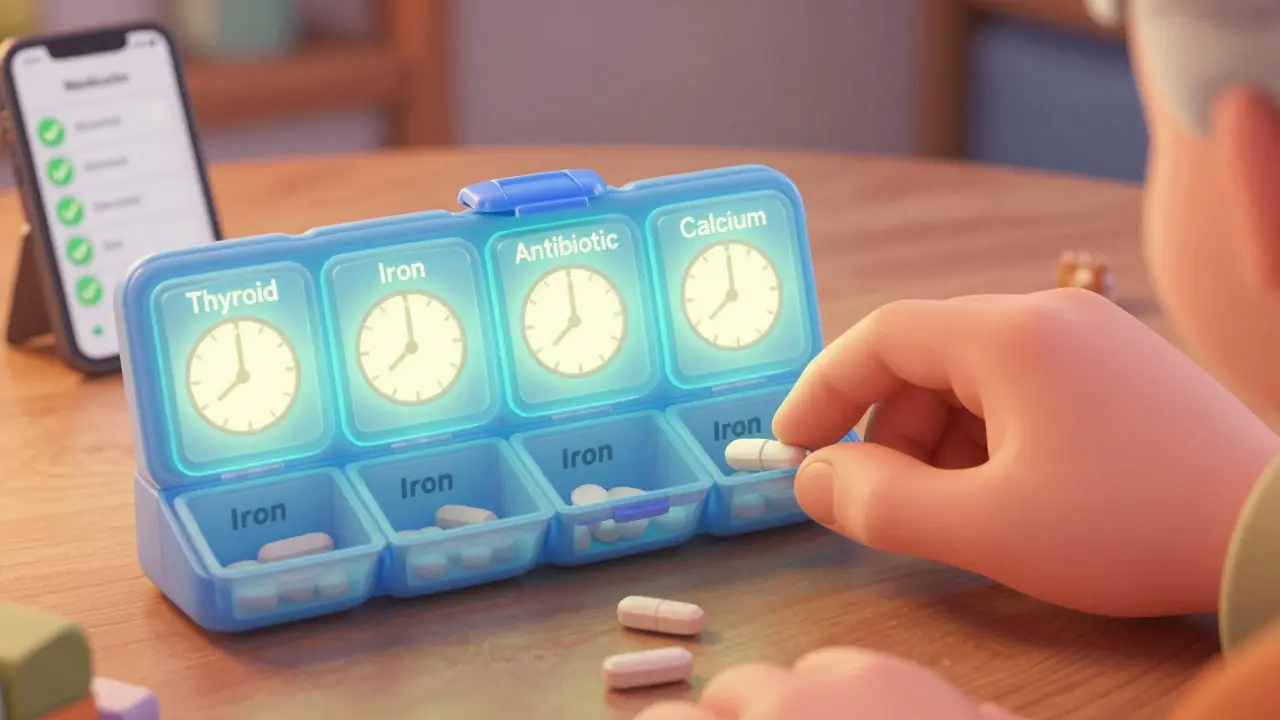
- Build a schedule: Group pills that can be taken together. Separate the ones that can’t. Use a chart or app.
Many patients find pill organizers with multiple compartments helpful. A 2021 study from the Agency for Healthcare Research and Quality showed they cut timing errors by 43%. Even better? Digital tools. The Medisafe app, which sends timed alerts and reminds users when to wait, improved adherence by 57% in a trial of over 1,200 patients.
What’s Changing - And What’s Coming
The field is evolving. In 2023, Epic Systems rolled out AI-powered timing suggestions in their electronic health records. These tools now consider your kidney function, stomach pH, and even your usual meal times to predict the best schedule - not just a fixed gap.The FDA is pushing drug makers to include timing instructions on labels. In 2021, only 15% of labels had them. By 2024, that number jumped to 40%. New guidelines now recommend separation times for 17 high-risk combinations, including clarithromycin and colchicine - where a two-hour gap cuts toxicity risk by 60%.
Looking ahead, personalized timing could be a game-changer. The FDA’s 2024 draft guidance suggests using genetic data to adjust separation intervals. If your body breaks down drugs slowly due to your genes, you might need longer gaps. This could make timing 22% more effective for some patients.
By 2028, experts estimate that proper timing could prevent 115,000 to 178,000 hospitalizations each year in the U.S. - and save $1.2 to $1.8 billion in healthcare costs.
What You Can Do Today
You don’t need a PhD to get this right. Start simple:- Take your thyroid medicine on an empty stomach, 30-60 minutes before food.
- Wait two hours after taking an antibiotic before eating dairy or taking calcium.
- Don’t take iron or calcium with your other pills - space them out by at least four hours.
- Use a phone alarm or app to remind you when to take each pill - and when to wait.
- Ask your pharmacist: “Which of my meds need to be spaced apart?” They’ll know.
Timing isn’t magic. It’s science. And it’s one of the easiest, cheapest ways to make your medications work better - without adding more pills, side effects, or risks.
Can I take all my pills at once if I’m in a hurry?
No - especially if you’re on thyroid medicine, antibiotics, iron, or calcium supplements. Taking them together can cut absorption by up to 90%. Even if you feel fine, your body isn’t getting the full dose. It’s better to wait two to four hours between certain drugs than to risk them not working at all.
Do I need to avoid food completely with all my medications?
Not all. Some drugs, like statins or blood pressure pills, work fine with food. But thyroid meds, bisphosphonates, and certain antibiotics need an empty stomach. Always check the label or ask your pharmacist. If it says "take on an empty stomach," wait at least 30 minutes before eating.
What if I forget to space my pills? Should I skip the dose?
Don’t skip it. If you took your antibiotic with milk, for example, just wait until the next scheduled dose and take it correctly then. Don’t double up. Missing one dose is less risky than overdosing. If you’re unsure, call your pharmacist or doctor.
Are over-the-counter supplements safe to take with my prescriptions?
No - not without checking. Iron, calcium, magnesium, and even vitamin C can interfere with absorption of antibiotics, thyroid meds, and osteoporosis drugs. Many people think supplements are harmless, but they can be just as risky as prescription drugs when timing is off.
Can my pharmacist help me sort out my timing schedule?
Yes - and they should. Pharmacists are trained to spot timing interactions. Ask for a medication review. Many pharmacies offer free consultations, especially if you take five or more drugs. Bring all your pills and supplements in a bag. They’ll build you a simple schedule - often on paper or in an app.
Brandon Vasquez
February 26, 2026 AT 17:09Been taking levothyroxine for 8 years. Learned the hard way that coffee ruins it. Now I take it at 6 AM, wait 45 minutes, then make coffee. Simple. No more fatigue. No more doctor visits. Just science.
Also, never mix calcium with antibiotics. Learned that when my sinus infection came back worse. Took me 3 weeks to figure out why.
Miranda Anderson
February 27, 2026 AT 14:56I used to throw all my pills down at breakfast like it was a cereal bowl. My mom had 7 meds too, and she’d just stack them. We thought it was fine until she ended up in the ER with low TSH and iron deficiency. Turns out, the calcium supplement was blocking the thyroid med, and the PPI was stopping the iron from dissolving. It’s wild how something so simple-waiting two hours-can completely change your energy, mood, even your bloodwork. I made a chart now. Laminated it. Put it on the fridge. My dad says I’m obsessive. I say I’m alive.
And honestly? I wish every pharmacy handed out these charts like a map. We’re not lazy. We’re just not taught this. It’s like being told to drive a car without being shown the pedals.
Gigi Valdez
March 1, 2026 AT 07:59The data presented here is well-supported by clinical evidence. The FDA’s 2022 report and the JAMA study from 2020 are both peer-reviewed and widely cited. The distinction between absorption-based and metabolism-based interactions is critical, and the author correctly identifies that timing only resolves the former. Pharmacokinetic principles are often overlooked in patient education, and this post fills a significant gap. I recommend this be shared with primary care teams and included in pharmacist-led medication reconciliation protocols.
Sneha Mahapatra
March 2, 2026 AT 19:15It’s funny, isn’t it? We spend hours choosing the right skincare, the perfect yoga mat, the organic kale-but we toss pills into our mouths like candy, never thinking about when or how they meet our bodies.
My grandmother took her thyroid med with her chai. She thought it was ‘just tea.’ She died at 74 from heart complications. They said it was age. But I know. It was timing.
Now I set alarms for my meds. I even have a little note taped to my mirror: ‘Your body doesn’t care if you’re in a rush. It only cares if you’re listening.’
Maybe that’s the real medicine-not the pills, but the patience.
bill cook
March 4, 2026 AT 17:53Who even decided this timing stuff? Sounds like Big Pharma’s way of making us take more pills. What if the real problem is that we’re on too many drugs to begin with? Why not just cut the unnecessary ones instead of making us into pharmacists? I’ve got 6 meds and now I need a PhD in chemistry just to eat breakfast? This feels like a scam to keep us dependent.
Byron Duvall
March 5, 2026 AT 18:13Wait, so you’re telling me the FDA and big pharma didn’t tell us this for decades? And now they’re suddenly ‘pushing’ labeling? Sounds like they got caught. They’ve been selling us drugs for years without telling us how to take them. Now they’re pretending it’s our fault we didn’t know?
And don’t get me started on apps like Medisafe. That’s just another way to track you. What’s next? A chip in your pill bottle that reports to your insurance company?
I’m not taking any pills unless I can do it all at once. Let the side effects come. I’m tired of being manipulated.
Katherine Farmer
March 6, 2026 AT 04:34How quaint. A 12-page essay on something that should be taught in high school biology. The fact that this is even news suggests a catastrophic failure in public health literacy. And yet, we have people arguing about whether to take calcium with antibiotics like it’s a philosophical debate. The real tragedy isn’t the timing-it’s that we live in a society where a 72-year-old woman needs a laminated chart to survive her own medication regimen.
Perhaps we should stop calling this ‘patient education’ and start calling it ‘damage control’ for a broken system.
Full Scale Webmaster
March 8, 2026 AT 02:08Okay, I’ve been reading this whole thing and I’m not even mad-I’m terrified. I’ve been taking my antibiotics with my protein shake since 2020. I thought it was helping me build muscle. Turns out I was just feeding my infection. My last UTI lasted 6 weeks. I thought it was stress. Turns out, it was the calcium in my supplement blocking the cipro.
And now I find out my thyroid med was useless because I took it with my morning oatmeal? I’ve been tired for 3 years. My doctor said it was ‘aging.’
So what else have I been doing wrong? Is my blood pressure med useless because I take it with grapefruit juice? Is my statin not working because I eat avocado? Did my dentist give me amoxicillin with yogurt last year and I didn’t know? Am I just a walking drug failure?
Why didn’t anyone tell me? Why is this not on every prescription? Why do I have to Google this like I’m solving a crime? I’m not a scientist. I’m just trying to stay alive. And now I feel like I’ve been lied to my whole life. I’m not even mad. I’m just… hollow.
Who do I sue?