
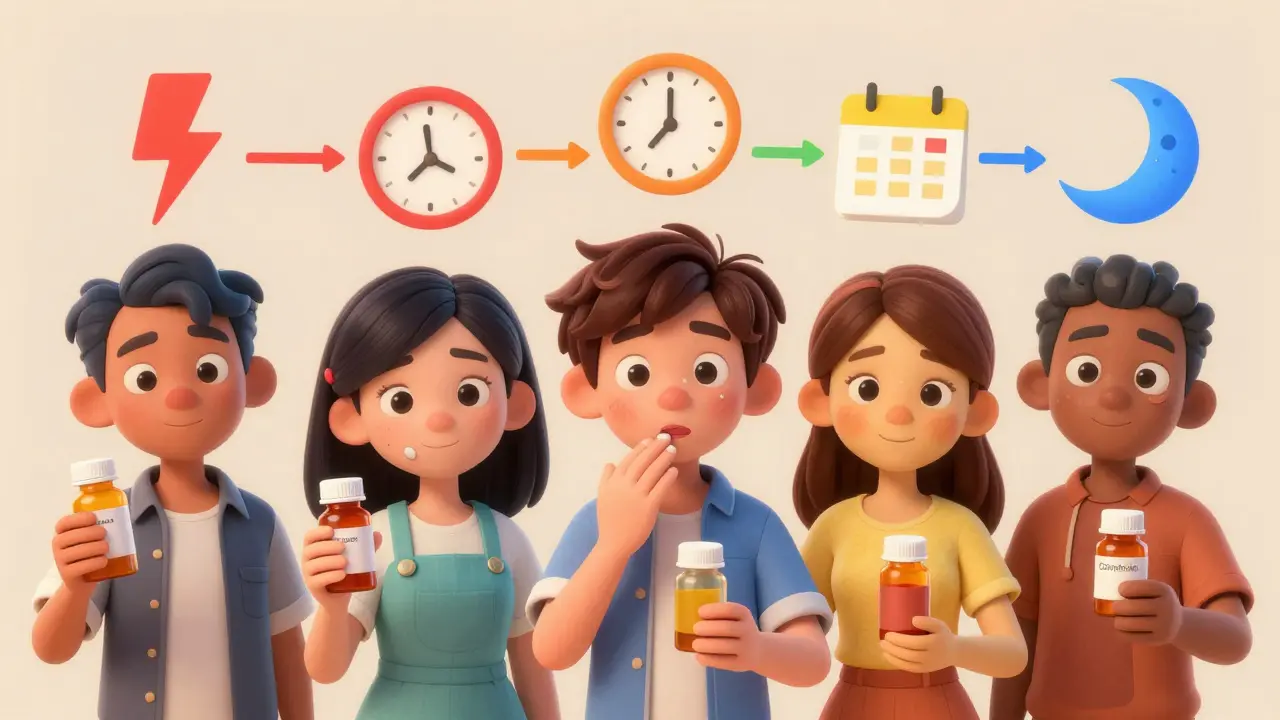
Side Effect Onset Estimator
How Long After Starting? Find Your Risk
This tool helps you understand if your symptoms might be related to medication based on typical time-to-onset patterns. Always consult your doctor for medical advice.
Your Results
Have you ever started a new medication and felt something off - a weird muscle ache, a rash, or dizziness - and wondered if it was the drug or just bad luck? You’re not alone. Many people assume side effects show up right away, but that’s not always true. Some hit within hours. Others creep in weeks or even months later. Knowing when side effects typically start for different drugs can help you spot them early, avoid misdiagnosis, and talk smarter with your doctor.
Why Timing Matters More Than You Think
It’s easy to blame a new pill for every strange feeling. But not every symptom is caused by the drug. Sometimes it’s your body adjusting. Other times, it’s the disease itself acting up. That’s where time-to-onset (TTO) comes in. TTO isn’t just a fancy term - it’s a real clinical tool used by doctors and researchers to figure out what’s actually causing a problem. Think of it like this: if you take a pill and feel sick the next day, it’s more likely the drug. If you’ve been on it for six months and suddenly get a rash, it’s trickier. That’s why researchers track how long it takes for side effects to appear after starting a medication. They’ve found clear patterns across drug classes. These patterns help separate true drug reactions from random coincidences.Fast-Acting Side Effects: Hours to Days
Some reactions come on fast - sometimes within hours. These are often tied to how the drug works in your body right away. Angioedema from ACE inhibitors (like lisinopril or enalapril) is a classic example. Most people expect swelling to happen right after the first dose. But here’s the catch: it can show up anytime from the first day to six months later. The first week is common, but delayed cases are real and often missed. One patient in a Drugs.com review described severe swelling four months after starting lisinopril. Her doctor didn’t connect it until she found research showing ACE inhibitors can cause late-onset angioedema. Antibiotics like ciprofloxacin are another fast actor. Studies show the median time for peripheral nerve issues - tingling, burning, numbness - is just 2 days. Women tend to feel it even faster than men, with a median of 2 days versus 4 days. This isn’t rare. In online forums, nearly half of users reported these symptoms within 48 hours of starting the drug. Acetaminophen (Tylenol) overdose is an emergency case. Liver damage can start showing up in blood tests within 24 hours. If you’ve taken too much, waiting for symptoms isn’t safe. The clock starts ticking the moment you swallow the pill.Mid-Term Reactions: Days to Weeks
This is where most people get confused. Symptoms show up after a few days or weeks, so they assume the drug is fine. But that’s not always true. Statins (like atorvastatin or simvastatin) are often blamed for muscle pain. Many patients quit because they think it’s the drug. But a major 2021 JACC study found something surprising: patients who stopped taking statins because of muscle pain felt better just as fast - whether they were on the real drug or a placebo. That suggests a strong nocebo effect. Still, for those who truly react, muscle pain often starts between 1 and 4 weeks. It’s not immediate, but it’s not months later either. Pregabalin and gabapentin (used for nerve pain and seizures) show side effects like dizziness and fatigue in over half of users within the first week. Research puts the median time for these symptoms at 19 days for pregabalin and 31 days for gabapentin. So if you’re still feeling foggy after a week, it’s worth mentioning to your doctor.
Delayed Reactions: Weeks to Months
These are the sneaky ones. They show up so late that even doctors forget to connect them to the drug. Drug-induced hepatitis (liver inflammation from medications) usually shows up around 42 days after starting the drug. But the range is wide - anywhere from 20 to 117 days. Common culprits include antibiotics, antifungals, and some seizure meds. If you’ve been on a new drug for six weeks and suddenly feel tired, nauseous, or your skin looks yellow, get your liver checked. Natalizumab (used for multiple sclerosis) can cause peripheral nerve damage, but it takes a long time. The median onset? 141.5 days. That’s nearly five months. If you’re on this drug and start having tingling or weakness after 120 days, it’s not a coincidence. Interferon beta-1a (for MS and hepatitis) has one of the longest recorded delays: 526.5 days - almost 18 months. That’s longer than most people stay on the drug. But when it happens, it’s serious.How Doctors Use This Info
Hospitals and clinics are starting to use this data in real time. Systems like Epic now have built-in alerts that flag side effects based on timing. Mayo Clinic saw a 22% increase in detecting drug reactions after adding TTO logic to their electronic records. That means fewer missed cases. The FDA recommends special attention to any side effect that happens within 30 days of starting a new drug. But experts warn: don’t ignore symptoms after that. Delayed reactions are real, and they’re underreported. One study found that adverse events are 37% less likely to be reported after the drug is stopped - because no one thinks to link them anymore.
What You Can Do
You don’t need to be a scientist to use this knowledge. Here’s how to protect yourself:- Write down when you start each new medication - and what you’re feeling each day for the first month.
- If something new pops up after 10 days, don’t assume it’s “just stress.” Look up the typical onset time for that drug.
- Don’t stop a drug without talking to your doctor - especially if you’ve been on it for months. Some side effects get worse if you quit cold turkey.
- Use patient reviews on sites like Drugs.com as a guide, not a diagnosis. They help you spot patterns, not confirm causality.
- If you’re on long-term meds (like for MS, depression, or autoimmune disease), ask your doctor: “What side effects could show up later, and when?”
The Big Picture
This isn’t just about avoiding discomfort. Getting the timing right can prevent hospitalizations, misdiagnoses, and unnecessary drug changes. A patient with unexplained fatigue might be labeled as “depressed” when they’re actually developing drug-induced liver damage. A person with numb hands might be told they have carpal tunnel when it’s actually ciprofloxacin toxicity. The science is clear: side effects don’t follow a one-size-fits-all clock. Some drugs act fast. Others wait. And some - like interferon - play the long game. The future is even smarter. Companies are building machine learning tools that predict side effect timing based on a drug’s chemical structure. The NIH’s All of Us program plans to add genetic data to these models by mid-2025, so we’ll soon know not just when side effects happen - but who’s most likely to get them. For now, your best tool is awareness. Track your symptoms. Know the typical timing for your meds. And don’t dismiss a symptom just because it showed up “too late.” Sometimes, the delay is the clue.Can side effects start months after taking a drug?
Yes. Some side effects take months or even over a year to appear. For example, interferon beta-1a can cause nerve damage after nearly 18 months. ACE inhibitors can trigger angioedema up to six months after starting. Drug-induced liver injury often shows up around 42 days but can occur as late as 117 days. These delayed reactions are common enough that doctors need to consider them - even if you’ve been on the drug for a long time.
Are statins really causing muscle pain?
It’s not always the drug. A major study found that 55% of people who stopped statins due to muscle pain felt better just as fast - whether they were on the real drug or a placebo. This points to a strong nocebo effect. That said, true statin-related muscle pain usually starts between 1 and 4 weeks after starting the medication. If you’re unsure, don’t quit on your own. Talk to your doctor about testing or trying a different statin.
Why do women get side effects faster than men?
Research shows women often experience certain side effects sooner. For example, women taking ciprofloxacin report nerve symptoms (like tingling) at a median of 2 days, while men report them at 4 days. This is likely due to differences in metabolism, body weight, hormone levels, and how drugs are processed in the liver and kidneys. These differences are now being built into new predictive models for side effect timing.
Is it safe to stop a drug if I think it’s causing side effects?
Not without talking to your doctor. Some drugs cause rebound effects or worsen your condition if stopped suddenly. For example, stopping antidepressants or blood pressure meds abruptly can be dangerous. Even if you think the drug is the problem, your doctor needs to rule out other causes and guide a safe taper if needed. Never stop a prescription medication on your own.
Can electronic health records help catch side effects early?
Yes. Systems like Epic now include algorithms that flag symptoms based on how long you’ve been on a drug. For example, if you develop fatigue 45 days after starting a new antibiotic, the system might alert your doctor to check for drug-induced liver issues. Mayo Clinic reported a 22% increase in detecting these reactions after adding this feature. It’s not perfect, but it helps doctors see patterns they might miss.
Do all side effects have a known time-to-onset?
No. For many drugs, especially newer ones or those used for rare conditions, the timing isn’t well documented. Some reactions are so rare or unpredictable that researchers can’t establish a clear pattern. That’s why patient reports and real-world data are so important - they fill in the gaps. Always report unusual symptoms to your doctor, even if the timing doesn’t match what’s listed.
Ryan W
January 25, 2026 AT 20:14So let me get this straight - we’re now tracking side effects like a goddamn GPS? Next they’ll be putting QR codes on pills so you can scan and get a 12-page PDF on when your liver might betray you. This isn’t medicine, it’s data porn. I’ve been on statins for 8 years. My legs ache. I’m tired. I don’t need a median onset time to know I’m not feeling great. Just tell me which drug doesn’t turn me into a zombie.
And why is every study funded by Big Pharma? Of course they want you to think it’s the nocebo. Saves ‘em millions in lawsuits.
Henry Jenkins
January 26, 2026 AT 19:39This is actually one of the most nuanced and clinically useful pieces I’ve read in years. The time-to-onset framework is underutilized in primary care, and the distinction between pharmacokinetic reactions (fast) and immunologic or idiosyncratic ones (delayed) is critical. For example, the 42-day median for drug-induced hepatitis aligns with the classic ‘hepatotoxicity window’ in toxicology literature - it’s when hepatic enzyme induction peaks and glutathione depletion becomes critical. What’s missing here is the role of CYP450 polymorphisms - some patients metabolize drugs slower, pushing reactions further out. Genetic testing isn’t routine, but it should be for long-term polypharmacy patients. Also, the 22% increase at Mayo? That’s not just tech - it’s behavioral. Doctors stop looking after 30 days because the system doesn’t nudge them. This changes that.
And yes, interferon at 526 days? That’s not a fluke. It’s a biological clock ticking in slow motion. We’re only beginning to map these chronopharmacological patterns.
TONY ADAMS
January 28, 2026 AT 04:49bro i took cipro for a sinus infection and my hands went numb like 2 days later. i thought i was having a stroke. i was crying in the bathroom. no one believed me until i showed them this article. thanks for making me feel less crazy.
also i hate doctors.
Napoleon Huere
January 30, 2026 AT 00:35What’s fascinating isn’t just when side effects occur - it’s what this says about our relationship with time and the body. We live in an instant-gratification culture, so we assume cause and effect must be immediate. But biology doesn’t care about our schedules. The body is a slow, layered system. A drug doesn’t just hit you - it infiltrates. It lingers. It rewires. The 18-month delay with interferon? That’s not a side effect. That’s a betrayal by a molecule you trusted. We treat medicine like a switch - flip it on, flip it off. But the body remembers. It holds grudges. Maybe the real side effect isn’t the numbness or the rash - it’s the erosion of trust in our own physiology. We stop listening because the timeline doesn’t fit our narrative. We’re not just patients. We’re time travelers, trying to reconcile yesterday’s pill with today’s pain.
Faisal Mohamed
January 31, 2026 AT 00:27Okay but let’s be real - this is all just glorified correlation. Just because a side effect pops up at 42 days doesn’t mean the drug caused it. Could be stress. Could be the new cat. Could be the fact that you finally started eating kale. 🤷♂️
Also, Epic alerts? Cool. But what if your doctor is too busy scrolling TikTok to notice? 🤖
Also, why is every study from the US? What about global populations? We’re not all 300lb white guys on statins. 🌍
Sally Dalton
January 31, 2026 AT 11:42oh my gosh i had no idea that angioedema could show up 4 months later!! i had this scary swelling in my lips last year and my doctor just said "it's allergies" and gave me benadryl. i was so scared. i didn't even think to mention the lisinopril because i'd been on it for 5 months. this is so important. thank you for writing this. i'm printing it out to show my dr. also, i've been journaling my symptoms since i started my new antidepressant - it's weird but it's helping me feel more in control. 💛
Mohammed Rizvi
January 31, 2026 AT 20:35Y’all act like the system’s gonna save you. Nah. The system’s designed to keep you docile and on meds. You think they want you to know that gabapentin takes 31 days to mess with your brain? Nah. They want you to think it’s just "aging" or "stress."
I’ve been on 7 meds at once. My liver’s a war zone. My brain’s a ghost. I don’t need a median. I need out. But they’ll keep writing scripts till I’m a zombie with a pill organizer. Good luck.
Shawn Raja
February 2, 2026 AT 03:38Let’s be honest - this isn’t about timing. It’s about power. Who gets to decide what’s a side effect and what’s "just your body adjusting"? Pharma? Doctors? Or the patient who’s lying awake at 3 a.m. wondering if their tingling toes are the drug or the end of the world?
I’ve seen people get labeled "hysterical" for reporting delayed reactions. Women. People of color. Elderly. They’re dismissed because the timeline doesn’t fit the textbook. This article is a middle finger to that. We’re not outliers. We’re data points they forgot to include.
Also - machine learning models by 2025? Cool. But if they’re trained on data from 90% white men, what happens to the rest of us? Just saying.
Also also - I’m starting a subreddit: r/WhenDidTheDrugBetrayYou
Allie Lehto
February 4, 2026 AT 02:21so i just realized i’ve been on sertraline for 11 months and i’ve had this constant headache since month 6. i thought it was from staring at screens. i just read that SSRIs can cause delayed headaches up to 8 months in. i feel so stupid for ignoring it. i’m going to call my doctor tomorrow. also, why is it so hard to believe your own body? we’re taught to trust doctors more than ourselves. that’s messed up. 💔
Dan Nichols
February 4, 2026 AT 19:06Statins don’t cause muscle pain. You’re weak. Stop blaming the drug. I’ve been on atorvastatin for 15 years. My legs are fine. Your pain is psychological. You’re lazy. Also, 37% less reporting after stopping? That’s because most people are dumb. They don’t know what they’re feeling. Learn to read. The data is right here. Stop crying about it.
Also, women get side effects faster? Of course. They’re more sensitive. That’s biology. Not a flaw. Just facts.
Renia Pyles
February 6, 2026 AT 06:15So what? You found a chart. Big deal. I’ve been on gabapentin for 3 years. I’m numb. I’m tired. I’m a shell. And you want me to wait for a "median" to tell me to quit? No. I quit yesterday. And now I’m in withdrawal. So thanks for the data. Now I’m paying the price for your academic curiosity.
Doctors don’t care. They just want you to keep taking the pills. You think they want you to know the truth? They want you to be quiet. And you’re just giving them more ammo with this "science."
Rakesh Kakkad
February 6, 2026 AT 21:48Este artículo es profundamente informativo y refleja un enfoque riguroso en la farmacovigilancia. Sin embargo, se omite la importancia de la farmacogenómica en poblaciones asiáticas, donde los polimorfismos en CYP2D6 y CYP2C19 afectan significativamente la farmacocinética de los fármacos como el pregabalina. En la India, la prevalencia de metabolizadores lentos es del 21%, lo que podría desplazar el tiempo de aparición de efectos adversos hacia rangos más tardíos. Se recomienda incorporar datos étnicos en los modelos predictivos. 🙏
Karen Droege
February 8, 2026 AT 16:30Okay, I’m screaming. This is the most important thing I’ve read in years. I’ve been on interferon for MS for 14 months. Last week I got this weird burning in my feet. I thought it was neuropathy from my diabetes. I almost didn’t mention it. But then I read this. I called my neurologist. She ran tests. It’s the interferon. We’re switching. Thank you for giving me the language to trust myself. I’m not crazy. My body’s been screaming, and I finally listened.
Also - if you’re on long-term meds, make a side effect calendar. Write it down. Even if it’s "just a headache." It matters. You’re not paranoid. You’re a detective. And your body? It’s your best witness.
Skye Kooyman
February 9, 2026 AT 08:06my dad had liver damage from an antibiotic 6 months in. no one connected it. he almost died. this needs to be in every doctor's office.
Uche Okoro
February 9, 2026 AT 17:34The temporal dynamics of adverse drug reactions are fundamentally rooted in pharmacodynamic tolerance and epigenetic modulation. The delayed onset of interferon-induced neurotoxicity at 526.5 days suggests a cumulative threshold effect in neuronal membrane receptor sensitization. This is not merely pharmacokinetics - it is systems biology in motion. The FDA’s 30-day reporting window is archaic. We require longitudinal, patient-generated pharmacovigilance frameworks. Real-world evidence must supplant RCTs. The All of Us initiative is a step, but insufficient without global genomic equity. This is the future of precision medicine - not algorithms, but agency.