
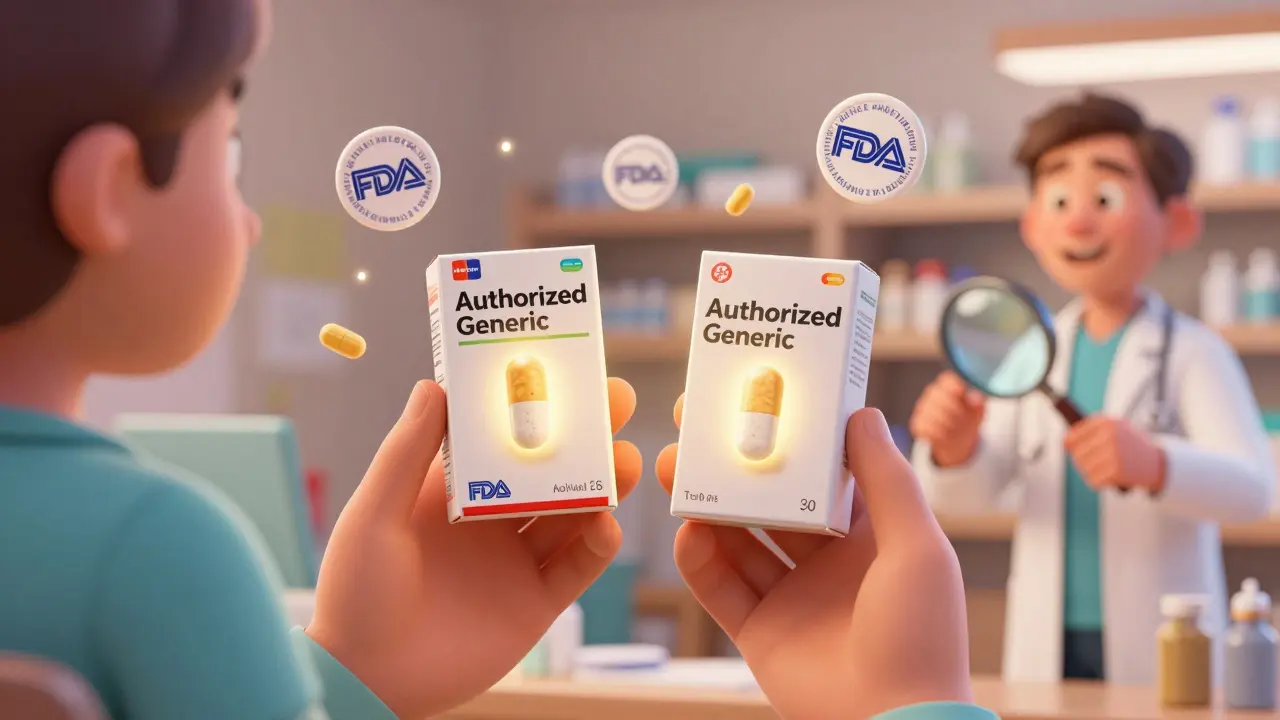
When your prescription switches from the brand-name drug you’ve been taking to a generic version, it’s normal to feel uneasy. What if it doesn’t work the same? What if it causes side effects you didn’t have before? The truth is, most of the time, you won’t notice a difference - especially if it’s an authorized generic.
An authorized generic isn’t just another generic. It’s the exact same pill, made by the same company that makes the brand-name version, just sold without the brand logo. No changes in ingredients. No changes in how it’s made. Same factory, same machine, same batch - only the label is different.
Why Authorized Generics Are Different
Most generics you see at the pharmacy are made by different companies. They have to prove they work the same as the brand-name drug through testing, but they might use slightly different fillers, colors, or shapes. That’s why your generic pill might look like a blue oval instead of the white capsule you’re used to.
An authorized generic doesn’t have to do that. It’s made under the original brand’s approval (NDA), not a generic one (ANDA). That means it’s identical in every way - down to the coating on the pill. If you’ve ever wondered why some generics look just like the brand, that’s why. It’s not a copy. It’s the same thing.
The FDA keeps a public list of all authorized generics. If you’re unsure whether the generic you’re getting is an authorized one, check the FDA’s quarterly update. It’s the only way to be sure.
How Much Money Can You Save?
Switching to an authorized generic can cut your out-of-pocket cost by $15 to $30 per prescription - sometimes more. Medicare Part D data from 2022 shows that when an authorized generic is available, insurance plans almost always require you to take it instead of the brand. That’s not a suggestion. It’s a rule.
And it’s not just about the price tag. When an authorized generic enters the market, it pushes down the price of traditional generics too. Studies show retail prices drop 4% to 8%, and wholesale prices drop even more - up to 14%. That’s because the brand company is now competing with itself. And competition, even from yourself, drives prices down.
For drugs like statins, blood pressure meds, or antidepressants, that savings adds up fast. A $50 monthly prescription can become $20. Over a year, that’s $360 in your pocket.
What to Do When Your Prescription Changes
Here’s what actually happens when your pharmacy switches your drug:
- You get a notification - either from your pharmacy, your insurer, or your doctor’s office.
- You pick up your refill and notice the pill looks different, or the box says a different name.
- You panic. Is this safe? Will it work?
Stop. Breathe. Check the label.
If the active ingredient matches your brand-name drug exactly - and the strength is the same - you’re fine. That’s the only thing that matters. The color? The shape? The brand name on the box? Irrelevant.
But here’s the catch: not every generic is an authorized generic. So ask your pharmacist: "Is this an authorized generic?" They’ll know. If they don’t, ask them to check the FDA’s list. Most pharmacies have access to it now.
And if you’re on a specialty drug - something expensive, like for MS or rheumatoid arthritis - your insurer might require prior authorization before switching. Don’t assume it’ll happen automatically. Call your insurance company and ask: "Is there an authorized generic for my drug? And will you cover it?"
What If You Notice a Difference?
Some people say they feel different after switching. Maybe they’re more tired. Or their stomach feels off. Or they think the pill isn’t working as well.
Here’s the thing: if it’s a true authorized generic, that shouldn’t happen. The ingredients are identical. The way your body absorbs it? The same.
But if you’re switching from a brand to a traditional generic - not an authorized one - then yes, differences can happen. Inactive ingredients (like dyes or fillers) can affect people with allergies or sensitivities. That’s rare, but it happens.
If you feel something’s off after switching:
- Don’t stop taking it. Talk to your doctor first.
- Check the label. Is it an authorized generic? Look up the manufacturer.
- If it’s not authorized, ask if you can switch to the authorized version.
- If you’re still having issues, your doctor can request a brand-name exception from your insurer.
Most people don’t have problems. A 2018 study found no difference in hospitalizations or medication discontinuation rates between people who switched to authorized generics versus traditional generics. Your body doesn’t know the difference.
How to Avoid Confusion at the Pharmacy
One of the biggest problems isn’t the drug - it’s the chaos at the pharmacy counter.
Some pharmacies stock both the brand and the authorized generic at the same time. The pharmacist might grab the wrong one. Or your insurance might switch you without telling you. You might think you’re getting the brand, but you’re not.
Here’s how to stay in control:
- Always check the pill before you leave. Compare it to your last refill.
- Ask the pharmacist: "Is this the same as my last one?"
- Keep a small note in your phone: "Brand: [name], Authorized Generic: [name], Manufacturer: [company]"
- If your insurance switches you, call your doctor to update your records. Some doctors need to know for monitoring purposes.
Also, don’t assume your refill will be the same next time. Authorized generics can come and go. A new one might be introduced. Or your insurer might change its formulary. Stay alert.
What Your Insurance Doesn’t Tell You
Your insurance plan doesn’t have to tell you when they switch you to an authorized generic. They just do it. And you pay less. That’s good - but you should still know.
Many patients don’t realize they’ve been switched until they see a lower copay and get curious. That’s okay. But if you’re managing a chronic condition - diabetes, heart disease, epilepsy - you need to know exactly what you’re taking.
Ask your insurer for a formulary list. Most have it online. Look up your drug. If it says "Authorized Generic" next to it, you’re covered. If it says "Generic (non-authorized)" - that’s a different story.
And if you’re on Medicaid or Medicare, you’re almost always switched automatically. No choice. But that’s fine. The law requires it to save money. And the science says it’s safe.
When Authorized Generics Aren’t Available
Not every brand-name drug has an authorized generic. Only about 20-25% of drugs with generic competition do. It’s a business decision by the manufacturer.
If your drug doesn’t have one, you still have options. Traditional generics are safe and effective for most people. Just make sure you’re not getting a different version every time. If your pill looks different every refill, ask your pharmacist why. That’s a red flag.
Some drugs - especially complex ones like injectables or extended-release pills - are harder to copy. But even then, authorized generics are starting to appear. In 2022, 42% of the top 200 brand-name drugs introduced an authorized generic within six months of generic competition. That number is rising.
Keep checking the FDA’s list. It’s updated every quarter. If your drug shows up, you’ll know.
Final Advice: Don’t Fear the Switch
Switching from a brand-name drug to an authorized generic isn’t a compromise. It’s a smart move. You’re getting the exact same medicine at a fraction of the cost. No risk. No trade-off.
It’s not about saving money because you’re desperate. It’s about saving money because you’re informed.
Ask questions. Check the label. Know your drug. Talk to your pharmacist. Use the FDA’s list. You don’t need to be a scientist to do this. You just need to be curious.
And if you’re still unsure? Ask your doctor to write "Do Not Substitute" on your prescription. That’s your right. But only do it if you have a real reason - not just fear.
Most people who switch to an authorized generic never look back. Their bills shrink. Their health stays the same. And they wonder why they ever paid more.
What’s the difference between an authorized generic and a regular generic?
An authorized generic is made by the same company that makes the brand-name drug, using the exact same ingredients and process. It’s sold without the brand name on the label. A regular generic is made by a different company and must prove it works the same through testing, but it can have different fillers, colors, or shapes.
Are authorized generics safe?
Yes. Authorized generics are identical to the brand-name drug in every way - active ingredients, dosage, strength, and how your body absorbs it. They’re made in the same facility under the same quality controls. The FDA requires them to meet the same standards as the brand.
Why does my pill look different now?
If you’re on an authorized generic, it might still look the same as the brand - because it is the same pill. But if you’re on a regular generic, the manufacturer may use different colors or shapes to avoid trademark issues. That doesn’t mean it’s less effective. Only the brand name and appearance change.
How do I know if my drug has an authorized generic?
Check the FDA’s quarterly list of authorized generics on their website. You can also ask your pharmacist to confirm. If the manufacturer name on the label matches the brand-name maker, it’s likely an authorized generic.
Will my insurance force me to switch?
Yes, if an authorized generic is available and your plan covers it. Most insurance plans require you to take the lowest-cost option that’s therapeutically equivalent. That’s usually the authorized generic. You can request a brand exception if you have a medical reason, but you’ll need your doctor’s support.
Next Steps
Start today. Look up your most-used prescription. Go to the FDA’s website. Search for your drug. See if an authorized generic exists. If it does, ask your pharmacist to confirm you’re getting it. If you’re not, ask why.
Don’t wait for your next refill. Take five minutes now. You could save hundreds this year - without changing how you feel.
Ayush Pareek
January 16, 2026 AT 06:27Been on an authorized generic for my blood pressure med for over a year now. Zero difference in how I feel, and my wallet thanks me every month. Seriously, if you're scared to switch, just give it a shot. Your body doesn't care about the label.
Iona Jane
January 17, 2026 AT 20:18They're lying to you. The FDA doesn't even test these things properly. Same factory? Please. They just repackage the same pills and call it a day. You think they care if you get sick? Big Pharma's just trying to make you pay less so they can raise prices on the brand next year.
Jaspreet Kaur Chana
January 18, 2026 AT 09:38Bro I was skeptical too but after switching my antidepressant to the authorized generic I felt like a new person-wait no, same person but with $200 extra in my bank account every year. India’s got these generics down to a science, man. My uncle’s been on the same one for 7 years and he still runs marathons. It’s not magic, it’s just smart medicine. Stop overthinking it. The pill’s the same. The cost? Not the same. That’s the win.
Tom Doan
January 18, 2026 AT 12:33Interesting. So you're telling me that a drug manufactured under an NDA, identical in every physical and chemical aspect to its branded counterpart, is legally and functionally indistinguishable-yet it's sold under a different label, and insurance companies are legally permitted to force the switch without patient consent? How is this not a regulatory loophole disguised as consumer savings?
Sohan Jindal
January 20, 2026 AT 09:57They're trying to poison us with cheap pills. I saw a guy on YouTube say the generics have fillers from China that cause cancer. My cousin's neighbor's dog got sick after eating a generic. Don't trust the government. If you want to live, ask for the brand. They don't want you to know this.
Nishant Garg
January 21, 2026 AT 12:17My mom’s on a statin-switched to authorized generic last year. Pill looks identical, same bottle shape, same imprint. She didn’t even notice until I pointed it out. Saved her $300 a year. And honestly? That’s the beauty of it. You don’t need to be a pharmacist to get this. Just check the manufacturer name on the box. If it’s Pfizer, Merck, or whatever made the brand? You’re golden. No drama. No fear. Just savings.
Sarah Mailloux
January 22, 2026 AT 03:49Just asked my pharmacist today if my new pill was an authorized generic. She said yes and showed me the FDA list on her tablet. Felt so empowered. Like I just unlocked a secret level in life. Also, I told my sister and now she’s doing it too. Spread the word, babes. Knowledge is money.
Nilesh Khedekar
January 24, 2026 AT 02:14Oh, so now we’re supposed to trust the system? The same system that lets pharmacies swap pills without telling you? The same system where your insurance switches you while you’re on vacation and you don’t find out until your heart starts racing? I’ve had three different generics in six months-all looking different, all with different side effects. I’m done. I’m switching back to brand. Screw the cost. My health isn’t a budget line item.