

When antidepressants don’t work the way you hope, it’s not always about trying harder-it’s about trying differently. For many people struggling with depression, especially when it comes with fatigue, brain fog, or chronic pain, SNRI medications offer a meaningful alternative when SSRIs fall short. These aren’t magic pills, but they’re one of the most studied and practical next steps in mental health treatment today.
What SNRI Medications Actually Do
SNRIs stand for Serotonin and Norepinephrine Reuptake Inhibitors. That’s a mouthful, but here’s what it means in plain terms: your brain uses serotonin and norepinephrine to help regulate mood, energy, focus, and even how you feel pain. When these chemicals don’t move properly between nerve cells, symptoms of depression and anxiety can get worse. SNRIs block the reabsorption (reuptake) of both chemicals, leaving more of them available where they’re needed.
Unlike SSRIs, which only target serotonin, SNRIs hit two targets at once. This dual action is why they often help people who still feel drained, unmotivated, or physically achy even after trying other antidepressants. Venlafaxine (Effexor XR), duloxetine (Cymbalta), desvenlafaxine (Pristiq), and levomilnacipran (Fetzima) are the four main SNRIs approved in the U.S. for depression. Each works slightly differently-venlafaxine, for example, acts mostly like an SSRI at low doses but becomes a full SNRI at higher doses. Duloxetine works as a balanced SNRI from the start.
Why SNRIs Are Used Beyond Depression
One of the biggest reasons SNRIs stand out is that they’re not just for depression. Duloxetine is FDA-approved to treat diabetic nerve pain, fibromyalgia, chronic back pain, and even osteoarthritis. That’s rare for an antidepressant. In fact, about 40% of people with fibromyalgia who take duloxetine report at least a 30% reduction in pain after 12 weeks. For someone juggling depression and constant body aches, this isn’t a bonus-it’s life-changing.
Why does this work? Norepinephrine doesn’t just affect mood. It’s also part of the brain’s pain-control system. By boosting it, SNRIs help dampen pain signals traveling from the body to the brain. That’s why doctors often reach for duloxetine when a patient says, “I’m depressed, but I also can’t sleep because my hips and knees hurt all the time.”
How Long Until They Work-and What to Expect
SNRIs don’t kick in overnight. Most people start noticing small improvements in energy or mood after 3-4 weeks. Full effects often take 6-12 weeks. That’s longer than many expect, and it’s why people sometimes quit too soon. If you’re feeling worse in the first week-nausea, dizziness, headaches-that’s common. About 25% of people on duloxetine report nausea early on, but for most, it fades within two weeks.
Side effects are real, but not everyone gets them. Common ones include:
- Nausea (20-25%)
- Dizziness (15-20%)
- Insomnia or sleepiness
- Sweating
- Sexual side effects (20-30%)
- Increased blood pressure (2-3% of users)
Unlike older antidepressants like tricyclics, SNRIs don’t usually cause dry mouth, constipation, or weight gain as much. But they can raise blood pressure, so your doctor will likely check it every few weeks when you start. If your blood pressure climbs above 140/90, they may adjust your dose or switch you.

SNRIs vs. SSRIs: Which Is Better?
SSRIs like sertraline or escitalopram are still the first choice for most people with depression. They’re gentler, have fewer side effects, and are cheaper. But if you’ve tried one or two SSRIs and still feel stuck-especially if you’re tired, have trouble concentrating, or are in pain-SNRIs often make the difference.
Studies show SNRIs have a slightly higher response rate: about 55-65% compared to 50-60% for SSRIs. That 5-10% edge isn’t huge for pure depression, but it matters a lot when pain or fatigue is part of the picture. One 2022 analysis found that people with both depression and chronic pain were twice as likely to respond to an SNRI than to an SSRI.
On Reddit and patient forums, many say: “I tried four SSRIs. Nothing worked. Then I tried venlafaxine-and for the first time in years, I got out of bed without crying.” Others say: “It helped my anxiety, but the brain zaps when I missed a dose were awful.” That’s the trade-off.
Discontinuation Is a Real Risk
One of the biggest downsides of SNRIs is withdrawal. If you stop suddenly, you can get “brain zaps”-sudden electric-shock feelings in your head-along with dizziness, nausea, anxiety, and insomnia. About 20-30% of people experience this if they quit cold turkey.
The fix? Taper slowly. A 2021 study found that stretching the taper over 4-6 weeks cuts the risk of withdrawal symptoms from 28% down to just 9%. Never stop an SNRI on your own. Talk to your doctor. Even if you feel fine, your brain has adapted to the extra serotonin and norepinephrine. It needs time to readjust.
Combining SNRIs With Therapy Works Best
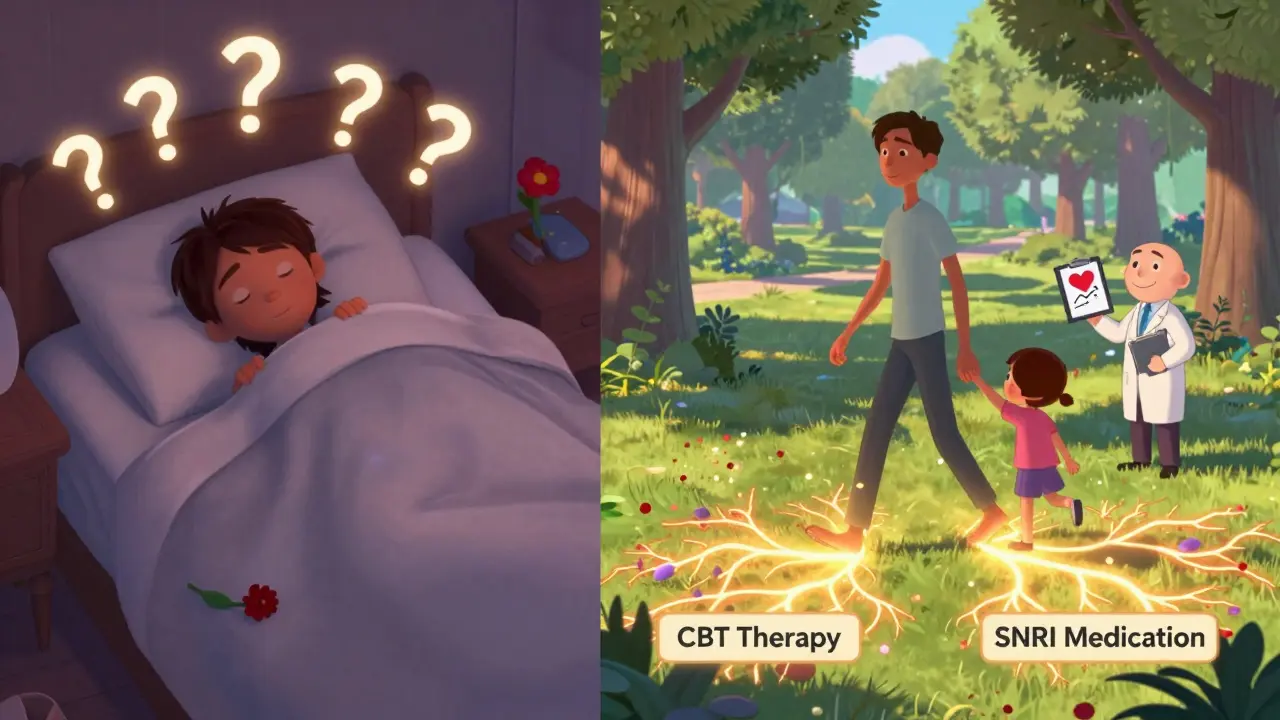
Medication alone isn’t the whole story. A 2022 clinical trial showed that people who took an SNRI and went to cognitive behavioral therapy (CBT) had a 73% chance of achieving full remission from depression. Those on medication only? Only 48%.
CBT helps you reframe negative thoughts, build routines, and cope with stress-things medication can’t do alone. When you combine both, you’re not just treating symptoms. You’re rebuilding your relationship with your mind.
Who Should Avoid SNRIs?
SNRIs aren’t for everyone. You should avoid them if you:
- Have uncontrolled high blood pressure
- Take MAO inhibitors (a different type of antidepressant)
- Have liver disease (duloxetine is processed by the liver)
- Are pregnant or breastfeeding (data is limited)
- Are under 25 (all antidepressants carry a black box warning for increased suicidal thoughts in young adults)
Also, if you’ve had a bad reaction to one SNRI, you might not respond well to others. But it’s worth trying a different one-some people tolerate venlafaxine fine but can’t handle duloxetine, or vice versa.
The Future of SNRIs
SNRIs aren’t new, but they’re evolving. In 2022, the FDA approved Drizalma Sprinkle-a new form of duloxetine that comes as tiny granules you can sprinkle on food. It’s designed for kids with anxiety, expanding use beyond adults. That’s a big deal.
Researchers are also looking at genetic testing to predict who will respond to SNRIs. If you have certain gene variants (like CYP2D6 or CYP2C19), your body may process these drugs faster or slower. Testing can help avoid trial-and-error.
And new combinations are being tested. One Phase III trial is pairing SNRIs with esketamine (a nasal spray used for treatment-resistant depression). Early results show 45% remission rates-much higher than SNRIs alone.
Still, 30-40% of people with depression don’t respond to any medication, including SNRIs. That’s why research continues. But for now, SNRIs remain one of the most reliable second-line options-if you’ve tried SSRIs and still feel stuck, they’re worth discussing.
Real Talk: What Patients Say
On Drugs.com, duloxetine has a 6.1 out of 10 rating. Reviews are split. One person wrote: “After three SSRIs failed, this finally lifted my depression and my fibromyalgia pain. I can walk again.” Another said: “The nausea was unbearable for two months. I quit. Worth it? Not for me.”
Surveys show 58% of people stay on SNRIs past six months. That’s lower than SSRIs (65%), but still high enough to suggest that for many, the benefits outweigh the hassle.
The bottom line? SNRIs aren’t perfect. They’re not always the first choice. But for people with depression plus pain, fatigue, or lack of focus-they’re often the missing piece.
Are SNRIs better than SSRIs for depression?
Not necessarily for pure depression. SSRIs are usually tried first because they have fewer side effects. But SNRIs can be more effective if you also have chronic pain, extreme fatigue, or poor concentration. Studies show a 5-10% higher response rate with SNRIs in these cases, making them a strong second-line option.
How long do SNRI side effects last?
Initial side effects like nausea, dizziness, or insomnia usually improve within 1-2 weeks as your body adjusts. Sexual side effects and increased blood pressure may last longer and need dose adjustments. If side effects persist beyond 4-6 weeks, talk to your doctor about switching or adjusting your dose.
Can SNRIs help with anxiety too?
Yes. All approved SNRIs are also used to treat generalized anxiety disorder, social anxiety, and panic disorder. Duloxetine and venlafaxine have strong evidence for reducing anxiety symptoms, often as effectively as SSRIs. Their effect on norepinephrine may help with physical anxiety symptoms like restlessness and muscle tension.
Do SNRIs cause weight gain?
Unlike some SSRIs and older antidepressants, SNRIs are less likely to cause significant weight gain. In fact, some people lose a small amount of weight early on due to nausea or reduced appetite. Long-term weight changes vary by person, but overall, SNRIs have a neutral to slightly positive effect on weight compared to other antidepressants.
Is it safe to take SNRIs long-term?
Yes, for most people. SNRIs are approved for long-term use, and many patients stay on them for years. Regular monitoring of blood pressure and liver function (especially with duloxetine) is important. There’s no evidence of brain damage or permanent changes from long-term use. The main risks are withdrawal if stopped abruptly and rare cases of elevated blood pressure.
What should I do if my SNRI isn’t working?
Wait at least 8-12 weeks before deciding it’s ineffective. If there’s no improvement, talk to your doctor about switching to another SNRI, trying an SSRI, adding therapy, or exploring other options like bupropion or newer treatments. Never stop or change your dose without medical guidance.
Meenakshi Jaiswal
December 20, 2025 AT 03:10For anyone stuck on SSRIs and still feeling like a zombie-SNRIs changed my life. I had depression + fibromyalgia and nothing worked until duloxetine. The first week was rough-nausea like I’d swallowed battery acid-but by week 4, I could walk to the mailbox without crying. Not magic. Just science that actually works for some of us.
holly Sinclair
December 20, 2025 AT 04:37It’s fascinating how norepinephrine’s role in pain modulation is so under-discussed in mainstream mental health conversations. The brain’s descending inhibitory pathways-those are the real heroes here. SNRIs don’t just ‘boost mood’-they recalibrate the body’s internal alarm system. That’s why people with chronic pain respond differently than those with pure MDD. It’s not just pharmacology-it’s neurophysiology. And yet, most doctors still treat depression like it’s a single-dimension problem. We need more integrative models.
Monte Pareek
December 22, 2025 AT 04:12Stop treating SNRIs like some last-resort drug. They’re not. If you’re fatigued, foggy, or hurting-go for SNRI first. SSRIs are for people who just need a little mood lift. If you’re struggling to get out of bed because your body feels like it’s wrapped in concrete, SNRIs are the damn key. I’ve seen too many people waste months on Zoloft when Effexor would’ve saved them. And yes, the brain zaps suck-but taper slow. 4-6 weeks. No excuses. Your brain isn’t a light switch.
Connie Zehner
December 22, 2025 AT 18:35OMG I’m so glad someone finally said this!! I was on Cymbalta for 3 years and the brain zaps were HORRIFYING!! I’d wake up and feel like my skull was being zapped with a taser!! But I couldn’t quit bc I’d spiral!! My doctor said ‘just push through’ but NO. I tapered over 10 weeks and now I’m off and honestly?? I miss the calm. Not the zaps. The calm. 😭💊
bhushan telavane
December 23, 2025 AT 07:42In India, doctors still think antidepressants are for ‘weak minds’. I had to explain to my family that SNRIs aren’t ‘drugs to escape reality’-they’re tools to fix broken chemistry. My mom cried when I told her I was starting venlafaxine. Said ‘you’re not yourself anymore’. But I am. Just… less broken. Maybe the real stigma isn’t the pill-it’s the silence around pain.
Mahammad Muradov
December 23, 2025 AT 17:53People act like SNRIs are some miracle cure but they’re just another chemical crutch. Depression isn’t a neurotransmitter imbalance-it’s a moral failing masked as biology. You don’t need a pill to get out of bed. You need discipline. Willpower. Faith. Stop outsourcing your emotional labor to Big Pharma. I’ve seen too many people trade their agency for a prescription. You’re not broken. You’re just lazy.
Moses Odumbe
December 23, 2025 AT 21:25As someone who’s been on 5 different antidepressants, I’ll say this: SNRIs aren’t better-they’re just *different*. Venlafaxine at 150mg? Life-changing. But at 225mg? My BP spiked to 152/96. Doctor had to switch me. Also, the withdrawal? Brutal. I thought I was having a stroke. Brain zaps feel like your head’s full of static. But hey-worth it if you’re in pain. Just don’t skip the taper. 🤓🩺
Kelly Mulder
December 23, 2025 AT 22:33While I appreciate the clinical overview, I must emphasize that the normalization of pharmacological intervention for psychological distress represents a profound epistemological regression in contemporary psychiatry. The conflation of neurochemical modulation with existential resolution undermines the ontological integrity of human suffering. One must question whether the reduction of melancholia to a serotonin-norepinephrine equilibrium is not, in fact, a capitulation to biopolitical hegemony. The true cure lies not in pharmacology, but in the reclamation of narrative agency.