
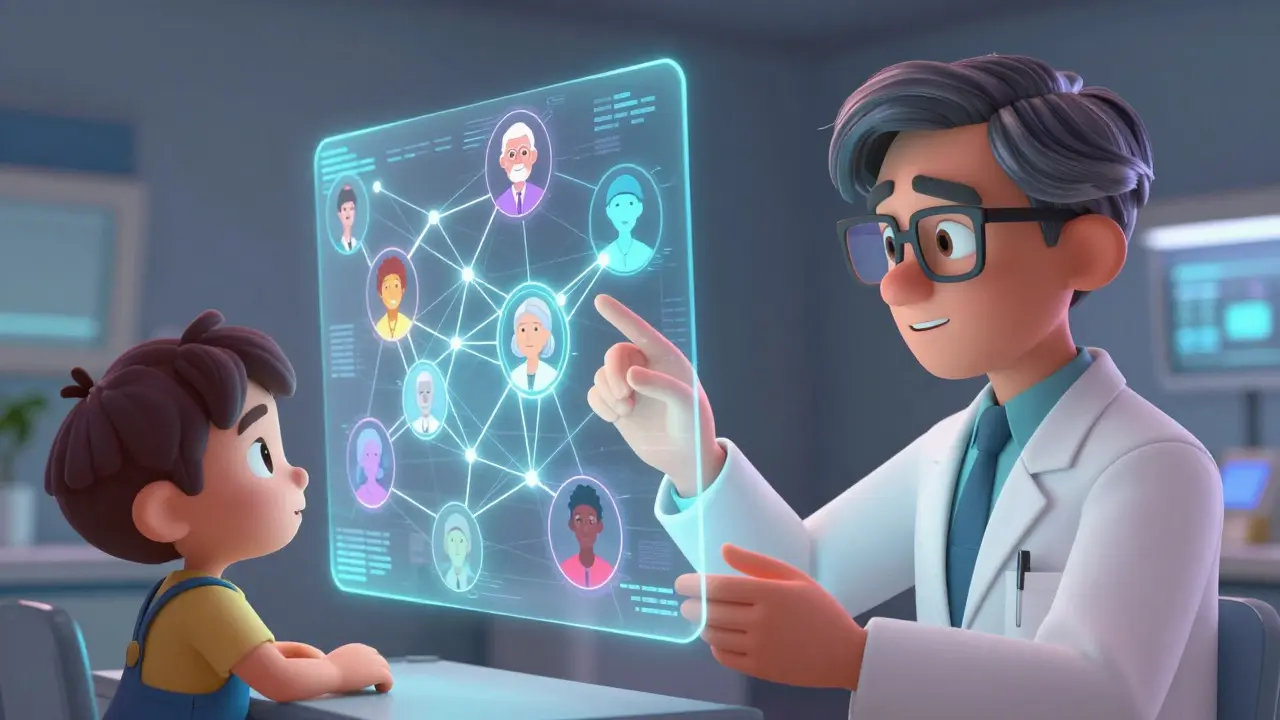
Traditional bioequivalence studies often require healthy volunteers to undergo multiple blood draws over hours. But what if you need to compare drugs for patients with kidney disease, older adults, or those taking other medications? That's where population pharmacokineticsA statistical modeling approach that analyzes drug concentration data from multiple individuals to understand variability and prove therapeutic equivalence. comes in. This method uses real-world data to prove whether two drugs work the same way in diverse populations, without needing perfect lab conditions.
What Is Population Pharmacokinetics?
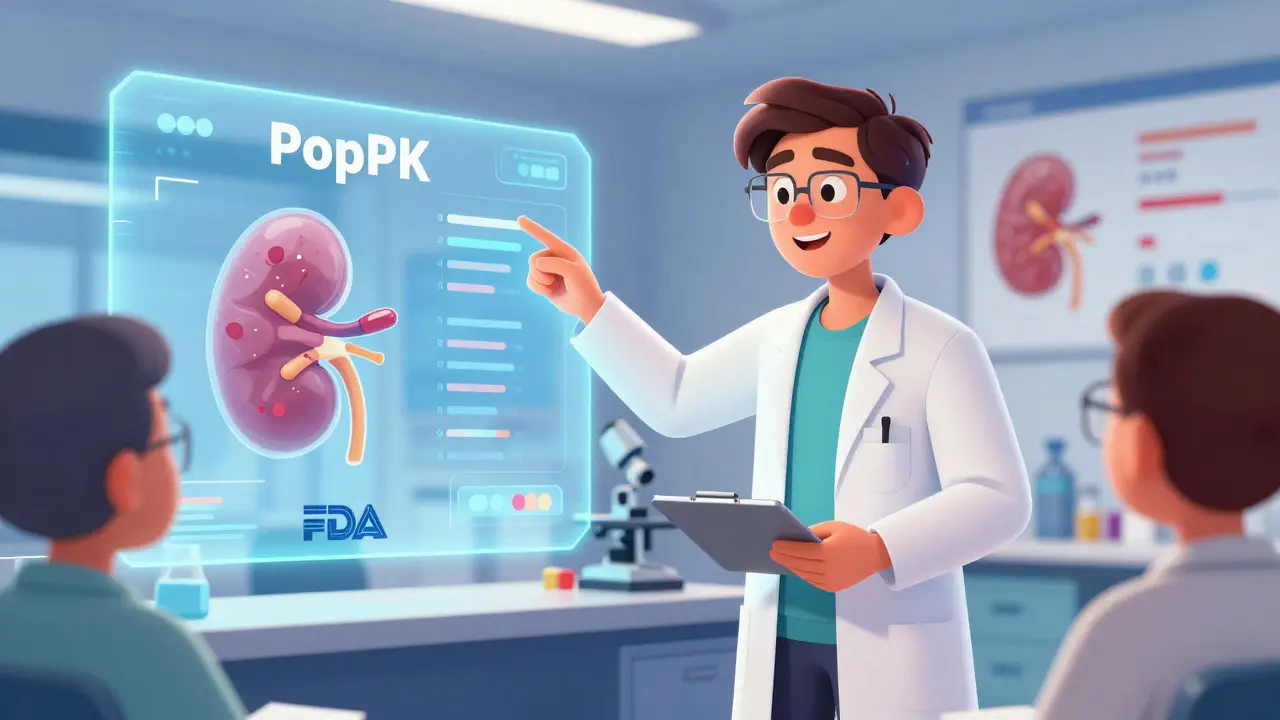
Population pharmacokinetics (PopPK) is a statistical technique that examines how drugs move through the bodies of many people at once. Unlike traditional studies that test small groups of healthy volunteers under strict conditions, PopPK uses messy, real-world data from actual patients. Think of it like analyzing traffic patterns across an entire city instead of just one road. It captures how factors like age, weight, kidney function, or other medications affect drug behavior in everyday settings. This approach emerged in the late 1970s but has gained serious traction recently. The FDA formalized its guidance for PopPK in 2022, recognizing its role in modern drug development.
How PopPK Works in Practice
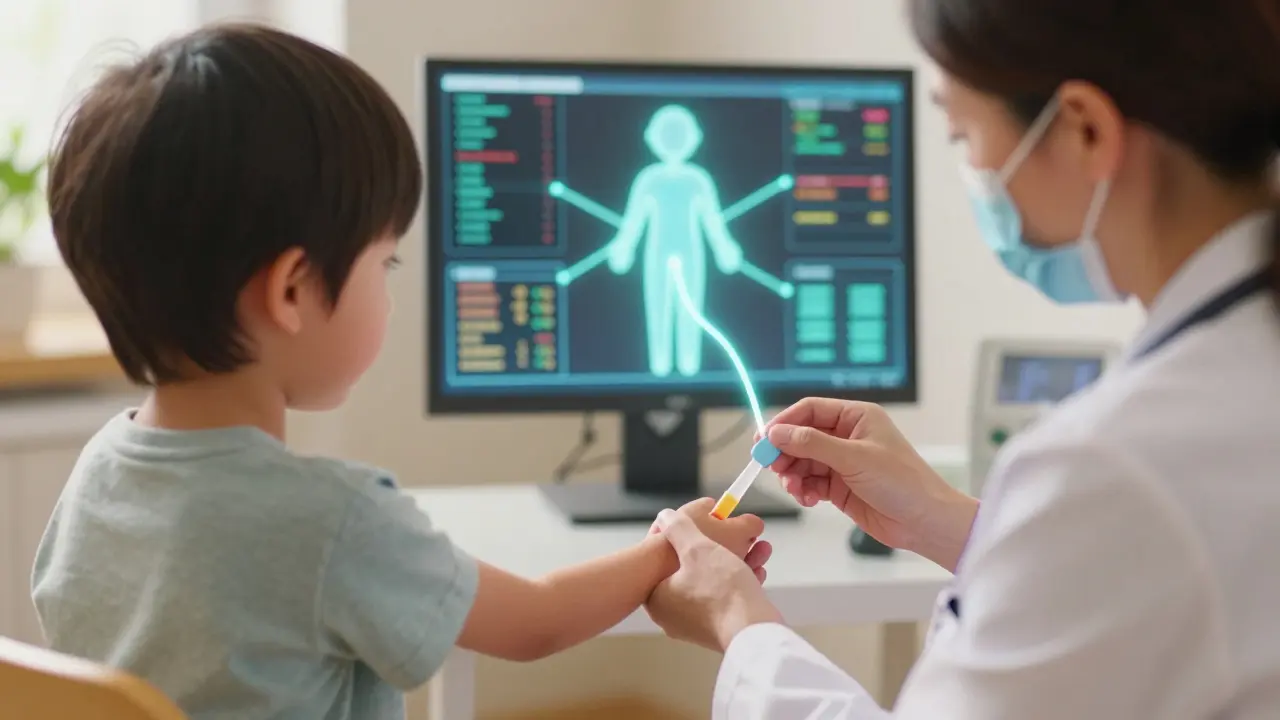
PopPK models process sparse data-often just 2-4 blood samples per patient collected during routine care. For example, a diabetes patient might have a single glucose test during a checkup, and that data point gets added to a larger pool. The model then identifies patterns across all patients to predict drug behavior. It uses nonlinear mixed-effects modeling, which has two layers: one for individual patient data and another for population-wide trends. This reveals critical details like between-subject variability (BSV), which measures how much drug exposure differs between people. For most drugs, BSV ranges from 10% to 60%. If two drug versions show BSV within acceptable limits (usually 80-125% for key measurements), they’re considered therapeutically equivalent. The FDA requires at least 40 participants for reliable PopPK analyses, though the exact number depends on the drug and patient group.
PopPK vs. Traditional Bioequivalence Studies
| Aspect | Traditional Bioequivalence Studies | Population Pharmacokinetics (PopPK) |
|---|---|---|
| Data Source | Healthy volunteers under controlled conditions | Real-world patients during routine care |
| Sample Size | 24-48 participants | At least 40 participants (varies by covariate effects) |
| Sampling Intensity | Multiple blood draws per subject (e.g., 8-12 samples) | Sparse data (2-4 samples per patient) |
| Special Populations | Limited applicability (e.g., excludes elderly or renal impairment) | Directly assesses variability across diverse groups |
| Time to Results | Months (requires dedicated study) | Integrated into ongoing clinical data collection |
| Regulatory Recognition | Standard method for generic drug approval | Increasingly accepted (FDA 2022 guidance) |
Regulatory Acceptance and Real-World Impact
The FDA’s 2022 guidance was a game-changer. It explicitly states PopPK data can "alleviate the need for postmarketing requirements or commitments"-meaning companies might skip extra trials if PopPK proves equivalence. Between 2017 and 2021, about 70% of new drug applications included PopPK analyses. For example, Merck used PopPK to show a cancer drug worked safely in patients with kidney failure, where traditional studies would’ve been unethical. Pfizer reported saving 30% on clinical trial costs by using PopPK for bioequivalence claims in special populations. The EMA also supports PopPK, emphasizing it "comprises the assessment of variability within the population." This shift means faster approvals for drugs that work well across diverse patient groups.
Challenges and Limitations
Despite its advantages, PopPK isn’t perfect. A 2022 survey by the International Society of Pharmacometrics found 65% of industry experts cite "model validation and qualification" as their biggest hurdle. Some regulators, like certain EMA committees, remain cautious about PopPK-only equivalence claims. Data quality is another issue: if clinical trials weren’t designed with PopPK in mind, the sparse data might lack critical information. Overly complex models can also backfire-30% of FDA submissions in 2019-2021 needed revisions due to poor model validation. Dr. Robert Bauer from the FDA’s Office of Clinical Pharmacology noted in a 2019 workshop that "the lack of standardization in model-building approaches creates challenges for consistent evaluation." This means even small differences in how analysts build models can affect results.
Tools and Future Directions
Most regulatory submissions use NONMEM software (85% of FDA PopPK analyses), though Monolix and Phoenix NLME are also common. Training to use these tools properly takes 18-24 months of dedicated study. But the field is evolving fast. Machine learning is now being integrated into PopPK modeling, as described in Nature’s January 2025 publication. This helps detect subtle patterns-like how a specific gene variant affects drug metabolism-that traditional methods might miss. The IQ Consortium is working toward standardized validation protocols by late 2025, which could smooth regulatory acceptance globally. For biosimilars (complex biologic drugs), PopPK is becoming essential since traditional bioequivalence studies are often impossible for large molecules. The global pharmacometrics market, driven largely by PopPK, is projected to grow from $498 million in 2022 to $1.27 billion by 2029.
Frequently Asked Questions
How does PopPK handle data from patients with irregular dosing schedules?
PopPK models are designed for exactly this scenario. They use nonlinear mixed-effects modeling to account for varying doses and sampling times. For example, if a patient takes medication at different times each day or has blood drawn at random checkups, the model mathematically adjusts for these inconsistencies. It focuses on the overall pattern across many patients rather than perfect individual data points. This flexibility is why PopPK works for real-world clinical settings where traditional studies would fail.
Can PopPK replace traditional bioequivalence studies completely?
Not yet for all cases. PopPK excels for special populations (like children or those with organ impairment) and complex drugs like biologics. However, for simple generic drugs in healthy adults, traditional crossover studies remain the gold standard. Regulators often require both approaches: PopPK for subgroup analysis and traditional studies for the primary equivalence claim. The FDA’s guidance suggests using PopPK when "the target population is quite heterogeneous" or when "the target concentration window is narrow," but not as a universal replacement.
Why do some companies prefer PopPK despite the challenges?
Because it saves time and money. Traditional bioequivalence studies for special populations can take years and cost millions. PopPK uses existing clinical data, so no extra trials are needed. For example, a generics company in New Zealand used PopPK to prove equivalence for a heart medication in elderly patients-cutting development time by 18 months. It also provides deeper insights: instead of just saying "the drugs work similarly," PopPK shows exactly *why* (e.g., "age affects absorption more than kidney function"). This helps optimize dosing for real patients.
What role does machine learning play in PopPK?
Machine learning enhances PopPK by finding hidden patterns in complex data. Traditional models assume linear relationships between factors like weight and drug clearance. Machine learning algorithms, however, can detect nonlinear interactions-such as how a specific combination of age, genetics, and liver function affects a drug. For instance, a 2025 study in Nature showed AI-powered PopPK identified a rare genetic variant that doubled drug toxicity risk in 5% of patients, something standard models missed. This makes PopPK more precise for personalized medicine.
Is PopPK used for biosimilars?
Absolutely. Biosimilars are complex biologic drugs that are nearly identical to reference products. Traditional bioequivalence studies don’t work here because these drugs can’t be easily measured in blood like small-molecule drugs. PopPK is the primary method for proving biosimilar equivalence. For example, the FDA approved a biosimilar for rheumatoid arthritis in 2023 based entirely on PopPK analyses showing consistent drug exposure across 150 patients. Without PopPK, developing biosimilars would be nearly impossible for many therapies.
Lisa Scott
February 6, 2026 AT 08:41Population pharmacokinetics relies on sparse data from real-world patients
The FDA's 2022 guidance lacks standardization in model-building
65% of experts cite validation issues
This is dangerous
Traditional studies are safer
The industry is cutting corners
No oversight
Trust no one
This is a conspiracy
Cole Streeper
February 7, 2026 AT 13:31PopPK is a scam. Period.
Tehya Wilson
February 8, 2026 AT 14:25Population pharmacokinetics represents a significant advancement in drug development methodology
However the reliance on sparse data and inconsistent model validation protocols presents substantial regulatory challenges
The FDA's 2022 guidance while progressive lacks sufficient detail on standardization procedures
This necessitates further research and collaboration to ensure robustness
Kate Gile
February 9, 2026 AT 08:02Population pharmacokinetics is a game-changer for personalized medicine
By analyzing real-world data from diverse patient groups we can understand drug behavior better
This approach captures variability due to age weight kidney function and other factors
Traditional studies with healthy volunteers can't replicate real-world complexity
The FDA's 2022 guidance supports this method for proving therapeutic equivalence
Machine learning integration is helping uncover hidden patterns
For instance AI can detect genetic variants affecting drug metabolism
These insights improve dosing strategies for individual patients
Regulatory acceptance is growing globally
EMA and FDA both recognize its value
While challenges exist like model validation the benefits outweigh the drawbacks
Collaboration between industry regulators and researchers is key
PopPK is the future of drug development
It ensures safer and more effective treatments for everyone
Let's embrace this innovation
Gregory Rodriguez
February 10, 2026 AT 15:28Oh great more machine learning hype
Because nothing says 'scientific rigor' like throwing AI at a problem without proper validation
Next thing you know we'll have chatbots writing FDA guidelines
'Dear patient your drug works... probably'
Jenna Elliott
February 12, 2026 AT 05:29America should lead in pharmacometrics
Foreign regulators don't get it
PopPK is great for us but not for others
Cullen Bausman
February 13, 2026 AT 12:04Your nationalist perspective is misplaced
The global adoption of PopPK is evidence of its scientific merit
Regulatory bodies worldwide recognize its value for patient safety and efficient drug development
It's not about nationalism but evidence-based practice
Dina Santorelli
February 14, 2026 AT 04:08PopPK is a joke
The data is too messy
Models are unreliable
They're just trying to save money
Patients are being used as guinea pigs
No one cares about the real risks