
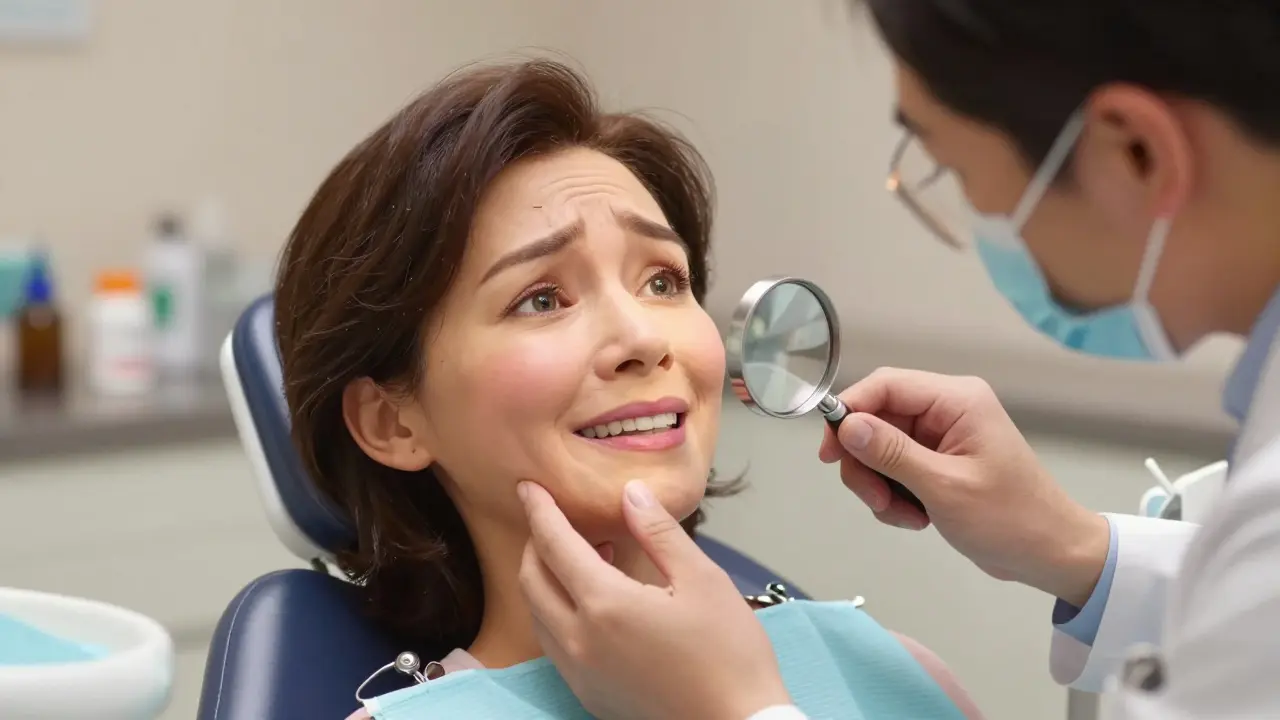
MRONJ Risk Assessment Tool
Assess Your MRONJ Risk
This tool estimates your risk of developing osteonecrosis of the jaw based on your medication type, treatment duration, and other factors. Remember: Early detection is key to prevention.
When you’re taking medication for osteoporosis or cancer that has spread to your bones, your dentist might not be the first person you think to talk to. But ignoring your oral health could lead to a serious, painful condition called osteonecrosis of the jaw - or MRONJ for short. It’s rare, but when it happens, it doesn’t go away on its own. And if you don’t catch it early, you could end up with exposed bone in your jaw, chronic infections, and even surgery. What exactly is MRONJ? It’s when the jawbone stops healing after minor trauma - like a tooth extraction - or even without any clear cause. The bone dies because the medications you’re taking prevent your body from repairing it. This isn’t a myth or a scare tactic. It’s a real, documented condition with clear warning signs. And if you know what to look for, you can stop it before it gets worse. Here’s what you need to know: You’re not at high risk if you’re taking a low-dose oral bisphosphonate for osteoporosis. The chance is less than 1 in 10,000. But if you’re on intravenous drugs for cancer, your risk jumps. And if you’ve had a tooth pulled while on these meds? That’s when you need to pay close attention. Here are the six most common warning signs of MRONJ:
- Pain or swelling in your jaw - not just a toothache. This feels deeper, like pressure or a dull ache that doesn’t improve with painkillers. In over 87% of cases, this is the first symptom patients report.
- Gum tissue that won’t heal - after a tooth extraction, filling, or even a deep cleaning. If your gums are still raw, bleeding, or swollen after four weeks, that’s not normal. Normal healing takes 7-10 days. If it’s still open after eight weeks? That’s one of the official diagnostic criteria.
- Loose teeth - not from gum disease, but because the bone holding them is dying. You might notice your teeth shifting or feeling wobbly without any history of trauma or periodontal disease.
- Exposed bone in your mouth - this is the defining feature. You might see grayish, rough bone sticking out from your gums. It’s often painless at first, which is why many people miss it. But it’s unmistakable once you’ve seen it.
- Pus or bad taste in your mouth - if you have a persistent foul taste or drainage from your gums, especially with swelling, it’s likely an infection. This isn’t just a cavity. It’s bone infection.
- Heaviness or numbness in your jaw - like a constant pressure or tingling, especially in the lower jaw. This happens when the nerves around the dying bone get irritated or compressed.
These signs don’t show up overnight. They creep in slowly. That’s why so many patients are misdiagnosed. One woman from Christchurch told her dentist her jaw hurt after a filling. She was told it was a nerve reaction and given antibiotics. Six months later, she had exposed bone. She wasn’t told her osteoporosis medication could cause this. Which medications are linked to MRONJ?
The biggest culprits are drugs that stop bone from breaking down - called antiresorptives. They’re lifesavers for people with osteoporosis or bone metastases. But they also slow healing.
- Oral bisphosphonates - like Fosamax (alendronate), Boniva (ibandronate), and Actonel (risedronate). These are taken as pills for osteoporosis. Risk is very low - about 0.001% to 0.01%.
- Intravenous bisphosphonates - like Reclast (zoledronate). Used in cancer patients to stop bone damage from tumors. Risk jumps to 1%-10%. That’s 100 to 1,000 times higher than oral versions.
- Denosumab (Prolia) - an injection given every six months for osteoporosis. It works differently than bisphosphonates but carries similar jawbone risks.
- Romosozumab - a newer osteoporosis drug. Less data, but warnings are included in prescribing info.
The route matters. A pill you swallow once a week? Low risk. A powerful IV drip every month for cancer? High risk. Duration matters too. After three to four years of continuous use, your risk starts climbing. Most cases happen after three or more years on the medication. What makes it worse?
It’s not just the drug. Other things stack the odds:
- Dental procedures - especially tooth extractions. One study found 3.2% of people on bisphosphonates developed MRONJ after an extraction. That’s 60 times higher than in people not on these meds.
- Poor oral hygiene - plaque buildup and gum disease create constant low-grade trauma. Your jaw can’t handle that if it’s already struggling to heal.
- Diabetes - if you have it, your healing is already impaired. Add a bisphosphonate? Risk shoots up.
- Smoking - cuts blood flow to the gums. Combine that with a drug that stops bone repair? Bad combo.
One study from the University of Edinburgh showed that patients with diabetes and poor oral hygiene had a 15-fold higher risk than those without those factors. How to prevent it - before it starts
Prevention is simple, but only if you act early.
- Get a full dental checkup before starting - if you’re about to begin IV bisphosphonates or denosumab for cancer, schedule a full exam 4-6 weeks before your first dose. Fix cavities, remove loose teeth, treat gum disease. Do this before the drug hits your system.
- Tell your dentist what you’re taking - don’t assume they know. Bring a list. Say: "I’m on Fosamax/Prolia/Reclast." Many dentists don’t ask. One survey found 73% of patients weren’t questioned about their meds before treatment.
- Don’t delay dental care - if you’re already on these drugs, keep up with cleanings and checkups. Routine fillings and cleanings are safe. Avoid extractions unless absolutely necessary.
- Use chlorhexidine rinse - a 0.12% mouthwash twice a day reduces MRONJ risk by 37%. It’s cheap, easy, and proven in clinical trials.
- Ask about a drug holiday - for high-risk patients needing major dental work, some doctors pause IV bisphosphonates for 2-3 months. Talk to your oncologist or rheumatologist. This isn’t risky for bone health if done properly.
One woman from Wellington started Prolia for osteoporosis. She had a wisdom tooth removed two weeks later. No one warned her. Four months later, she had exposed bone. She’s now on monthly mouth rinses and antibiotics. She says: "If someone had just told me to see the dentist before I started, this never would’ve happened." What if you already have it?
MRONJ is treatable - if caught early. Stage 1 (exposed bone, no infection) has a 78% healing rate with conservative care: antibiotics, mouth rinses, and avoiding trauma. Stage 2 (infection, pus) needs more aggressive treatment. Stage 3 (bone fracture, fistula) often requires surgery. New research from UCSF shows that teriparatide (Forteo), a bone-building drug, can actually help heal early MRONJ. In trials, 78% of stage 1 patients saw improvement. That’s huge. It’s not standard yet, but it’s a breakthrough. What’s changing now?
In 2023, the FDA and European Medicines Agency now require drug manufacturers to include clear dental warning inserts with all high-risk osteoporosis medications. U.S. dental schools now teach MRONJ recognition - up from 42% in 2015 to 87% today. A new tool called the Osteonecrosis Prediction Algorithm (OPA) is in final trials. By 2025, it could give you a personalized risk score based on your genetics, medication, and dental history. That’s the future: not one-size-fits-all warnings, but smart, individualized care. Bottom line: You don’t need to stop your osteoporosis or cancer meds. They save lives. But you do need to protect your jaw. Talk to your dentist. Tell them what you’re on. Get checked before you start. Watch for those six signs. If something feels off in your mouth - don’t wait. Go back. Early action can mean the difference between a simple rinse and major surgery.
Mike Hammer
February 16, 2026 AT 08:50Daniel Dover
February 16, 2026 AT 10:43Virginia Kimball
February 18, 2026 AT 05:15Michael Page
February 19, 2026 AT 11:44Betty Kirby
February 21, 2026 AT 01:39Josiah Demara
February 22, 2026 AT 12:49Charlotte Dacre
February 23, 2026 AT 16:13Esha Pathak
February 24, 2026 AT 18:44