
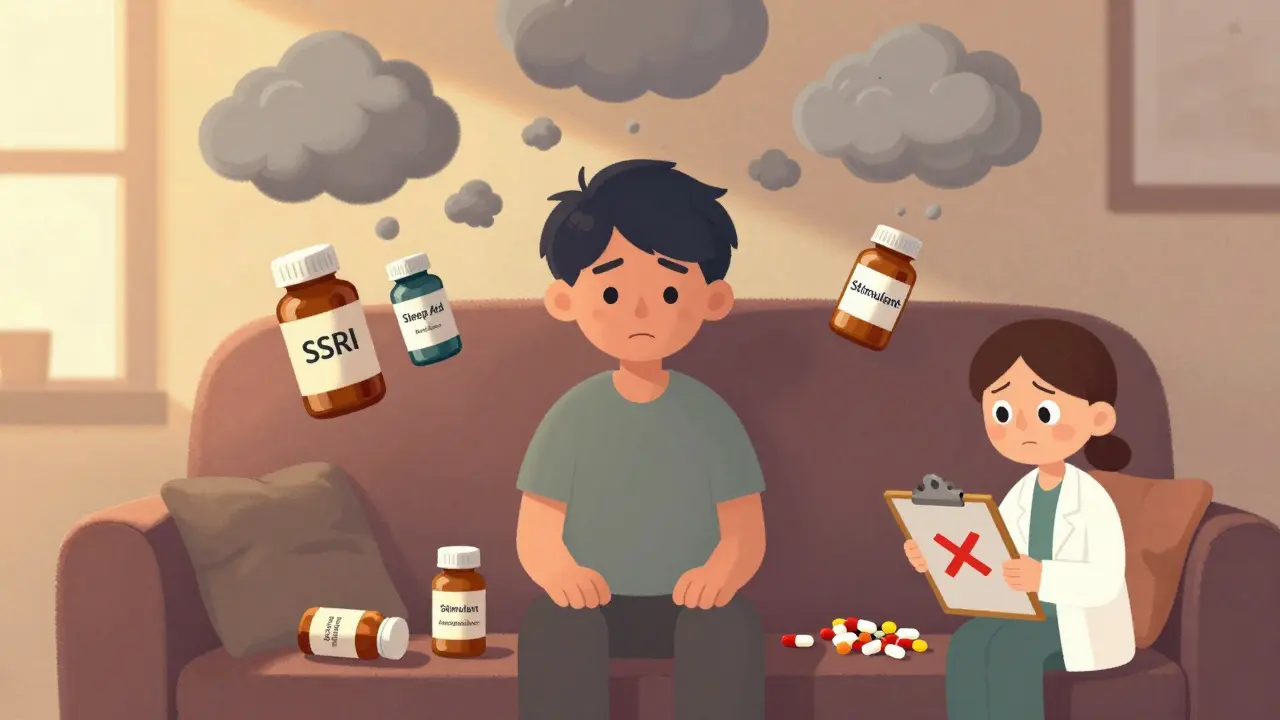
Psychiatric Polypharmacy Risk Assessment
How Many Psychiatric Medications Are You Taking?
Psychiatric polypharmacy refers to taking 3 or more psychiatric medications at once. This is more common than many realize, but can increase side effects and complications.
When someone is prescribed three, four, or even five psychiatric medications at once, it’s not always because one drug didn’t work. More often, it’s because the system is overwhelmed-clinicians trying to fix multiple symptoms with multiple pills, patients stuck in cycles of trial and error, and little time to step back and ask: Is this really helping?
Why Do So Many People Take Multiple Psychiatric Drugs?
Psychiatric polypharmacy-the use of two or more psychiatric drugs at the same time-isn’t new. But it’s become alarmingly common. Between 1999 and 2005, the rate of people with schizophrenia taking two or more antipsychotics jumped from 3.3% to 13.7% among Medicaid enrollees. That’s a fourfold increase in just six years. And it’s not just antipsychotics. People with depression, bipolar disorder, anxiety, and PTSD are often stacked with antidepressants, mood stabilizers, sleep aids, and anti-anxiety meds-all at once. The idea behind this approach sounds logical: if one drug doesn’t fully control symptoms, add another. Maybe the first drug helps with sadness but not sleep. Add a sedative. Maybe the mood stabilizer helps with mania but leaves you sluggish. Add a stimulant. It feels like a fix. But in practice, it often becomes a cascade. Studies show that 43.8% of people with treatment-resistant depression were taking three or more psychiatric drugs by the mid-1990s. Today, that number is likely higher. And while some combinations are backed by research-like adding bupropion to an SSRI for partial responders-many aren’t. In fact, using two antipsychotics together? The evidence is weak. Mostly case reports. Rarely solid trials.The Hidden Risks: More Pills, More Problems
Every medication you take interacts with your body in ways that aren’t always obvious. When you stack five drugs, the risks multiply. Some interactions are mild: dizziness, dry mouth, weight gain. Others are dangerous: irregular heart rhythms, liver damage, sudden drops in blood pressure. The CDC found that people taking five or more medications-common in mental health care-had significantly lower quality of life. Their physical health scores on standard tests dropped. Their energy levels fell. Their mobility suffered. And yet, their depression or anxiety scores didn’t improve much. That’s the paradox: more drugs, less function. Older adults are especially vulnerable. As we age, our kidneys and liver slow down. They can’t clear drugs as quickly. A dose that was fine at 40 can become toxic at 70. And many older patients with schizophrenia are now on antipsychotics plus blood pressure meds, diabetes drugs, cholesterol pills, and pain relievers. The mix? A ticking time bomb. One study showed that polypharmacy in this group is rising fast-not because of better outcomes, but because of comorbidities. They’re not just treating the mind. They’re treating the whole body. And sometimes, the treatments fight each other.What Works? Evidence-Based Combinations
Not all polypharmacy is bad. Some combinations are proven, targeted, and necessary.- Adding bupropion to an SSRI like citalopram for depression that didn’t fully respond.
- Using lithium or valproate with an antipsychotic during acute mania.
- Short-term use of benzodiazepines with antidepressants for severe anxiety alongside depression.
- Antipsychotics paired with antidepressants when psychosis and depression occur together.

The Kitchen Sink Approach
There’s a term clinicians use, sometimes in frustration: “kitchen sink” prescribing. It means throwing everything at the wall and seeing what sticks. Add an antipsychotic. Add an anticonvulsant. Add a sleep aid. Add an anti-anxiety pill. Add a stimulant to counter the drowsiness. It’s not science. It’s desperation. And it’s everywhere. Dr. Joseph Goldberg, a leading psychopharmacologist, calls this approach “lazy medicine.” Why? Because it avoids the harder work: adjusting doses, trying different single agents, addressing lifestyle factors, or exploring therapy. It’s faster. It feels like action. But it rarely leads to lasting recovery. One study found that in primary care settings-where most mental health care happens-37.2% of patients on psychiatric meds were on complex, unstructured polypharmacy regimens. No protocol. No review. Just a prescription pad and a hope.How to Break the Cycle: Deprescribing and Better Tools
The good news? Change is possible. A 18-month program tracked patients on multiple psychiatric drugs. With careful review, gradual tapering, and close monitoring, the average number of medications dropped by nearly half. Side effects decreased. Mood improved. Blood pressure, cholesterol, and blood sugar levels got better too. Not because they added more drugs-but because they removed the ones that weren’t needed. The key? Structure.- Regular medication reviews: Every 3-6 months, go through every pill. Ask: Why is this here? Is it still helping? Can we try less?
- Start low, go slow: When adding a drug, wait at least 6-8 weeks before adding another. Give each one time to show its effect-or its side effects.
- Use tools like PHQ-9 and GAD-7: Track mood and anxiety scores, not just whether the patient says they “feel better.”
- Involve the patient: Many people are scared to stop meds. They fear relapse. Educate them. Explain that reducing meds isn’t quitting-it’s optimizing.

Why This Is So Hard to Fix
Even when we know polypharmacy is risky, it’s hard to change. Clinicians worry about destabilizing patients. Patients fear falling apart without their pills. Insurance often doesn’t cover therapy or longer appointments, so prescribing is the easiest option. And there are no clear national guidelines for when to stop. A 2023 survey found that 78% of medical centers had no formal protocol for reducing psychiatric polypharmacy. Sixty-five percent of doctors said they avoided deprescribing because they didn’t know how to do it safely. The system isn’t broken because people are careless. It’s broken because it’s designed for speed, not safety. For volume, not clarity.What You Can Do
If you or someone you care about is on multiple psychiatric medications:- Ask for a full medication review with your prescriber. Bring a list of every pill, including over-the-counter drugs and supplements.
- Ask: “Is this drug still necessary? What’s the goal? What happens if we stop it?”
- Don’t stop anything on your own. Tapering too fast can cause withdrawal or rebound symptoms.
- Request pharmacogenomic testing if it’s available. It’s not expensive, and it can prevent dangerous reactions.
- Track your symptoms. Use a simple journal: mood, sleep, energy, side effects. Bring it to appointments.
The Future: Less Is More
The tide is turning. By 2025, 62% of academic medical centers plan to launch formal deprescribing programs. That’s a sign of real progress. The goal isn’t to eliminate all polypharmacy. Some people need multiple drugs. But the goal is to stop prescribing them blindly. We need to shift from “add more” to “optimize what’s there.” From “what can we add?” to “what can we take away?” Because in mental health, more pills don’t always mean better outcomes. Sometimes, they mean more confusion, more side effects, and less life. Less medication. More clarity. Better sleep. More energy. That’s what recovery looks like-not a medicine cabinet full of bottles, but a person who feels like themselves again.Is it safe to take multiple psychiatric medications at once?
It can be, but only when carefully planned and monitored. Some combinations are evidence-based and necessary-for example, adding bupropion to an SSRI for depression that hasn’t fully responded. But many polypharmacy regimens lack strong evidence and increase the risk of side effects like dizziness, weight gain, heart rhythm problems, and liver stress. Always review your medications regularly with your doctor and never combine drugs without professional guidance.
Why do doctors prescribe so many psychiatric drugs?
Doctors often prescribe multiple medications because symptoms are complex, and patients may not respond to single drugs. In busy clinics, adding another pill can feel faster than adjusting doses, trying therapy, or waiting weeks to see results. But this “kitchen sink” approach is common-not because it’s best, but because the system rewards quick fixes over careful optimization. Many clinicians are now recognizing this problem and are moving toward more structured, evidence-based approaches.
Can you reduce or stop psychiatric medications safely?
Yes, but only under medical supervision. Stopping psychiatric drugs suddenly can cause withdrawal symptoms, rebound anxiety, or even relapse. A slow, planned taper-over weeks or months-is usually safest. Many patients who’ve reduced their medications report improved energy, better sleep, and fewer side effects. Success depends on patient readiness, careful monitoring, and a supportive care team.
What is pharmacogenomic testing, and can it help with polypharmacy?
Pharmacogenomic testing analyzes your genes to predict how your body processes certain medications. For example, it can tell if you’re a slow or fast metabolizer of SSRIs or antipsychotics. This helps avoid drugs that might cause side effects or not work at all. Studies show it can reduce adverse reactions by 30-50% in psychiatric patients. While not a cure-all, it’s a powerful tool to reduce trial-and-error prescribing and lower the need for multiple drugs.
Are older adults more at risk from psychiatric polypharmacy?
Yes. As people age, their kidneys and liver process drugs more slowly, making them more sensitive to side effects. Older adults with mental illness often take multiple medications for physical conditions like high blood pressure, diabetes, or arthritis-which can interact dangerously with psychiatric drugs. Studies show they’re at higher risk for falls, confusion, and hospitalization due to drug interactions. Regular medication reviews are critical for this group.
What’s the difference between evidence-based and non-evidence-based polypharmacy?
Evidence-based polypharmacy uses combinations proven in clinical trials-like adding lithium to an antipsychotic for mania. Non-evidence-based polypharmacy includes practices like prescribing two antipsychotics together, which has little support from high-quality studies and is often based on anecdotal experience. The former improves outcomes; the latter often increases risk without clear benefit.
How can I tell if I’m on too many psychiatric drugs?
Signs include: constant side effects (drowsiness, weight gain, tremors), feeling worse instead of better, needing more drugs to fix side effects of other drugs, or being on the same meds for years without a review. If you’re taking five or more medications-including non-psychiatric ones-you’re in the polypharmacy range. Ask your doctor for a full medication audit.
Complex medication regimens aren’t the end of the road-they’re a signal. A signal that care needs to be smarter, slower, and more personal. The goal isn’t to eliminate drugs entirely. It’s to make sure every pill has a purpose-and that you’re not just surviving on chemicals, but truly living.
Melissa Cogswell
January 30, 2026 AT 22:28I've been on a cocktail of meds for 8 years. Started with one SSRI, then added an SNRI, then an antipsychotic for 'mild paranoia'-turned out it was just burnout. Took me 3 years to taper off the antipsychotic. No one ever asked if I actually needed it. Just kept adding. Now I'm on two meds and feel like myself for the first time since college. Less really is more.
Don't let anyone tell you you're weak for wanting to reduce. It's the opposite.
Diana Dougan
January 31, 2026 AT 07:49lol so the system is 'overwhelmed'? newsflash: doctors are just lazy and paid by the script. also why is everyone suddenly an expert on pharmacology? i took 7 meds once and my hair fell out. guess what? i didn't die. the world didn't end. maybe we should all just chill and stop pretending every side effect is a conspiracy.
also 'kitchen sink' is a dumb term. it's called medicine. you don't fix a broken engine by only changing one spark plug.
Bobbi Van Riet
February 1, 2026 AT 19:50I’m a nurse in a psych clinic and I see this every day. Patients come in with 6 prescriptions, 3 OTC sleep aids, and a bottle of melatonin they’ve been taking since 2017. We do monthly med reviews. We use PHQ-9, we track sleep logs, we ask ‘what’s one thing you’d like to feel better about?’
One woman had been on lorazepam for 11 years. We tapered over 9 months. She cried the first week. By month 6, she was gardening again. No meds. Just her. And her roses.
It’s not about taking less. It’s about living more. And yes, it takes time. But it’s worth it.
Also-pharmacogenomic testing? My clinic just started offering it. 40% of our patients had a gene variant that made their SSRIs useless or toxic. Game changer.
Holly Robin
February 2, 2026 AT 07:20THE PHARMA COMPANIES ARE RUNNING THIS. THEY PAY DOCTORS TO PRESCRIBE. THEY OWN THE GUIDELINES. THEY PAY FOR 'STUDIES' THAT SAY TWO ANTIPSYCHOTICS IS FINE. THEY DON’T WANT YOU TO WEAN OFF BECAUSE THEN YOU’D STOP BUYING.
EVERY SINGLE 'EVIDENCE-BASED' COMBINATION WAS FUNDED BY A DRUG COMPANY. EVEN PHARMACOGENOMIC TESTING? THEY OWN THE PATENTS. THEY WANT YOU TO THINK YOU NEED A $500 TEST TO KNOW WHAT DRUGS TO TAKE. IT’S A SCAM.
THEY’RE MAKING BILLIONS OFF YOUR DEPENDENCE. AND THEY’RE CALLING IT 'MEDICINE'.
STOP TRUSTING THE SYSTEM. START TRUSTING YOURSELF.
Shubham Dixit
February 3, 2026 AT 04:35How can you even compare American mental health chaos with real systems? In India, we have one psychiatrist for every 100,000 people. Most patients get one pill, maybe two. No fancy testing. No 10-drug cocktails. Just basic care. And yet, people still live, still work, still love. Maybe the problem isn't the meds-it's the obsession with over-treating.
Here, you treat the mind like a smartphone: if one app crashes, download three more. In the real world, you fix the root. Not the symptoms. Not the side effects. The root.
Stop buying into Western medical excess.
KATHRYN JOHNSON
February 3, 2026 AT 05:36There is no evidence supporting the long-term efficacy of polypharmacy in mood disorders. The CDC data is clear: functional decline correlates directly with medication burden. The APA guidelines acknowledge this, yet institutional inertia persists. Deprescribing protocols are not optional-they are ethically imperative. Patients deserve autonomy, not pharmacological overload.
Furthermore, the absence of formal institutional protocols constitutes a systemic failure of clinical governance. This is not negligence. It is institutional malpractice.
Blair Kelly
February 3, 2026 AT 19:50My therapist told me to stop taking my antianxiety med. I cried for a week. Then I started journaling. Then I started running. Then I stopped needing the med. I didn’t need more pills-I needed to stop running from myself.
Doctors don’t know how to say ‘try therapy first.’ They say ‘take this’ because it’s easier than listening.
I’m not mad at them. I’m mad at the system that made them choose easy over right.
Lily Steele
February 4, 2026 AT 22:18My dad was on 7 meds for depression and diabetes and high blood pressure. He was always tired, always dizzy. We asked his doctor for a review. He cut 3. Within a month, he was cooking again. Playing guitar. Laughing.
It wasn’t magic. It was just paying attention.
Don’t be afraid to ask: ‘Is this still helping?’
You’re not being difficult. You’re being brave.
Gaurav Meena
February 6, 2026 AT 07:57Bro, I’m from India too and I get it. Here, we don’t have the luxury of 5 meds. But that doesn’t mean we don’t suffer. The difference? We don’t have the noise. No Instagram influencers telling you your anxiety is a ‘chemical imbalance’ that needs 3 pills. No TikTok therapists selling you ‘healing protocols.’
But I’ve seen people here get better with just one med + therapy + community. No testing. No gimmicks. Just human connection.
Maybe the answer isn’t less pills… but more people who care.
And yes, I use emojis because I’m not a robot 😊
Jodi Olson
February 7, 2026 AT 20:45The notion that medication is inherently a tool of liberation or oppression is a false binary. The real question is not whether to prescribe, but whether the prescribing is done in service of the subject’s capacity for self-determination. When polypharmacy becomes a substitute for relational depth, it ceases to be therapeutic and becomes a mechanism of control disguised as care.
Deprescribing is not merely pharmacological-it is phenomenological. It is the reclamation of the body from the algorithm of clinical efficiency.
Amy Insalaco
February 8, 2026 AT 23:31It’s fascinating how the discourse around psychiatric polypharmacy has been co-opted by a neoliberal biopsychiatric hegemony that pathologizes nonconformity while simultaneously obscuring the structural determinants of distress-namely, late-stage capitalism’s erosion of social cohesion, labor precarity, and the commodification of affect. The ‘kitchen sink’ model is merely the symptomatic expression of a healthcare apparatus that prioritizes pharmacological intervention over sociopolitical accountability. The fact that pharmacogenomics is being marketed as a panacea reveals the epistemic violence of reducing existential suffering to genetic variance-a reductionist fantasy that absolves systemic culpability while profiting from the illusion of precision medicine.
Until we interrogate the political economy of mental health, all deprescribing is performative.
Katie and Nathan Milburn
February 10, 2026 AT 01:43My wife and I read this together. We both have depression. She’s on one med. I’m on two. We’ve been stable for 5 years. We don’t track scores. We don’t do testing. We just talk. We walk. We eat. We sleep.
It’s not glamorous. It’s not revolutionary.
But it works.
Natasha Plebani
February 10, 2026 AT 06:42The medical model treats the mind as a machine with broken parts. But what if the mind isn’t broken? What if it’s responding? What if the symptoms-the anxiety, the numbness, the insomnia-are not malfunctions but signals? A cry for safety. For rest. For meaning.
Adding drugs mutes the signal. It doesn’t resolve the cause.
Deprescribing isn’t about removing pills. It’s about listening to what the body has been screaming while we were busy writing prescriptions.