
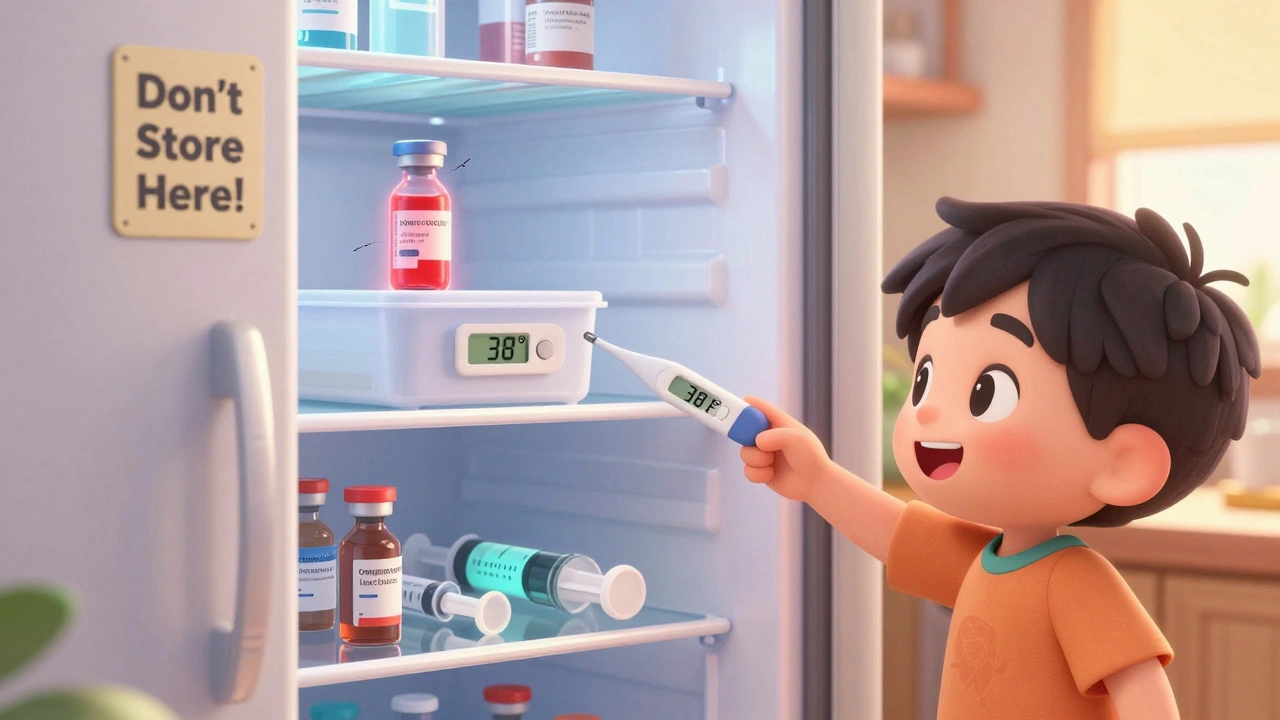
Many people don’t realize that some of the most important medications they take-like insulin, biologics, and vaccines-can go bad if not kept cold. Not just chilly. Not just in the fridge. But precisely between 36°F and 46°F (2°C to 8°C). Go outside that range, even for a few hours, and you could be taking a drug that doesn’t work. That’s not a hypothetical risk. It’s happened. People have ended up in the hospital because their insulin was left in a hot car or frozen in the back of the fridge.
What Medications Need Refrigeration?
You can’t guess. You have to check the label. But here’s the short list you’re most likely to encounter:
- Insulin (Lantus, Humalog, NovoLog, etc.)
- Biologics for autoimmune diseases (Humira, Enbrel, Remicade, Orencia)
- Vaccines (Shingrix, MMR, flu shots, COVID boosters)
- Certain antibiotics (like reconstituted amoxicillin clavulanate)
- Injectable hormones (growth hormone, some fertility drugs)
- Some injectable cancer drugs (like Rituxan, Herceptin)
These aren’t just pills you swallow. Most are liquids injected under the skin or into a vein. They’re made from proteins-fragile molecules that break down fast if they get too hot, too cold, or too old. Once they degrade, they won’t control your blood sugar, fight your infection, or stop your immune system from attacking your body.
Why Temperature Matters So Much
Think of your medication like a protein chain. Heat unravels it. Freezing shatters it. Both destroy its shape-and that shape is what lets it work in your body.
Studies show insulin stored at 86°F (30°C) for just 24 hours can lose up to 50% of its potency. At 95°F (35°C), it’s worse. One 2021 FDA report linked improperly stored insulin to a case of diabetic ketoacidosis-where blood sugar spiked dangerously high because the insulin didn’t work.
Vaccines are even more sensitive. The Shingrix vaccine, for example, loses effectiveness in under 7 days at room temperature. At 77°F (25°C), it’s good for 6 months. But if it hits 86°F (30°C)? That window shrinks to just 10 days. That’s why pharmacies and clinics use medical-grade fridges. You’re not just being careful-you’re protecting your health.
Home Fridge vs. Medical Fridge: The Real Difference
Your kitchen fridge isn’t built for medicine. It’s built for milk, leftovers, and soda. And that’s a problem.
Research from the Journal of the American Pharmacists Association found that the door shelves of household fridges average 52°F (11.3°C)-way too warm. The back wall? Around 38°F (3.4°C). Perfect. But here’s the catch: if you open the door every few minutes, that spot can swing from 35°F to 48°F in minutes. That’s a temperature excursion. And for biologics, that’s enough to damage them.
Medical-grade refrigerators (like those from Helmer or B Medical Systems) keep things stable within ±1°C. They have alarms, digital logs, and forced-air cooling. Your fridge? It doesn’t care. It doesn’t track. It doesn’t warn you.
And freezing? That’s a silent killer. If your insulin or vaccine freezes-even once-it’s ruined. Thawing it won’t fix it. The proteins are permanently damaged. You can’t tell by looking. It might still look clear. But it won’t work. And no one will tell you until your blood sugar spikes or your immune system flares up.
Where to Store Medications in Your Fridge
Don’t put them on the door. Don’t put them in the crisper. Don’t put them near the freezer compartment.
The safest spot is the middle shelf, away from the back wall (which can get too cold) and the door (which gets too warm). This is where temperatures stay most stable. Keep them in their original box to protect from light, and never stack other items on top.
Use a small, dedicated container-like a plastic bin with a lid-to keep them together. Label it. That way, no one accidentally throws it out or moves it to the door.
What About Insulin After You Start Using It?
This is where people get confused.
Unopened insulin? Always refrigerated. Opened? Most can go to room temperature-up to 77°F (25°C)-for 28 to 30 days. Check the package insert. Lantus? 28 days at room temp. Humalog? 28 days. NovoLog? 28 days. Some newer ones, like Fiasp, can last 4 weeks at up to 86°F (30°C).
But here’s the catch: if you’re traveling, in a hot car, or in a room without AC, don’t rely on that 28-day window. If it’s over 86°F, put it back in the fridge-even if it’s been open for 10 days.
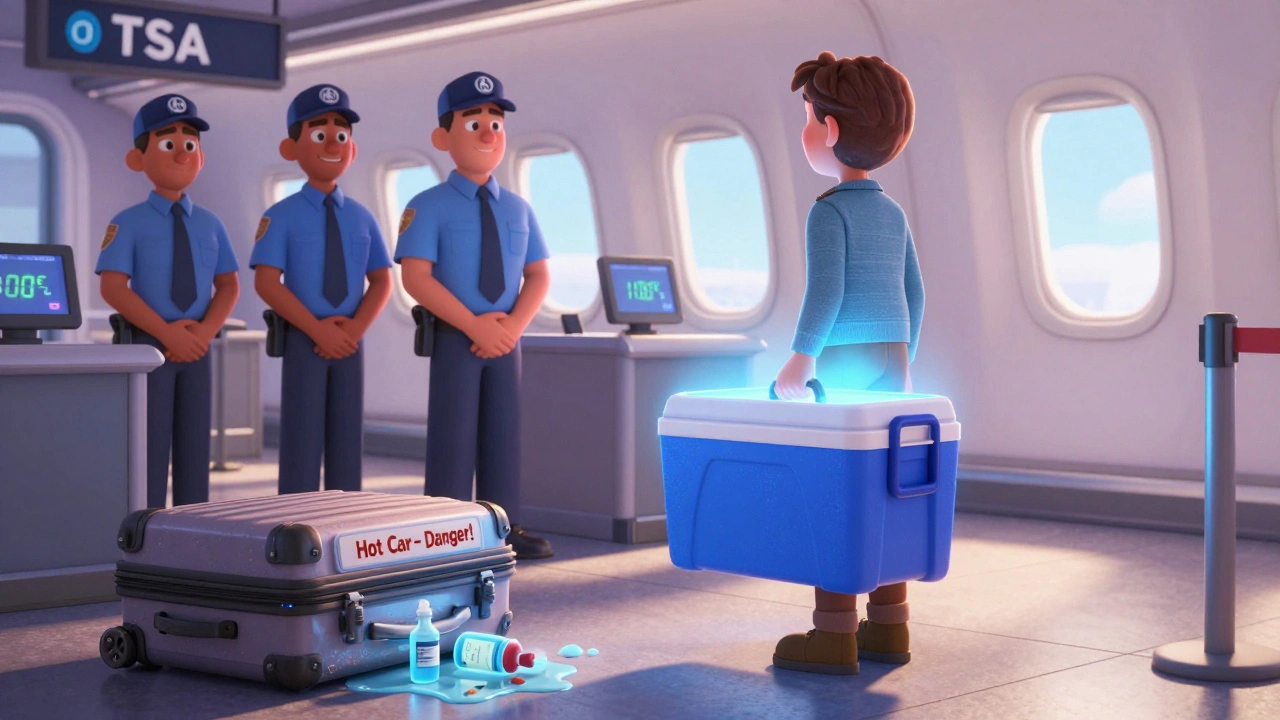
And never, ever leave insulin in a parked car. Even in winter. A car can hit 120°F in minutes. That’s enough to ruin it.
What to Do During Power Outages
Power goes out? Your meds are at risk.
Keep the fridge closed. A full fridge can stay cold for 24-48 hours. A half-full one? Maybe 12 hours.
Have a backup plan:
- Keep a small insulated cooler with ice packs on hand.
- Use phase-change material packs (like those from TempAid MediCool)-they stay at 39°F for up to 48 hours.
- Ask your pharmacy if they offer emergency refrigeration. Some do.
Don’t use dry ice or regular ice cubes directly touching the vials. That can freeze them. Wrap them in a towel first.
Traveling With Refrigerated Medications
Traveling? You need a plan.
- Use a validated travel cooler (like the Medically Safe Cooler or TempAid). These are tested to stay between 36°F-46°F for 24-48 hours.
- Carry a small digital thermometer with you. Check it every few hours.
- Never check these meds in luggage. Always carry them on the plane.
- Bring a doctor’s note. TSA allows refrigerated meds, but you’ll need to declare them.
Some airlines let you store meds in their onboard fridge. Ask ahead. And never rely on the hotel mini-fridge. They’re not calibrated.

How to Know If Your Medication Is Bad
It’s not always obvious. But here’s what to look for:
- Insulin: Cloudy or clumpy when it should be clear. Particles floating. Discoloration.
- Biologics: Visible particles, foam, or a change in color (like turning yellow or brown).
- Vaccines: Crystals in the vial. Cloudiness where there shouldn’t be any.
If you see any of these, don’t use it. Even if it’s within the expiration date. Temperature damage doesn’t show up on the label.
And if your blood sugar spikes for no reason, or your arthritis flare-up returns after being stable-think about your meds. Temperature failure is one of the most common but overlooked causes.
What Experts Say
Pharmacists and doctors are clear: improper storage is one of the top preventable reasons biologic therapies fail.
Dr. Robert99 at Baystate Health says: “The impact of a less-than-effective heart medication or asthma inhaler has the potential to be dangerous or even fatal.”
The FDA says any deviation from labeled storage conditions is an “unapproved use.” That means if you store insulin at room temp for 45 days when the label says 28, you’re using it outside approved guidelines. And if something goes wrong? Insurance might not cover it.
Some experts argue manufacturers are overly cautious. But that caution saves lives. One study found insulin labeled for 28 days at room temp still worked at 37°C for 42 days. But the manufacturer didn’t test that. They tested what’s safe. And they can’t risk people getting sick.
What You Can Do Today
You don’t need a $2,000 medical fridge. But you do need to be smart.
- Buy a $30 digital thermometer with a max/min readout. Put it in your fridge next to your meds. Check it weekly.
- Use a small, dedicated container for your refrigerated meds. Label it clearly.
- Never leave meds in a hot car, near a window, or on the fridge door.
- When you get a new prescription, ask your pharmacist: “Is this refrigerated? What happens if it gets too warm or too cold?”
- Sign up for alerts from your pharmacy. Many now send reminders when your meds are nearing their room-temp expiration date.
And if you’re on insulin or a biologic? Consider a small dedicated fridge. Models like the Whynter FM-50G cost under $200. It’s not a luxury. It’s insurance.
Final Thought
Medications that need refrigeration aren’t just inconvenient. They’re critical. They’re not optional. And the difference between a working dose and a useless one can come down to a few degrees.
You don’t need to be a scientist to keep them safe. You just need to know where to put them, how to check them, and when to say “no” to convenience. Your body depends on it.
Ollie Newland
December 4, 2025 AT 02:05Been using Humira for 7 years. Learned the hard way that fridge doors are a death trap. Now I keep my vials in a small insulated box on the middle shelf with a little thermometer taped to the side. Worth every penny. No more surprises when my joints flare up outta nowhere.
Rebecca Braatz
December 5, 2025 AT 04:32THIS. So many people don’t realize their insulin might be garbage and they’re just blaming themselves for bad numbers. If you’re on anything injectable and not tracking temps, you’re playing Russian roulette with your health. Get a $20 fridge thermometer. Do it today.
Elizabeth Crutchfield
December 5, 2025 AT 16:28i just found out my insuline was probly bad last month bc i kept it on the door… my bg was all over the place. i feel so dumb. now its in a little bin on the middle shelf. lesson learned.
Joe Lam
December 6, 2025 AT 01:01Let’s be real-most people don’t give a damn until they end up in the ER. The fact that drug companies get away with not mandating smart packaging or temperature-alert vials is criminal. You think they care? They make billions off your ignorance. This isn’t healthcare-it’s a profit-driven lottery.
Scott van Haastrecht
December 6, 2025 AT 23:38And yet the FDA still lets companies label insulin as stable at room temp for 28 days while knowing full well most patients live in unairconditioned homes or travel in hot cars. It’s not just negligence-it’s systemic malpractice disguised as convenience. Someone should sue.
Augusta Barlow
December 7, 2025 AT 06:37Did you know the government is secretly using this to control the diabetic population? The FDA and Big Pharma colluded to make sure meds are unstable unless you buy their $200 medical fridges. That’s why they don’t warn you about the door shelf-it’s not an accident, it’s a trap. They want you to fail so you keep buying new vials. I’ve seen the documents. They’re hiding the real temp limits. Your insulin isn’t just going bad-it’s being engineered to fail.
And don’t get me started on how the vaccines are designed to degrade faster if you don’t buy the $150 coolers. It’s all about recurring revenue. Your body’s not broken. The system is.
I used to trust my pharmacist. Now I test every vial with a UV light I bought off eBay. The proteins glow differently when tampered with. I’m not crazy. I’m just awake.
They told me my arthritis flare-up was stress. I knew better. I checked the fridge. The temp had spiked to 49°F for 14 hours. That’s not a glitch. That’s a signal. They don’t want you to know this. But now you do.
And yes, I’ve emailed the FDA. They never replied. That’s how you know they’re guilty.
Rachel Bonaparte
December 8, 2025 AT 07:49Okay, but have you considered that the real issue isn’t the fridge-it’s the fact that we’re all being forced to manage complex biologics like we’re pharmacists? This isn’t 1980. We’re supposed to be curing disease, not becoming DIY lab technicians. Why can’t these drugs be shelf-stable? Why do we need to carry coolers on vacation? Why does my child’s growth hormone require a temperature log like it’s a nuclear reactor? It’s absurd. And the companies know it. They’re just too lazy-or too greedy-to innovate. I’m not the problem. The system is.
My mom had diabetes for 40 years. She never had to worry about this. Now my sister needs a mini-fridge in her bedroom just to survive. Progress? More like regression disguised as science.
I get that temperature matters. But the fact that we’ve accepted this as normal? That’s the real tragedy.
Jenny Rogers
December 8, 2025 AT 11:15It is both a moral and scientific imperative to adhere strictly to the labeled storage parameters of biopharmaceutical agents. To deviate, even marginally, is not merely imprudent-it constitutes a fundamental breach of the fiduciary relationship between patient and pharmacological integrity. The denaturing of protein conformation is not a metaphor; it is a thermodynamic inevitability governed by the laws of physical chemistry. One cannot invoke convenience as a justification for the erosion of therapeutic efficacy. The FDA’s guidelines are not suggestions-they are the minimum threshold of ethical responsibility. To disregard them is to participate in a quiet, systemic violence against the vulnerable.
Michael Feldstein
December 9, 2025 AT 22:22Just wanted to say thanks for the tip about the insulated container. I bought one of those $15 Medically Safe coolers for my wife’s biologic and it’s been a game-changer. We travel a lot and now we don’t stress about hotel fridges. Also, the thermometer idea? Genius. We check it every morning like a ritual. Small habits save lives.
George Graham
December 10, 2025 AT 04:34I’m from India and we don’t have easy access to medical fridges. We use a clay pot with wet cloth wrapped around it-keeps things cool naturally. It’s not perfect, but it’s better than leaving meds on the counter. I’ve been doing this for my father’s insulin for 5 years. No issues. Sometimes the old ways work better than the expensive gadgets.
jagdish kumar
December 11, 2025 AT 13:01Temperature is just a number. The real medicine is in the mind.