

When your insurance plan drops your medication from coverage or moves it to a higher cost tier, it’s not just a paperwork issue-it’s a health risk. For millions of Americans on chronic medications, a formulary change can mean suddenly paying $600 more a month, scrambling for alternatives, or even stopping treatment altogether. This isn’t rare. In 2024, 34% of Medicare beneficiaries experienced a formulary change affecting their meds, and 47% of patients abandoned their prescriptions when drugs moved from tier 2 to tier 3. If you’re on insulin, Humira, or any specialty drug, knowing how to handle these shifts isn’t optional-it’s survival.
What Is a Formulary, Really?
A formulary is a list of drugs your insurance plan agrees to cover. It’s not random. Each drug is placed into a tier based on cost, effectiveness, and negotiation deals between insurers and drugmakers. Tier 1 usually means low-cost generics. Tier 4 or 5? That’s where the expensive biologics live-with coinsurance rates hitting 33% or more. The system exists to control costs, but it also creates real barriers. For example, 73% of rare disease drugs require prior authorization, and 22% of patients skip doses or quit treatment because of coverage changes.
There are five main types of formularies:
- Open formularies cover nearly all drugs-great for access, but expensive for insurers. Only 15% of plans use this.
- Closed formularies block non-listed drugs entirely-common in Medicaid, used by 40% of managed care plans.
- Generic-only formularies allow only generics-used in 8% of employer plans to cut costs.
- Value-based formularies pick drugs based on real-world outcomes, not just price. Used by 25% of large employers.
- Tiered formularies are the most common-used by 92% of Medicare Part D plans and 87% of all commercial plans.
Medicare Part D plans must cover at least two drugs per therapeutic class and give 60 days’ notice before removing a drug. Commercial plans? They often give just 22 days. That’s not enough time to switch, appeal, or find help.
Why Formulary Changes Happen
Changes aren’t arbitrary. They’re driven by three things: rebates, new drugs, and cost pressure.
Drugmakers pay rebates to insurers to get their drugs on the formulary. If a competitor offers a bigger rebate, your current drug gets bumped. For example, if Humira’s maker stops paying as much as a newer biologic, the insurer may move Humira to a higher tier-or off the list entirely. That’s what happened to many patients in 2024.
New drugs also trigger changes. When a cheaper generic hits the market, insurers rush to add it and remove the brand-name version. That’s good for costs-but bad if you’ve been stable on the brand for years.
And then there’s cost pressure. Medicare Part D plans must spend less than $2,000 per beneficiary in 2025 thanks to the Inflation Reduction Act. That means they’ll be even more aggressive about pushing lower-cost drugs, even if they’re not your best option.
How to Spot a Formulary Change Before It Hits
Don’t wait for a bill to arrive. Proactive steps save money and stress.
- Check your plan’s formulary every year during open enrollment. Most insurers update their lists by October 1 for the next year.
- Use tools like Medicare’s Plan Finder or your insurer’s online formulary lookup. 92% of health plans offer these tools.
- Set up alerts. Some pharmacy benefit managers (PBMs) like Optum Rx and CVS Caremark let you sign up for email or text alerts when your drug changes tier.
- Ask your pharmacist. They see formulary updates daily. A simple question-“Is my med still covered next month?”-can prevent a surprise.
One clinic in Ohio started a system where pharmacists review all patient medications 60 days before plan changes. They switched 80% of at-risk patients to alternatives during routine visits-no disruption, no emergency.
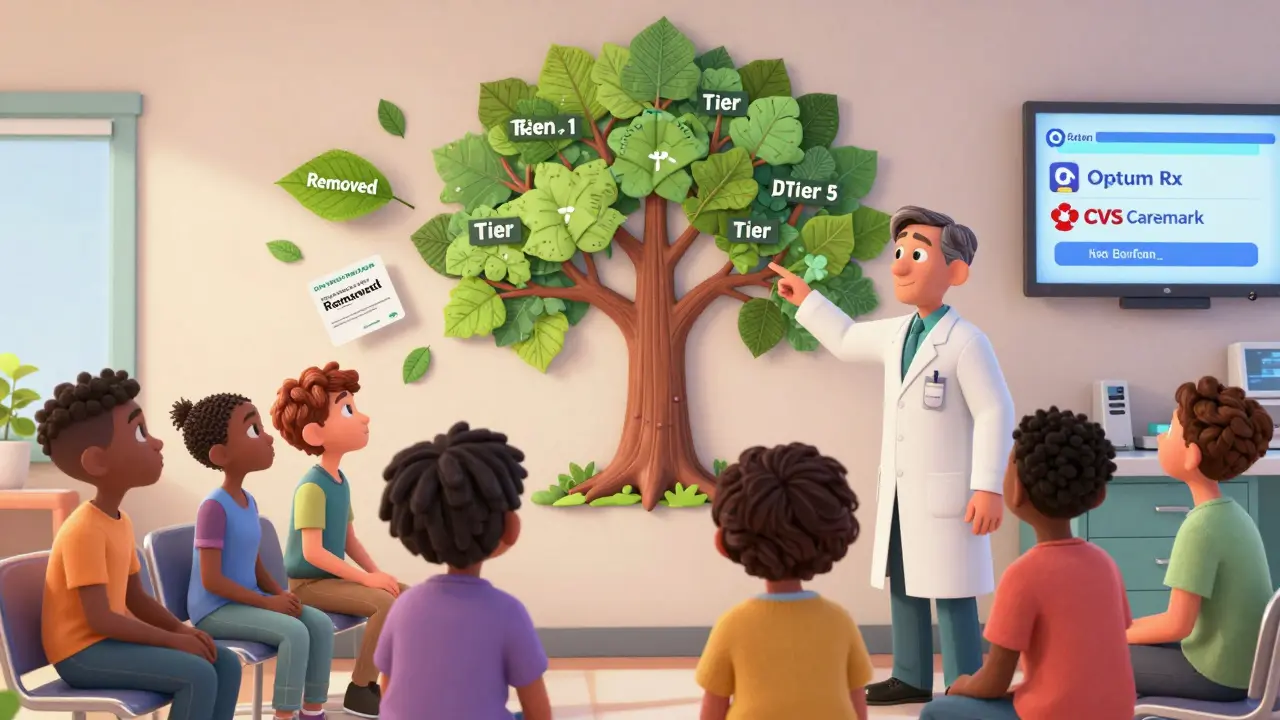
What to Do When Your Drug Is Removed or Moved
If your drug gets kicked off the formulary, you have options. Don’t panic. Don’t stop taking it.
- Request a formulary exception. This is a formal appeal. You need a letter from your doctor explaining why the new drug won’t work for you. 64% of these requests are approved if they’re medically justified.
- Ask for a transition supply. If your drug is being removed, your plan must give you a 30- to 60-day supply to keep you going while you appeal or switch.
- Check for manufacturer assistance. Companies like AbbVie (Humira), Roche (Ocrevus), and Novo Nordisk (Ozempic) offer copay cards or free drug programs. In 2024, these programs covered $6.2 billion in patient costs.
- Switch to a therapeutic alternative. Your doctor can find another drug in the same class. For example, if your statin is removed, there are 7 other options. For diabetes, there are 10+ GLP-1s and SGLT2 inhibitors.
- Use State Health Insurance Assistance Programs (SHIP). These free counseling services help Medicare beneficiaries navigate appeals. People who use SHIP have a 37% higher success rate.
One patient on Reddit shared: “After 7 years on Humira, my plan moved it to a specialty tier. My cost jumped from $50 to $650. I applied for manufacturer help, filed an exception, and got 3 months of free meds while I switched. It was a mess-but I didn’t go without.”
How Providers Can Help
Doctors and pharmacists aren’t just bystanders-they’re your frontline defense.
- Use e-prescribing systems that check formulary status in real time. 76% of large medical groups now do this.
- Flag high-risk patients: those on specialty drugs, with chronic conditions, or low income.
- Keep a list of alternative drugs with comparable efficacy and cost. For example, if a patient’s biologic is removed, know which biosimilars are covered.
- Advocate. If your patient’s exception is denied, write a second letter. Include data on adherence, hospitalizations, or lab results.
One endocrinologist in Texas started a formulary tracker spreadsheet. She updates it monthly and shares it with her team. Her patients’ medication discontinuation rate dropped by 52% in a year.

What’s Changing in 2025 and Beyond
The game is shifting fast.
- The Inflation Reduction Act caps out-of-pocket drug costs at $2,000/year for Medicare beneficiaries starting in 2025. This will force plans to rethink how they structure tiers.
- Accumulator adjustment programs are growing. These programs don’t count manufacturer coupons toward your deductible. 71% of commercial plans now use them, making patient assistance less effective.
- AI tools are being used to predict which formulary changes will cause patients to quit treatment. One 2024 study showed these tools predict non-adherence with 89% accuracy.
- By 2027, 45% of employer plans are expected to use value-based formularies-where drugs are chosen based on real outcomes, not just price.
- Long-term? Experts predict “individualized formularies” based on genetics and treatment response within 10 years.
But transparency remains a problem. Only 22% of patients understand how formulary decisions are made. That’s not just a communication gap-it’s a trust gap.
Key Takeaways
- Formulary changes are common, predictable, and often disruptive-but not inevitable.
- You have rights: 60-day notice (for Medicare), transition supplies, and the right to appeal.
- Don’t wait for a bill. Check your formulary every year. Set alerts. Talk to your pharmacist.
- Manufacturer assistance programs are real and available. Use them.
- Doctors and pharmacists can help-ask them to verify coverage before prescribing.
What should I do if my drug is removed from my insurance formulary?
First, don’t stop taking your medication. Contact your insurer immediately to request a transition supply, which gives you 30-60 days of coverage. Then, ask your doctor to file a formulary exception-this is a formal appeal based on medical necessity. Also check if the drugmaker offers a patient assistance program. If the exception is denied, explore alternative medications in the same class that are covered. Use your State Health Insurance Assistance Program (SHIP) for free guidance if you’re on Medicare.
How often do insurance formularies change?
Formularies are reviewed quarterly by most large pharmacy benefit managers (PBMs), with changes typically taking effect at the start of a new calendar year. Medicare Part D plans must notify members 60 days before removing a drug, while commercial plans often give as little as 22 days. Changes can also happen mid-year if a drug is recalled, if a new generic enters the market, or if a drugmaker stops offering rebates.
Can I switch to a different insurance plan to avoid formulary changes?
Yes-but timing matters. You can only switch plans during open enrollment (October 15-December 7 for Medicare) or after a qualifying life event like moving, losing job-based coverage, or getting married. If you’re already in the middle of the year, switching isn’t usually an option. Instead, use the appeal process, request a transition supply, or find a covered alternative. Waiting until next year to switch plans is often safer than trying to change mid-year.
Are generic drugs always better than brand-name drugs when it comes to formularies?
Not always. While generics are usually cheaper and equally effective for most conditions, some patients respond differently to biosimilars or generics-especially with complex drugs like biologics for rheumatoid arthritis, Crohn’s, or multiple sclerosis. Formularies often push generics to save money, but if your doctor says a brand-name drug works better for you, you have the right to request an exception. The FDA approves generics as bioequivalent, but real-world experience shows some patients need the original formulation.
Why do insurance companies change formularies so often?
Insurance companies change formularies to control costs and maximize rebates. Drugmakers pay billions in rebates to get their drugs placed on preferred tiers. If a competitor offers a bigger rebate, the insurer will often swap drugs-even if your current one works fine. New drugs, patent expirations, and regulatory changes also trigger updates. The goal is to reduce spending, but the trade-off is patient disruption. In 2023, formulary exclusions cost patients an average of $587 more per year in out-of-pocket expenses.
Stephen Rudd
March 10, 2026 AT 07:47Jazminn Jones
March 10, 2026 AT 13:56Scott Easterling
March 12, 2026 AT 04:53Mantooth Lehto
March 12, 2026 AT 13:18Melba Miller
March 12, 2026 AT 14:49Dan Mayer
March 13, 2026 AT 23:45Samantha Fierro
March 15, 2026 AT 14:57Robert Bliss
March 15, 2026 AT 19:15Peter Kovac
March 17, 2026 AT 04:06Philip Mattawashish
March 18, 2026 AT 03:13Tom Sanders
March 20, 2026 AT 00:33Erica Santos
March 20, 2026 AT 22:08George Vou
March 22, 2026 AT 01:18Katy Shamitz
March 23, 2026 AT 07:15