
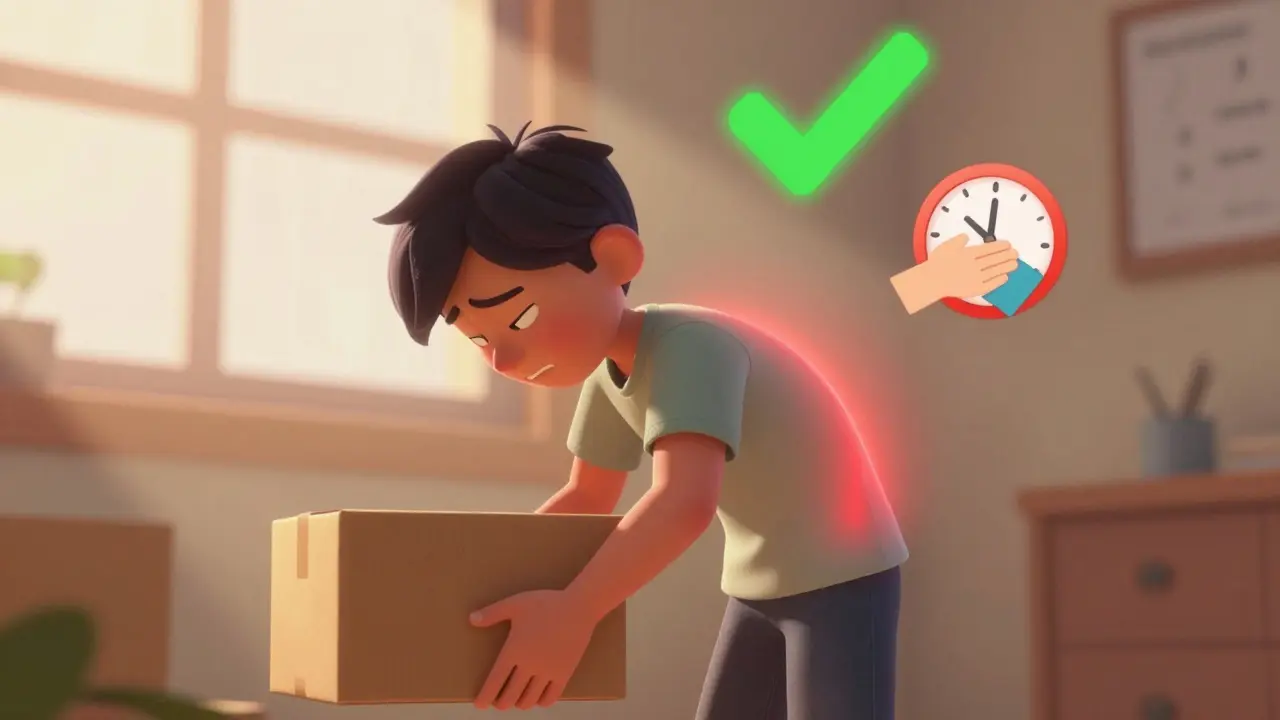
Most people will feel low back pain at some point in their life. It’s not rare. It’s not unusual. But how you handle it-especially in the first few days-can change everything. The difference between acute and chronic back pain isn’t just about how long it lasts. It’s about what’s happening inside your body, and that changes everything about how physical therapy works.
What Exactly Is Acute Low Back Pain?
Acute low back pain shows up fast. Maybe you lifted something heavy, twisted wrong, or slipped on ice. One moment you’re fine. The next, your lower back is locking up. This kind of pain usually hits between 18 and 45-year-olds. It’s sharp, localized, and gets worse when you move in certain ways-bending, twisting, even coughing. It’s not a sign of something broken. Most of the time, it’s just strained muscles or irritated ligaments. Tissues heal. And they heal fast. About 90% of people with acute back pain, even those with herniated discs, feel better within 4 to 12 weeks. No surgery. No injections. Just time and smart movement. The real danger isn’t the pain itself. It’s what happens if you wait. If you ignore it for more than two weeks, you’re playing Russian roulette with your spine. Research shows that if you start physical therapy within 72 hours of the injury, you cut your risk of turning acute pain into chronic pain by 22%. Wait past 16 days? Your chance of chronic pain jumps by 38%.What Makes Chronic Low Back Pain Different?
Chronic back pain doesn’t always have a clear cause. You might not remember the exact moment it started. It creeps in. It lingers. It’s not sharp like acute pain. It’s a dull, constant ache. Sometimes it radiates down your leg. Sometimes it just feels like your back is stiff all the time, even when you’re sitting still. This isn’t about damaged tissue anymore. After three to six months, the body has healed. But your nervous system hasn’t. Your brain and spinal cord have become hypersensitive. Pain signals get amplified. Even normal movements feel threatening. This is called central sensitization. It’s not in your back-it’s in your nervous system. That’s why traditional treatments often fail. Stretching, massage, heat packs-they help with acute pain. But for chronic pain? They only give temporary relief. You might do 20 sessions over five months and still feel 70% pain. That’s not failure. That’s biology.Physical Therapy for Acute Pain: Speed Matters
If you’ve got acute back pain, physical therapy isn’t a luxury. It’s a preventive tool. The goal isn’t to fix your back. It’s to stop your nervous system from learning pain. A good physical therapist starts with movement. Not rest. Not braces. Not imaging. Just gentle motion. You’ll do pelvic tilts, cat-cow stretches, walking. No heavy lifting. No deep squats. Just enough to keep your spine moving without triggering more pain. Within three to six sessions, most people see a 40-60% drop in pain. They get back to work faster. Studies show they miss 35-50% fewer workdays than those who wait. And here’s the kicker: early PT prevents chronic pain in 84% of cases. Delayed treatment? Only 68% avoid it. The best outcomes? People who start within 14 days. That’s two weeks. Not two months. Not after an MRI. Not after seeing three doctors. Two weeks.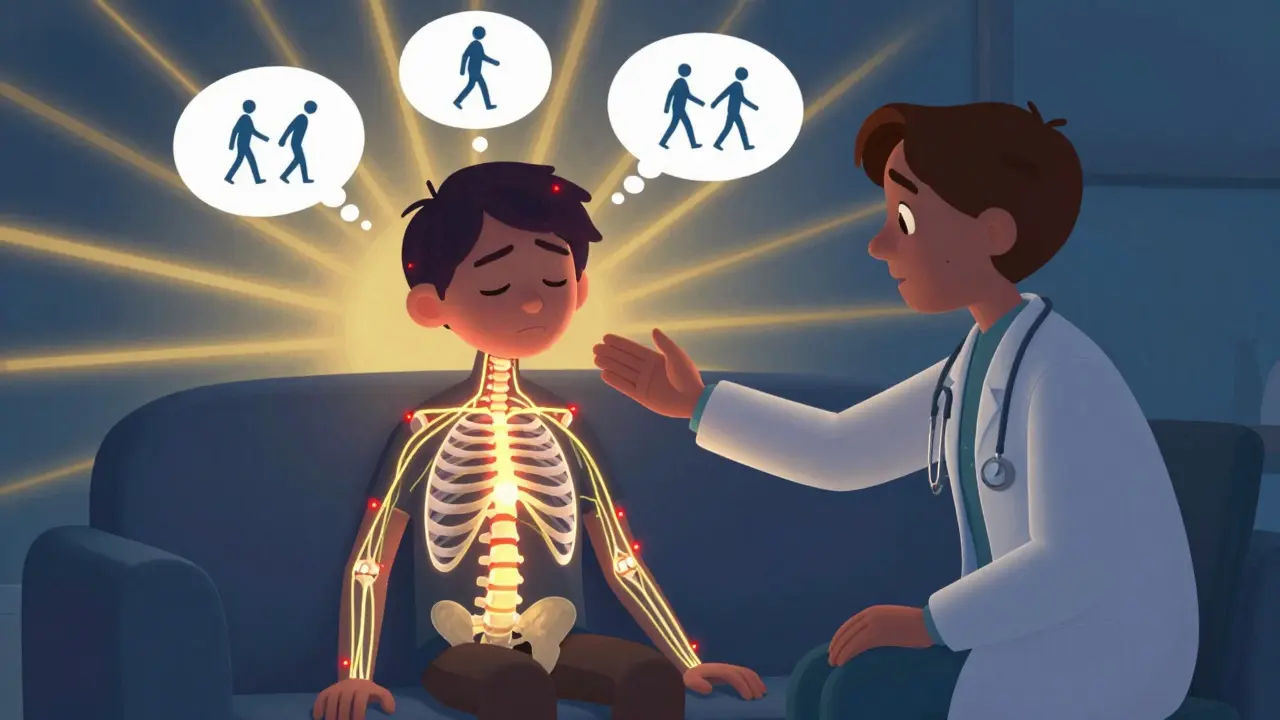
Physical Therapy for Chronic Pain: Rewiring the System
Chronic pain needs a different kind of physical therapy. You can’t just stretch your way out of it. You have to retrain your brain. Treatment usually lasts 15 to 25 sessions over three to four months. It starts with pain neuroscience education. No jargon. No diagrams. Just clear talk: “Your back isn’t broken. Your nerves are on overdrive.” Then comes graded exposure. You don’t avoid movement. You slowly, safely, reintroduce it. Walk 5 minutes. Then 7. Then 10. Lift a light bag. Then a heavier one. Each time, your brain learns: “This doesn’t hurt me.” Fear-avoidance is the enemy here. 70% of chronic back pain patients avoid activity because they think it’ll make things worse. But avoiding movement makes the pain worse. Physical therapy breaks that cycle. Results aren’t perfect. Only 20-30% of chronic pain patients get complete relief. But 60-70% see real functional improvement. They can sleep better. Walk farther. Play with their kids. That’s not a cure. But it’s a life changed.What the Research Says About Outcomes
Patient reviews tell the real story. On Healthgrades, 82% of people with acute back pain said they felt 90% better after 4-6 PT sessions. One man lifted a box, hurt his back, saw a therapist three days later. By session five, his pain was gone. For chronic pain? Only 58% reported meaningful improvement. Many said they’d done 20 sessions and still had pain. But the ones who did get better? Almost all mentioned pain neuroscience education. “They taught me why my back hurt even when nothing was broken,” one wrote. That insight changed everything. Reddit threads echo this. People with acute pain say, “I was back at the gym in three weeks.” Those with chronic pain say, “I’ve tried everything. Nothing stuck.” Until they found a therapist who explained the nervous system.How Treatment Protocols Differ
Acute pain protocol: 6-12 sessions over 3-6 weeks. First few visits focus on reducing pain with ice, heat, and gentle motion. Then you move to strengthening. Core work. Hip mobility. Walking. That’s it. 92% of acute cases don’t need fancy tools or advanced techniques. Chronic pain protocol: 15-25 sessions over 8-12 weeks. First 2-4 sessions are all about education. Then you layer in movement retraining, graded exposure, and cognitive strategies. You learn to notice fear. To breathe through discomfort. To separate pain from danger. Adherence is the biggest hurdle. 88% of people finish acute PT. Only 65% finish chronic PT. Why? Because chronic pain is exhausting. It’s emotionally draining. You need more than a therapist-you need a guide.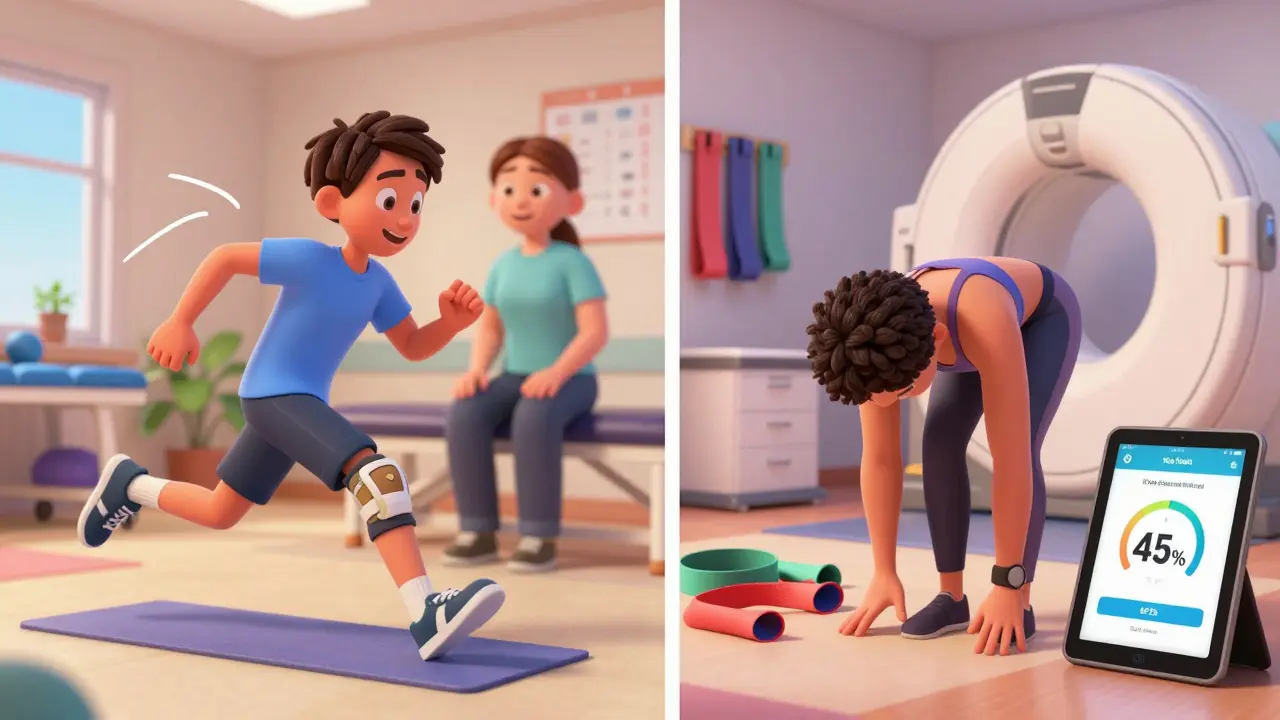
Gregory Parschauer
January 15, 2026 AT 05:28Let me just say this: if you're waiting more than 72 hours to see a PT after acute back pain, you're not just lazy-you're actively sabotaging your own nervous system. The data is crystal clear, and yet people still treat it like a minor inconvenience. You wouldn't wait two weeks to treat a broken arm, so why the hell are you treating your spine like it's disposable? This isn't 'rest and ice' territory-it's neuroplasticity warfare. If you don't move smartly from day one, your brain starts wiring pain into its default setting. And then you're stuck with chronic pain for years. Stop normalizing suffering.
Acacia Hendrix
January 16, 2026 AT 12:14Frankly, the entire paradigm is still rooted in a biomechanical fallacy. The notion that ‘movement = healing’ ignores the epigenetic modulation of nociceptive pathways and the role of interoceptive dysregulation in central sensitization. Until clinicians stop conflating tissue damage with pain perception, we’re just rearranging deck chairs on the Titanic. CFT isn’t a ‘treatment’-it’s a phenomenological recalibration. And yet, insurance companies still reimburse for ultrasound and TENS like they’re magic bullets. Pathetic.
James Castner
January 17, 2026 AT 19:21There’s something profoundly human here that gets lost in all the clinical jargon and statistical breakdowns. Pain isn’t just a signal-it’s a story your body is telling you, and most of us have been trained to ignore it until it screams. The tragedy isn’t the pain itself, but the culture that tells us to endure it, to push through it, to ‘tough it out.’ We’ve turned our bodies into machines that need fixing, not partners that need listening to. When you start physical therapy early, you’re not just preventing chronic pain-you’re reclaiming your relationship with your own physicality. It’s not about strength or flexibility. It’s about trust. Trust that your body isn’t your enemy. And that’s a revolution more powerful than any MRI or injection.
Adam Rivera
January 18, 2026 AT 22:50Hey, I had acute back pain last year after moving furniture-totally stupid move, I know. Went to PT three days later, did like five sessions, and now I can lift my kid without thinking twice. Honestly? Best $200 I ever spent. No surgery, no meds, no drama. Just a lady who told me to walk more and not panic every time I felt a twinge. Seriously, if you're reading this and you're in pain? Just call someone. Don't overthink it. Your future self will thank you.
Rosalee Vanness
January 20, 2026 AT 19:30I’ve been living with chronic back pain for over five years. Tried everything-chiropractors, acupuncture, yoga, massage, even that expensive ‘spinal decompression’ machine at the wellness spa (spoiler: it did nothing). Then I found a therapist who didn’t touch my back once in the first session. Instead, she sat me down and said, ‘Your brain thinks your spine is under attack-even when it’s not.’ And for the first time, I didn’t feel broken. I felt understood. She taught me to breathe through the ache, to move in tiny increments, to celebrate the 1% gains. It’s not a cure, but it’s the closest thing to peace I’ve had in years. If you’re still stuck in the ‘more stretching = better’ loop? Please, let go. Your nervous system is begging you to stop fighting it.
lucy cooke
January 22, 2026 AT 11:21Oh, please. We’ve been sold this narrative like it’s some divine revelation from the PT gods. ‘Early intervention prevents chronic pain!’ As if pain is just a glitch in the matrix you can patch with a few pelvic tilts. Pain is existential. It’s the body screaming into the void, and you think a 12-session protocol can answer that? You’re romanticizing suffering. Chronic pain isn’t a medical problem-it’s a metaphysical one. Your brain didn’t ‘learn’ pain. It remembered it. And memory doesn’t submit to graded exposure. It clings. It haunts. It transforms you. You can’t ‘retrain’ a soul that’s been wounded.
Trevor Davis
January 23, 2026 AT 21:43Look, I’m not a doctor, but I’ve had both acute and chronic back pain. I did the early PT thing and it saved me. Then I got chronic pain after a bad fall and tried everything. The only thing that actually helped? Talking to someone who didn’t try to fix me. Just listened. Said, ‘Yeah, that sucks.’ And then gently nudged me to walk around the block. No magic. No miracles. Just presence. And honestly? That’s what the system is missing. Not more protocols. More humanity.
John Tran
January 25, 2026 AT 05:43ok so i read this whole thing and i think the real issue is that people dont understand that pain is just a feeling and if you just stop being scared of it youll be fine. like why do you need 25 sessions? just move. walk. dont be a baby. i had back pain for 6 months and i just started lifting again and now im fine. the science is all just bs anyway. they just want your money. also i think the word 'neuroplasticity' is used way too much like its a trend now. its not a magic word. its just biology. and biology dont care about your feelings.
Trevor Whipple
January 25, 2026 AT 14:57Wow. So you're telling me that if I just walk more, my brain will magically stop screaming at me? That's it? No drugs? No surgery? No magic pills? I'm supposed to believe that 20 years of chronic pain can be undone by some guy telling me to do cat-cow stretches? Please. I've seen the research. It's funded by PT associations. The real solution? CBD. Ketamine. Or just accept that your spine is ruined and get a cane. This whole 'nervous system retraining' thing is just placebo with a PowerPoint. And don't even get me started on AI apps. Kaia Health? More like Kaia Scam.
Lethabo Phalafala
January 27, 2026 AT 06:11My cousin in Johannesburg had the same thing-acute pain after lifting a crate, ignored it for three weeks, ended up with chronic pain that turned her into a shadow of herself. She finally found a therapist who didn’t try to ‘fix’ her. He asked her, ‘What are you afraid of?’ And she cried for the first time in months. That’s when healing started. Not because of the exercises. But because someone finally saw her pain as real-not a diagnosis. If you’re reading this and you’re in pain? Don’t just chase solutions. Chase someone who listens. That’s the real therapy.
Lance Nickie
January 27, 2026 AT 19:36PT is just a racket. I hurt my back, did nothing, it got better. Case closed.