
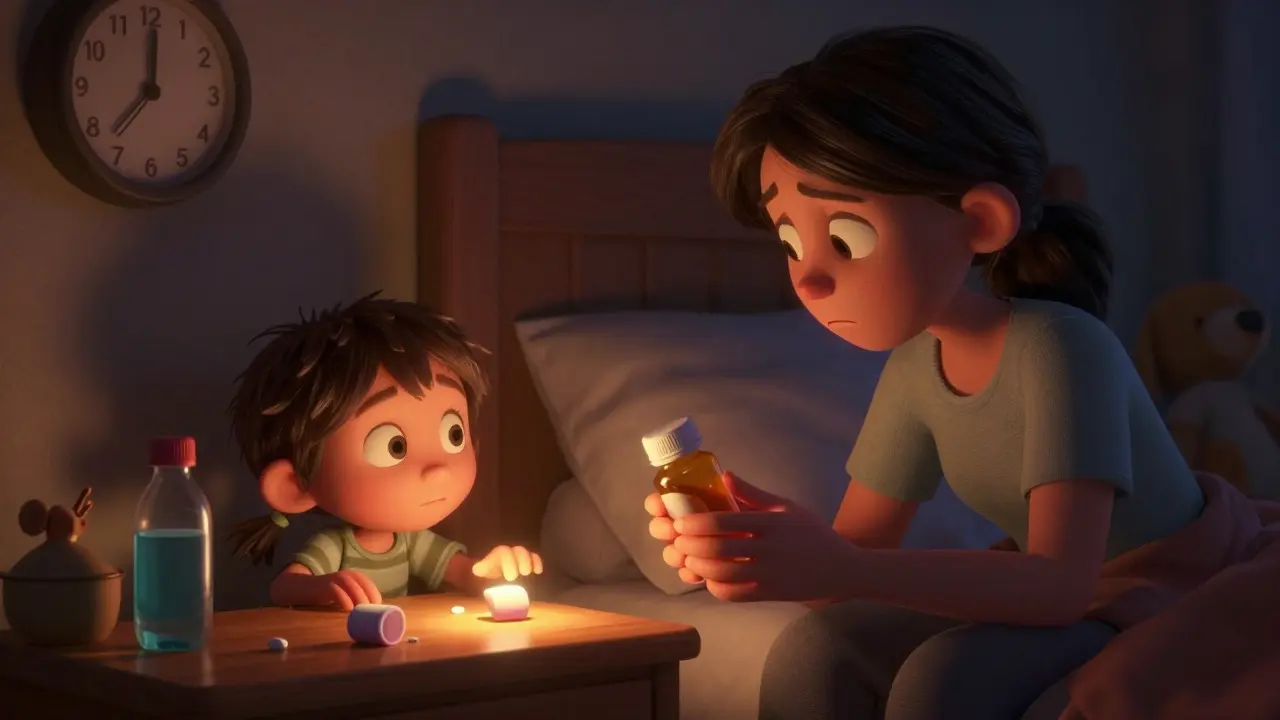
When your child is sick, the medicine you choose matters more than you think
It’s 2 a.m. Your child has a fever. The doctor says antibiotics. You grab the bottle from the cabinet-liquid, right? That’s what you’ve always done. But what if the liquid isn’t the best choice? What if a tiny tablet, no bigger than a pencil eraser, could work better, cost less, and actually be easier for your kid to take?
The truth is, most parents assume liquid medicine is the only safe or practical option for kids. But that’s changing. New research, real-world data, and even parent experiences are turning this idea upside down. For many children, especially those over 2 years old, tablet medications are not just an alternative-they’re often the smarter choice.
Why we used to think liquids were the only option
For decades, pediatric medicine defaulted to liquids. Why? Because kids can’t swallow pills, right? It made sense. Infants and toddlers don’t have the coordination or muscle control to swallow a solid pill safely. So doctors and parents turned to syrups, suspensions, and drops-anything that could be measured in milliliters and spoon-fed.
But here’s the problem: that thinking never really updated. Even when kids turn 3, 4, or 5, many parents and even some doctors keep reaching for the liquid bottle. Why? Habit. Fear. Convenience. But modern pediatric medicine has caught up. Today, there are tablets designed specifically for children-mini-tablets as small as 2mm, orodispersible films that melt on the tongue, and coated pills that taste nothing like medicine.
How liquid medications actually make things harder
Liquids might seem easier, but they come with hidden costs.
- Taste issues: A 2007 study found 68% of kids refuse liquid meds because they taste bad. Even "strawberry-flavored" ones often taste like chemicals-not real fruit. One parent on Reddit said their 4-year-old would rather swallow a tablet than take the "strawberry" antibiotic that tasted like plastic.
- Dosing errors: The FDA says 12-18% of parents mismeasure liquid doses. Using kitchen spoons? That’s a recipe for under- or overdosing. Even with syringes, spills, drips, and misreads happen. One study showed 15-20% of parents make mistakes when giving liquid meds.
- Storage and shelf life: Many liquid antibiotics need refrigeration. Once opened, they expire in 14-30 days. If your child finishes the course early, you’re throwing away half the bottle. That’s waste-and money down the drain.
- Cost: A 2021 NHS analysis found switching from liquid to tablet forms saves £7,842 per 10,000 pediatric prescriptions. For a hospital, that’s tens of thousands of dollars saved annually.
Liquids aren’t bad-they’re necessary for babies under 6 months. But for older kids? They’re often the less efficient option.
Why tablets are now a better fit for most kids
Tablets for children aren’t what you remember from your childhood. Today’s pediatric tablets are engineered for tiny mouths and developing swallowing skills.
- Size matters: Mini-tablets as small as 2mm are now common. Studies show even infants as young as 6 months can swallow them without choking. In one trial, kids aged 6 months to 6 years accepted mini-tablets just as well-or better-than liquids.
- Accuracy: No measuring. No spills. No guesswork. A tablet delivers exactly the dose prescribed. No room for error.
- Stability: Tablets last 2-3 years at room temperature. No refrigeration. No spoilage. You can keep them in the medicine cabinet without worry.
- Cost savings: Tablets cost 25-40% less per dose than liquids. For chronic conditions like asthma or ADHD, that adds up fast.
- Adherence: Kids who take tablets consistently are 22% more likely to finish their full course than those on liquids, according to a 2022 JAMA Pediatrics meta-analysis.
And here’s the kicker: kids learn to swallow tablets faster than you think.
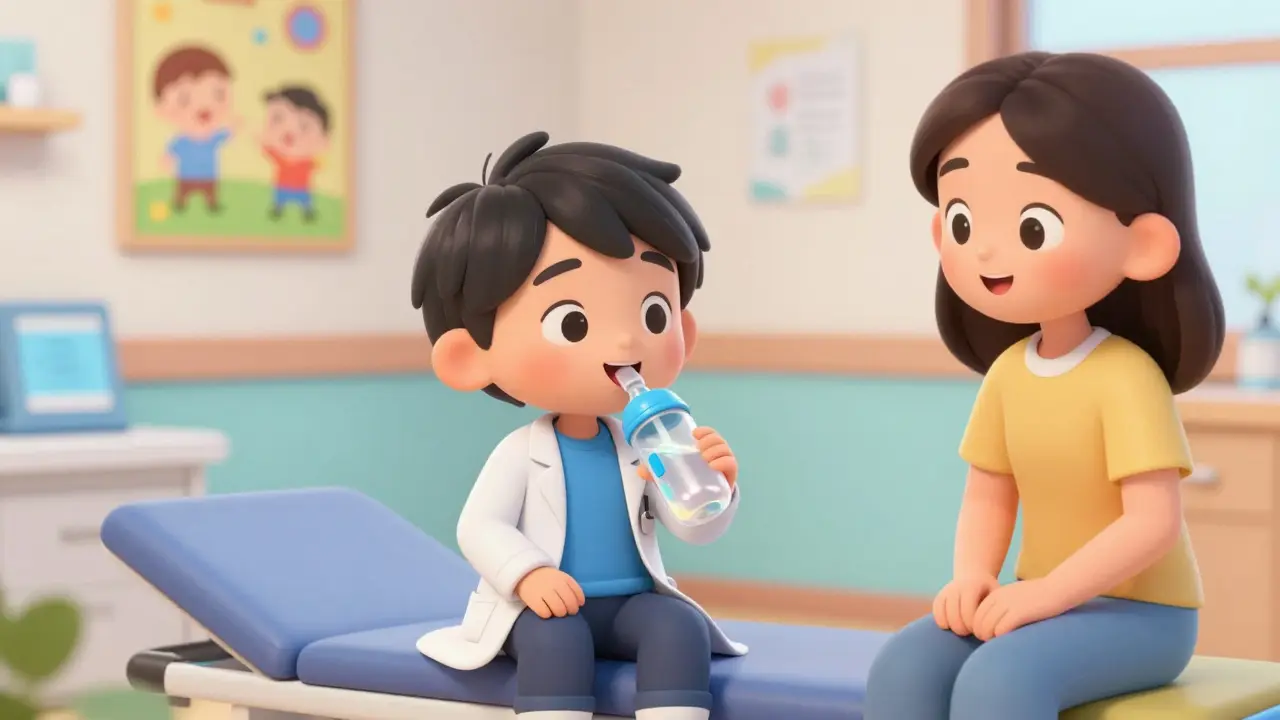
Can your 3-year-old really swallow a tablet?
Yes. And here’s how to make it work.
The American Academy of Pediatrics says children as young as 2 can begin learning to swallow pills-with the right training. By age 4, most can reliably swallow 2-4mm tablets. By 6-7, they can handle standard-sized pills.
Start with practice:
- Use mini-marshmallows or tiny bread balls-same size as the tablet.
- Have your child sit upright. Place the "pill" on the tongue.
- Use the "pop-bottle method": Have them sip water from a bottle while keeping their head tilted slightly forward. The suction helps the pill slide down.
- Practice daily for 5 minutes. Celebrate small wins.
One study found that when parents were shown this technique, tablet acceptance jumped by 65%. No magic. Just practice.
When you still need the liquid
Tablets aren’t the answer for every situation. There are times when liquid is the only safe or effective choice:
- Babies under 6 months: Their swallowing reflex isn’t developed enough. Stick with drops or syrups.
- Medications that need precise titration: Drugs like levothyroxine (for thyroid) or warfarin (for blood thinning) require exact milligram adjustments. Liquids allow dosing down to 0.1mL-something tablets can’t do yet.
- Children with swallowing disorders: If your child has cerebral palsy, autism with sensory issues, or a history of choking, liquids may still be necessary.
- When no tablet form exists: Some medications simply aren’t available as tablets for kids. Check with your pharmacist.
Don’t force a tablet if it’s not appropriate. But don’t default to liquid just because it’s familiar.
What the experts say
The European Medicines Agency has been clear since 2013: children should be trained to swallow tablets from age 3-5, especially for long-term conditions. The World Health Organization recommends solid forms over liquids in developing countries because they’re more stable and less prone to spoilage.
Dr. Jane Standing, a pediatric pharmacology expert at Great Ormond Street Hospital, says: "The automatic preference for liquid formulations in children is not evidence-based and often counterproductive to long-term medication adherence."
Yet, a 2021 survey of 500 U.S. pediatricians found 62% still prescribe liquids for kids under 8-mostly because parents ask for them. That’s the real barrier: perception, not science.
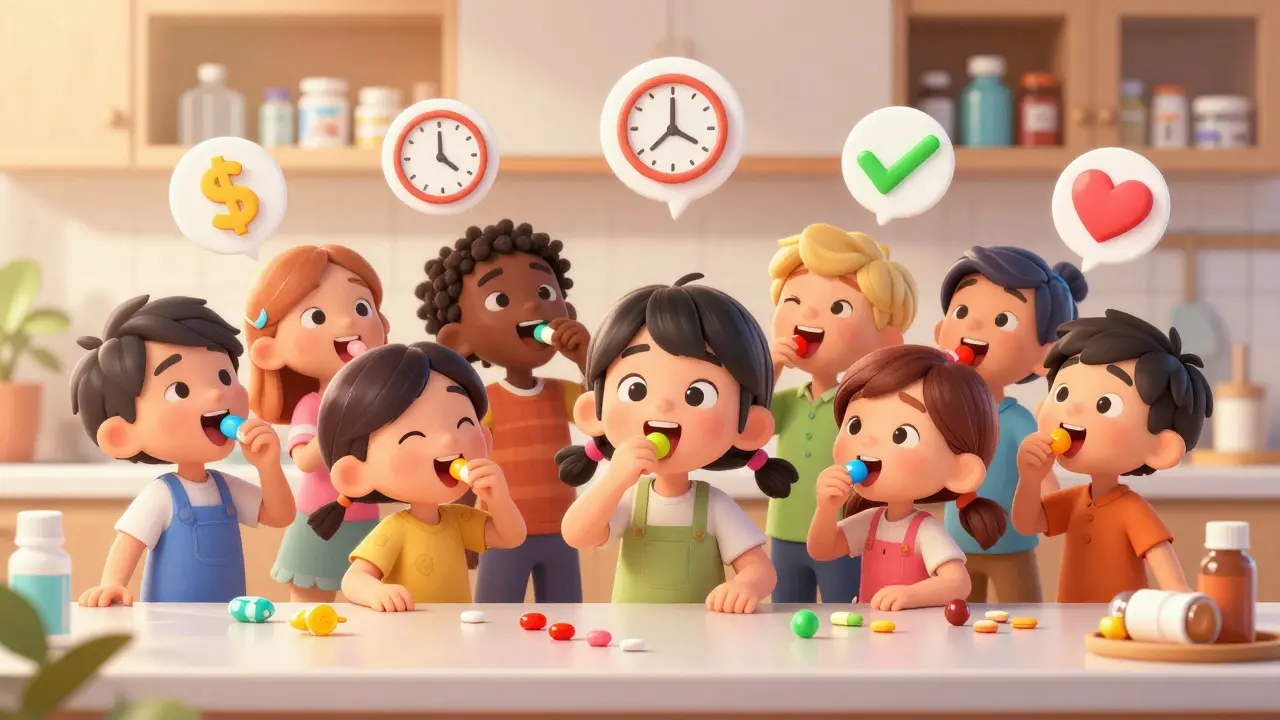
What you can do today
Here’s your action plan:
- Ask your doctor: "Is there a tablet form of this medication?" Don’t assume there isn’t.
- Check with your pharmacist: They know what formulations are available-even if the doctor doesn’t prescribe them.
- Start training: If your child is 3 or older, begin practicing with soft, edible "pills" (marshmallows, bread balls).
- Look for child-friendly options: Choose orodispersible tablets, film-coated mini-tablets, or chewables with real fruit flavors-not artificial "strawberry flavoring."
- Track adherence: If your child misses doses because of taste or mess, switch to a tablet. You’ll likely see better results.
The goal isn’t to eliminate liquids. It’s to stop using them out of habit. When the right tablet is available, it’s often safer, cheaper, and easier for everyone.
Frequently Asked Questions
Can my 2-year-old swallow a tablet?
Yes, with training. Many 2-year-olds can swallow mini-tablets (2-4mm) using the pop-bottle method. Start with practice using soft, bite-sized food like mini-marshmallows. Supervise closely and make it a game. Success rates jump to over 90% when parents use proper techniques.
Are tablets more dangerous than liquids because of choking?
No. Choking incidents with properly sized pediatric tablets are extremely rare-less than 0.002% according to FDA data from 2010-2020. The fear of choking is real, but the risk is minimal when tablets are age-appropriate and given with water. Liquids pose a higher choking risk if given too quickly or in large volumes.
Why do some liquid medicines taste so bad?
Many "flavored" liquids use artificial additives that mimic flavor but don’t taste like real fruit. Kids notice. A 2023 study found that if a "strawberry" medicine doesn’t taste like actual strawberries, refusal rates jump by 40%. Look for brands that use real fruit extracts or ask your pharmacist for alternatives.
Can I crush a tablet if my child won’t swallow it?
Only if your pharmacist or doctor says it’s safe. Many tablets are designed to release medicine slowly. Crushing them can cause dangerous spikes in drug levels or make them ineffective. Never crush capsules, extended-release pills, or enteric-coated tablets. Always ask first.
Is it cheaper to use tablets instead of liquids?
Yes, often by 25-40% per dose. Tablets don’t require preservatives, flavoring, or refrigeration. They last longer, waste less, and are easier to manufacture. One UK study found switching to tablets saved £7,842 per 10,000 pediatric prescriptions. For families, that means fewer repeat trips to the pharmacy and less medicine thrown away.
What’s next for pediatric meds?
The future is moving toward solid forms. The FDA and WHO are pushing for more age-appropriate tablets. New micro-tablets, as small as 1mm, are being tested-these can be sprinkled on food or swallowed whole. By 2030, experts predict solid forms will make up 55-60% of pediatric prescriptions, up from just 35% today.
But change doesn’t happen overnight. It starts with one question: "Is there a tablet version?" And one decision: "Let’s try training my child to swallow it."
For most kids, the answer isn’t liquid. It’s not even a choice. It’s the better option.
Harriot Rockey
February 3, 2026 AT 15:13Alec Stewart Stewart
February 5, 2026 AT 14:02Joy Johnston
February 7, 2026 AT 13:09Lorena Druetta
February 8, 2026 AT 15:36Nathan King
February 9, 2026 AT 07:50Justin Fauth
February 9, 2026 AT 18:19Shelby Price
February 10, 2026 AT 12:22Zachary French
February 10, 2026 AT 14:13pradnya paramita
February 12, 2026 AT 06:07Mandy Vodak-Marotta
February 12, 2026 AT 09:23Daz Leonheart
February 14, 2026 AT 05:32Jhoantan Moreira
February 14, 2026 AT 15:52Daz Leonheart
February 16, 2026 AT 05:17