

Switching from a brand-name drug to a generic version can save you hundreds of dollars a year. But if you’ve ever felt off after the switch-more nausea, worse sleep, or just a general sense that something’s not right-you’re not imagining it. The active ingredient is the same. So why does it feel different?
What are inactive ingredients, really?
Inactive ingredients, also called excipients, are the non-drug parts of your pill or capsule. They don’t treat your condition. But they do a lot of important work behind the scenes. Think of them like the frame, padding, and packaging of a sofa. The cushioning is what makes it comfortable to sit on, even though it’s not the seat itself.
These ingredients help the medicine hold its shape, dissolve at the right time, taste better, or last longer on the shelf. Common ones include:
- Fillers: Lactose, microcrystalline cellulose, or starch-used to make pills the right size when the active ingredient is just a tiny amount.
- Binders: Povidone or hydroxypropyl methylcellulose-hold everything together so the pill doesn’t crumble.
- Disintegrants: Croscarmellose sodium or sodium starch glycolate-help the pill break apart in your stomach so the drug can be absorbed.
- Coatings: Hydroxypropyl methylcellulose or polyethylene glycol-make pills easier to swallow or control how fast the drug releases.
- Preservatives and dyes: Sodium benzoate, parabens, or FD&C red #40-keep the medicine stable or make it visually distinct.
The FDA requires all these ingredients to be safe for most people. But "safe for most" doesn’t mean safe for everyone.
Why your body might react differently
Generic drugs must contain the same active ingredient in the same amount as the brand-name version. That part is tightly controlled. But the FDA allows manufacturers to use different inactive ingredients. And that’s where things get personal.
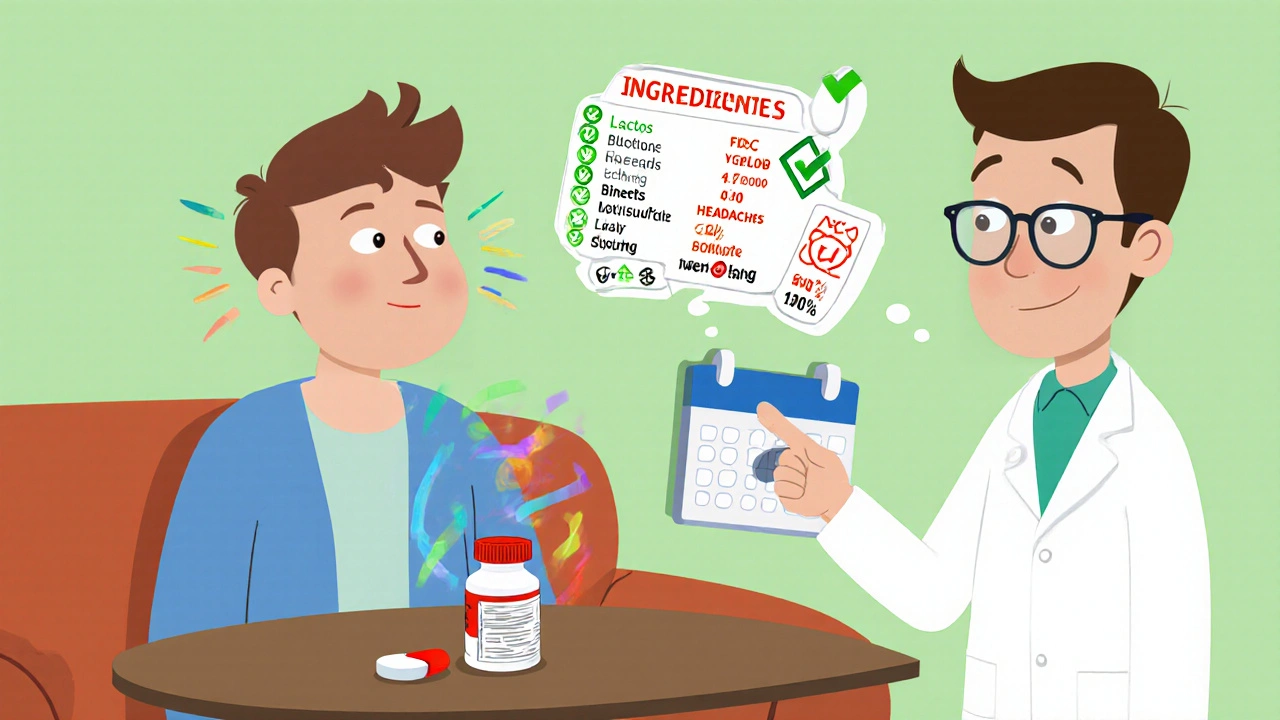
Take lactose. About 40% of all oral medications contain it. That’s fine for most people. But if you’re lactose intolerant-about 36% of Americans are-you might get bloating, gas, or diarrhea after switching to a generic version that uses lactose as a filler. Your brand-name pill might have used starch instead. Same drug. Different filler. Different symptoms.
Same goes for dyes. Some people report headaches or mood changes after switching to a generic with red or yellow dye. One patient on Reddit described her depression symptoms worsening after switching to a generic sertraline with FD&C yellow #6. Her doctor checked her blood levels-they were fine. But the dye was triggering her sensitivity.
And then there’s sulfites. Found in about 5% of injectables and liquid meds, they can trigger asthma attacks in sensitive people. If your generic asthma inhaler or liquid antibiotic suddenly makes your breathing worse, check the ingredient list. It might have added sodium metabisulfite. Your brand version didn’t.
When differences actually matter
For most drugs-like blood pressure pills, antibiotics, or antidepressants-the variation in inactive ingredients doesn’t change how well the drug works. A 2021 study of 2,000 patients switching from brand to generic found that 94.7% saw no difference at all.
But there are exceptions. For drugs with a narrow therapeutic index-where the difference between a helpful dose and a dangerous one is tiny-even small changes in how the drug is absorbed can cause problems. These include:
- Levothyroxine (for thyroid conditions)
- Warfarin (a blood thinner)
- Digoxin (for heart failure)
- Phenytoin (for seizures)
Patients on these drugs have reported changes in lab results after switching generics. One thyroid patient on PatientsLikeMe saw her TSH levels jump from 2.1 to 7.8 after switching to a generic levothyroxine. She felt exhausted, gained weight, and her doctor had to switch her back. Her blood levels were normal on the brand version. The generic? Same active ingredient. Different fillers. Slower absorption.
That’s why doctors often recommend staying on the same generic brand once you’ve found one that works. Not because generics are unsafe-but because consistency matters when your body is finely tuned.
How to protect yourself
You don’t need to avoid generics. They’re safe, effective, and save billions in healthcare costs every year. But you do need to be smart about switching.
Here’s what to do:
- Ask for the ingredient list. Pharmacists can print it out. Look for lactose, dyes, sulfites, aspartame, or soya lecithin if you know you’re sensitive.
- Don’t switch back and forth. If you’re on a generic and feel fine, stick with it. Switching between different generic brands can introduce new ingredients each time.
- Keep a symptom journal. For 2 to 4 weeks after switching, note any changes in how you feel-sleep, digestion, energy, mood, or side effects.
- Speak up if something’s off. Don’t assume it’s "just in your head." Your symptoms are real. Bring your journal to your doctor. Ask: "Could this be the filler?"
- Ask about authorized generics. These are made by the original brand company but sold under a generic label. They have the exact same inactive ingredients as the brand-name version. They’re cheaper than the brand, but often more expensive than regular generics.
What’s changing in the industry
The FDA is starting to take inactive ingredients more seriously. In 2023, they released draft guidance requiring stricter testing for generics of high-risk drugs like levothyroxine and warfarin. They’re also expanding their Inactive Ingredient Database, which will be fully public by early 2024. That means you’ll be able to look up any drug and see every single excipient used.
Some manufacturers are already responding. A growing number of generics now offer "allergen-free" versions-no lactose, no dyes, no sulfites. These are still rare, but they’re coming. By 2025, experts predict 70% of major generic drugs will have at least one allergen-free option.
And in 2023, a new law required clearer labeling of common allergens on prescription labels. That means your pill bottle might soon say: "Contains lactose" or "May contain soy"-just like food packaging.
Bottom line: Generics are still your best bet
For 9 out of 10 people, switching to a generic saves money with zero downside. The science backs it. The data confirms it. But for the 1 to 2% who notice a real difference, it’s not a myth. It’s chemistry. And it’s personal.
If you’ve had a bad experience, you’re not alone. And you’re not wrong. The system isn’t broken-it’s just complex. Your job isn’t to avoid generics. It’s to know how to use them wisely. Check the label. Track your symptoms. Talk to your pharmacist. And if something doesn’t feel right? Don’t ignore it. Your body is telling you something.
Are generic medications less effective than brand-name drugs?
No. Generics must meet the same FDA standards for strength, purity, and effectiveness as brand-name drugs. The active ingredient is identical, and bioequivalence testing ensures it works the same way in your body. For over 90% of patients, there’s no difference in how well the drug works.
Why do generic pills look different from brand-name ones?
Trademark laws require generic drugs to look different from the brand-name version. That means different colors, shapes, or markings. But appearance has nothing to do with effectiveness. It’s just a legal requirement to avoid confusion.
Can inactive ingredients cause side effects?
Yes, but rarely. For most people, inactive ingredients are harmless. But if you have allergies or sensitivities-like lactose intolerance, sulfite sensitivity, or dye reactions-you might experience bloating, nausea, headaches, or skin rashes. These aren’t side effects of the drug itself, but of the filler or coating.
Should I avoid generics if I have allergies?
Not necessarily. Many generics are made without common allergens like lactose or dyes. Always check the ingredient list. If you’re unsure, ask your pharmacist. They can tell you which generic version has the safest ingredients for you. Some even offer allergen-free options.
What should I do if I feel worse after switching to a generic?
Don’t stop taking the medication abruptly. Contact your doctor or pharmacist. Bring the pill bottle and note any new symptoms. Ask them to check the inactive ingredients. You may need to switch to a different generic brand or go back to the brand-name version. Your health matters more than the cost.
Are there generics without lactose or dyes?
Yes. More manufacturers are producing "clean label" generics with no lactose, no artificial dyes, and no common allergens. These are often labeled as "lactose-free" or "dye-free." Ask your pharmacist for these options-they’re becoming more widely available.
Peter Axelberg
December 1, 2025 AT 08:11Look, I get that generics save money, but I switched to a generic levothyroxine last year and went from feeling like a human to feeling like a zombie who forgot how to breathe. My TSH jumped, my energy crashed, and my doctor just shrugged and said, 'It's the same drug.' No, it's not. The fillers are different, and my body isn't dumb. I had to go back to the brand, and yeah, it cost me $180 a month instead of $12-but I can actually get out of bed now. If you're telling me my symptoms are 'in my head,' you've never had to live with a thyroid that won't cooperate.
Monica Lindsey
December 2, 2025 AT 08:25Of course you feel worse. You didn't read the label. You're not special. Just stop being dramatic.
linda wood
December 3, 2025 AT 05:45Monica, you're the reason people don't trust doctors. Some of us aren't 'dramatic'-we're just not dying to save $10 a month at the cost of our mental health. Ever think maybe your 'stop being dramatic' line is the real problem here?
gerardo beaudoin
December 3, 2025 AT 11:27My mom switched to a generic sertraline and started having panic attacks every night. She didn't even realize it was the dye until she checked the bottle. Yellow #6. Turns out she's had a mild sensitivity since childhood. We called the pharmacy, they gave her a lactose-free, dye-free version for the same price. No drama. Just smart choices. If you're gonna switch, at least ask for the ingredient sheet. It's right there on the label.
Sullivan Lauer
December 4, 2025 AT 03:17I used to think this was all in people's heads until my sister, who's been on warfarin for 12 years, had a near-stroke after switching generics. Her INR went from 2.4 to 4.9 in two weeks. They didn't change the active ingredient. They changed the filler. The pill looked different. The pill tasted different. And somehow, her blood stopped clotting properly. She was in the ER. They had to switch her back. This isn't conspiracy theory. This is pharmacology. If your drug has a narrow therapeutic window, don't gamble with fillers. Your life isn't a cost-cutting experiment.
Latika Gupta
December 4, 2025 AT 09:01My aunt in Mumbai takes a generic for hypertension and she says it makes her dizzy. She switched back and forth three times. Each time, the pill looked different. She stopped trusting all generics. Now she pays extra for the brand. She says, 'Better to pay than to feel like I'm floating.' I get it. Sometimes, peace of mind costs more than the pill.
Brandy Johnson
December 5, 2025 AT 03:19As a regulatory analyst with over 15 years in pharmaceutical compliance, I must emphasize: the FDA's bioequivalence standards are statistically robust and clinically validated. The notion that excipients cause clinically significant variation in 94.7% of cases is not supported by peer-reviewed evidence. While rare hypersensitivities exist, they are not a justification for abandoning generics, which are the cornerstone of affordable healthcare in the United States. Personal anecdotes do not constitute population-level data.
Joy Aniekwe
December 5, 2025 AT 20:47Oh please. You're a 'regulatory analyst'? So you've never met someone who actually had to go to the ER because their generic made them sick? You're the reason people roll their eyes at 'experts.' I know someone who lost 15 pounds and couldn't sleep for a month because of lactose in her generic antidepressant. You think she's lying? You think she's just 'dramatic'? You're the problem, Brandy. Not the patients.
jamie sigler
December 7, 2025 AT 02:56I don't even care anymore. I just take whatever the pharmacy gives me. If I feel weird, I blame the weather. Or my cat. Or my ex. Whatever. It's easier than fighting with doctors and pharmacists who don't listen. I'm just tired.
Peter Lubem Ause
December 9, 2025 AT 00:27Let me tell you something from Nigeria: we don’t have the luxury of choosing brand-name drugs. But even here, pharmacists are starting to keep logs of which generic brands cause reactions in patients-especially for epilepsy and TB meds. One pharmacy in Lagos now keeps a whiteboard: 'Avoid this batch-caused tremors in 3 patients.' That’s not conspiracy. That’s community wisdom. We don’t need fancy databases-we need pharmacists who care enough to track this stuff. And yes, some generics are better than others. The key is consistency. Stick with one that works. Don’t gamble. Your body remembers.
Sohini Majumder
December 10, 2025 AT 12:00OMG I JUST REALIZED MY GENERIC ZOLOFT HAS YELLOW DYE?? I THOUGHT I WAS JUST DEPRESSED AGAIN?? I'M SO SAD I'M SO SAD I'M SO SAD I'M SO SAD!!!