

Taking the wrong pill or the wrong dose might seem like a rare mistake, but it's a dangerous reality. In the U.S. alone, medication errors cause between 7,000 and 9,000 deaths every year. For most of us, the mistake isn't that we forgot to take our medicine; it's that we stopped looking at the label because we thought we knew what was in the bottle. Over-reliance on memory is a trap. In fact, experts warn that memory-based checking fails about 83% of patients within just two weeks if they don't have a structured system.
The good news is that you can actually train your brain to treat label checking like brushing your teeth-something you do without thinking. By moving from "trying to remember" to a behavioral ritual, you can reduce your personal risk of a medication error by up to 76%. Whether you're managing a single prescription or a complex regimen of five or more drugs, the goal is to build a physical and mental trigger that makes verification mandatory before the pill ever touches your tongue.
The Core Elements of a Safe Label Check
To train yourself, you first need to know exactly what you're looking for. You aren't just glancing at the bottle; you're verifying specific data points. According to safety research, a complete check involves ten essential elements. While you don't need to spend minutes on this, a focused 3-to-5 second scan of these details is the gold standard for safety.
When you pick up your bottle, look for these specifics:
- Patient Name: Does it match your name exactly?
- Drug Name: Check both the brand name and the generic version.
- Prescriber: Is this from the doctor who actually ordered this specific med?
- Dosage/Strength: Look at the milligrams (mg) or units. Is it the correct strength for this time of day?
- Quantity & Refills: How many are left? Do you need a refill soon?
- Warnings: Are there notes about food interactions or avoiding alcohol?
- Fill Date: Was this filled within the last 30 days?
- Expiration Date: Is the medicine still potent and safe to use?
- Pharmacy Info: Do you have the number to call if something looks wrong?
- Instructions: Exactly how and when should this be taken?
To make this easier, ensure you are in a well-lit area. FDA is the U.S. federal agency responsible for protecting public health by ensuring the safety and efficacy of medications. They recommend a minimum of 500 lux of lighting-basically, a bright room or a desk lamp-to avoid misreading labels, especially for those of us whose eyesight isn't what it used to be.
Building the "Label Check Ritual"
Willpower is a weak tool for safety. Instead, use behavioral conditioning. The key is to attach the new habit (checking the label) to an existing one (like pouring your morning coffee). If you place your medication bottles directly in the path of your daily routine, you can reduce missed checks by over 50%.
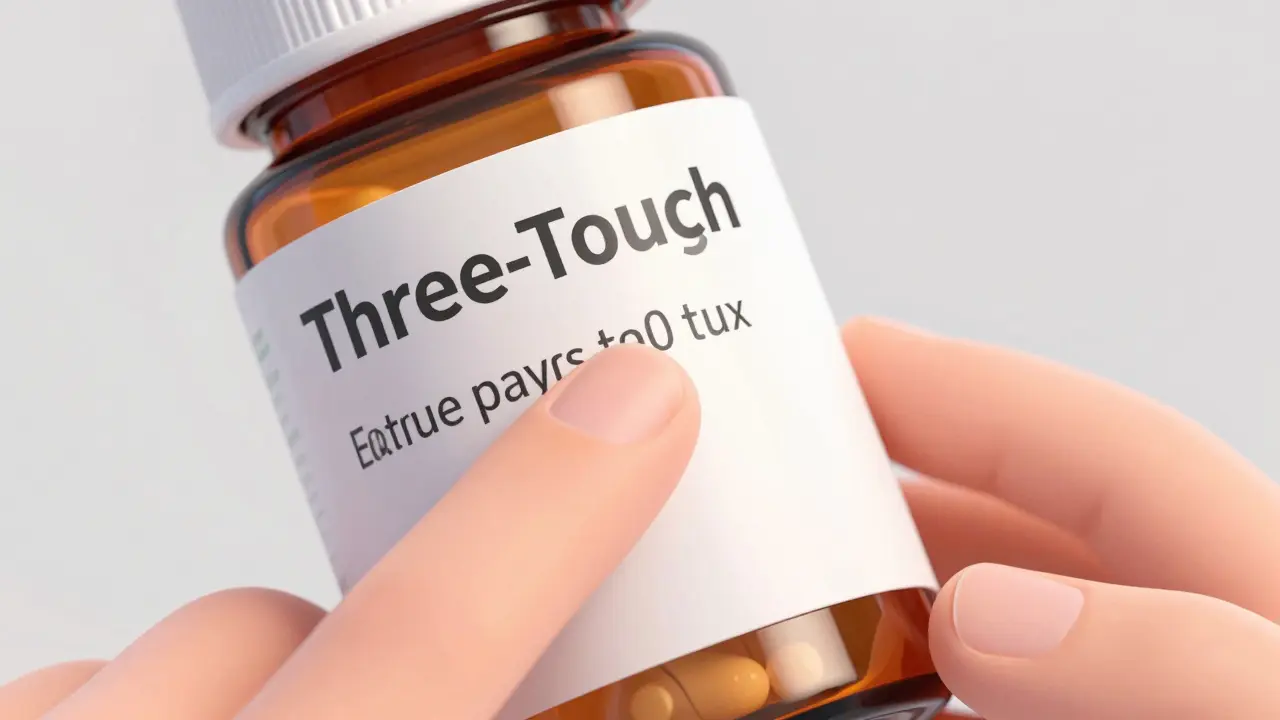
One of the most effective ways to automate this is through the Three-Touch Method. Instead of just looking, you physically engage with the label. This shifts the task from a passive glance to an active verification. Try this sequence:
- Touch the name on the label and say aloud: "This is [Your Name]."
- Touch the drug name and say: "This is for [Your Condition]."
- Touch the dosage and say: "I am taking [Dose] [Times per Day]."
Why speak out loud? Clinical trials show that verbalizing the information increases adherence to 92% after a month, compared to only 64% for those who check silently. It forces your brain to process the information rather than skimming over it.
| Method | Error Reduction Rate | Best For... |
|---|---|---|
| Label Checking (Every Dose) | 76% | Polypharmacy (5+ meds), Chronic Conditions |
| Pill Organizers (Alone) | 42% | Simple daily routines, Low-risk meds |
| Medication Apps (No Verification) | 29% | General reminders, Young adults |
Overcoming Common Obstacles
Most people fail at label checking not because they are lazy, but because of "friction." Common frictions include rushed mornings, tiny fonts, and cognitive overload. If you find yourself skipping the check because you're in a hurry, you need to change your environment, not your mindset.
For those struggling with readability, don't struggle through it. The latest 2025 labeling standards require high-contrast colors and sans-serif fonts, but that might still be too small. Using a magnifying label tool can reduce errors by nearly 38% for people with vision impairment. Additionally, if you manage multiple medications that look similar, use a color-coded system. Many pharmacists recommend adding a colored sticker to the cap of the bottle to provide an immediate visual cue before you even read the text.
If you have a caregiver or partner, use the "teach-back method." Every few days, explain the label's instructions to them. By teaching the information to someone else, you reinforce the knowledge in your own mind and ensure you haven't misinterpreted a confusing abbreviation.

The Path to Automation
How long does it take before this becomes automatic? For most adults, it takes between 18 and 22 repetitions. This means if you strictly follow the Three-Touch Method for three weeks, the behavior will likely move from your conscious effort to your subconscious routine.
If you prefer tech-based help, look for apps that require a mandatory verification step. Basic reminder apps that just ping you are far less effective. The most successful apps require you to photograph the label or check a box confirming you've read the dose before you can log the medication. These types of apps have significantly higher long-term retention because they force the habit of verification.
Remember, the goal is to make the label the final authority. No matter how many times you've taken the pill, the bottle is the only source of truth. By implementing a physical ritual and optimizing your environment, you turn a chore into a life-saving habit.
What if I'm taking a medication for a long time; do I still need to check every time?
Yes. Most errors happen not when a medication is new, but when it becomes routine. This is known as "automaticity," where you stop paying attention and rely on memory. A pharmacy could accidentally swap a bottle, or a doctor could change a dose without you noticing the updated label. Checking every single time is the only way to catch these errors.
How do I handle medications with very confusing names?
If you have "look-alike, sound-alike" medications, the best strategy is to use high-contrast visual cues. Use a bold color-coded sticker on the cap or a large-print custom label. Always verify both the brand and generic names to ensure there is no confusion between two different drugs that might look similar on the bottle.
Can I just use a pill organizer instead of checking labels?
Pill organizers are great for organization, but they aren't a substitute for label checking. The error often happens during the filling of the organizer. If you put the wrong pill in the Monday slot, the organizer actually hides the mistake. You should check the label while filling the organizer and then perform a quick verification check before taking the dose from the organizer.
What are the 2025 FDA labeling standards?
The 2025 standards focus on readability and patient safety. They mandate single-page labels with a minimum 6-point sans-serif font for core info and 8-point for warnings. They also require high-visibility verification zones and a minimum 70% color contrast ratio to help patients with vision impairment more easily identify critical dosing information.
I have a very rushed morning routine. How can I possibly fit this in?
The trick is to stop trying to "fit it in" and instead make it the trigger for your routine. Place your medications next to your coffee maker or your toothbrush. Use the Three-Touch Method, which only takes 3-5 seconds. By tying the check to a physical object you already use, it becomes a seamless part of your morning rather than an extra task.
Danny Wilks
April 9, 2026 AT 16:05It's quite fascinating how the Three-Touch Method mirrors certain mindfulness practices where physical engagement anchors the mind to the present moment, ensuring that we don't simply drift into a state of automaticity while performing tasks that are fundamentally critical to our survival, though I personally find the idea of speaking aloud to myself in the morning a bit eccentric.