

Missing a pill here and there might seem harmless, but when it becomes a pattern, it can land you back in the hospital. About half of people with chronic conditions don’t take their meds as prescribed. That’s not laziness-it’s forgetfulness, confusion, cost, or side effects. The result? $300 billion wasted each year in the U.S. on avoidable hospital visits, ER trips, and worsening illnesses. The good news? You can fix this-with simple lists, handwritten logs, or smart tech that actually works.
Why Tracking Medication Adherence Matters
It’s not just about taking pills. It’s about keeping your body stable. If you have high blood pressure, diabetes, or heart failure, skipping doses lets your condition creep back. One missed dose of a blood thinner might not cause a clot. But 10 missed doses over a month? That’s a real risk. Studies show patients who track their meds reduce hospital readmissions by up to 23%. That’s not magic-it’s data.
Doctors can’t read your mind. They rely on what you tell them. But here’s the problem: people think they’re taking their meds correctly. Surveys say 80% of patients are “adherent.” Electronic monitors say only 45% actually are. That gap? It’s dangerous.
Traditional Methods: Paper Lists and Logs
Before apps and smart pillboxes, people used paper. A simple list of meds, times, and doses. A daily log next to the kitchen sink. You check off each pill you take. Sounds basic? It works-for some.
Here’s how to make it effective:
- Write down every medication: name, dose, time, reason (e.g., “Lisinopril 10mg, morning, for blood pressure”).
- Use a printed calendar or a notebook with clear daily boxes.
- Sign or initial each line after taking the pill.
- Bring it to every doctor visit.
It’s cheap. It’s low-tech. But it has big flaws. People forget to write. They fake entries to please their doctor. One study found 42% of patients lied on paper logs. Others just lose them. And if you’re taking 8 pills a day across 3 times a day? That’s 24 boxes to fill in. It gets messy fast.
Electronic Monitoring: The Real Game-Changer
Since the 1990s, electronic systems have been proving what paper can’t: accuracy. The most trusted system? MEMS (Medication Event Monitoring System). It’s a cap with a tiny chip that records every time you open your pill bottle. No guessing. No lying. Just data. It’s 97% accurate-verified in over 1,000 clinical trials.
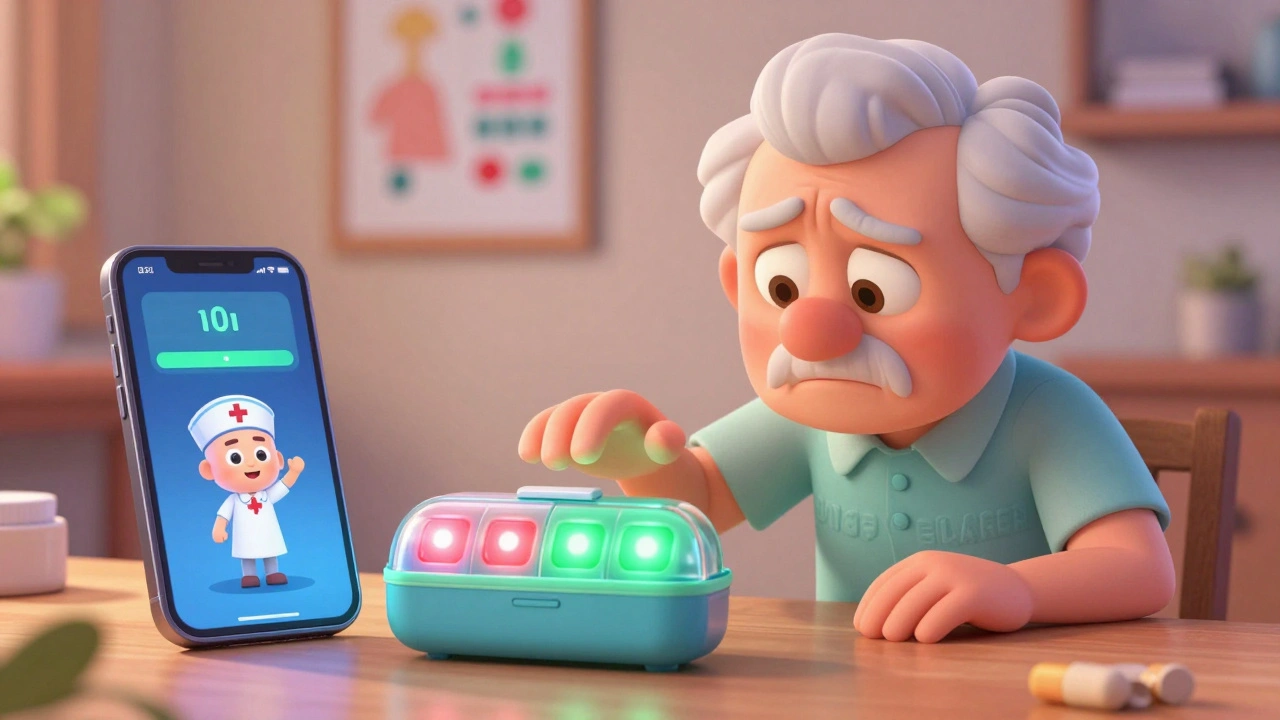
Today, you don’t need a clinical trial to use this tech. Companies like Tenovi make pillboxes with built-in sensors, LED lights, and cellular connections. When you miss a dose, the box flashes red. If you take it, you press a button. Green light. The system sends a report to your doctor’s dashboard in real time.
How does that help you? Say you’re supposed to take your diuretic at 8 a.m. You forget. By 11 a.m., your phone buzzes: “You missed your dose.” Your pharmacist sees it too. They call you. You take it. Your blood pressure stays stable. No ER visit. That’s the power of real-time tracking.
Advanced Systems: More Than Just a Box
Not all digital tools are the same. Here are the three main types you’ll see:
- IoT Pillboxes (like Tenovi): Track bottle openings. Send alerts. Use lights and sounds. Best for daily meds. Costs $50-$150.
- RFID Dispensers (like ReX): These open automatically at the right time and release the exact dose. You don’t even touch the pill. Accuracy? 99.2%. Used in nursing homes and for complex regimens.
- Video Directly Observed Therapy (VDOT): You take your pill in front of a camera during a video call. Used for TB or psychiatric meds. 98.5% accurate-but takes 17 minutes per dose. Not practical for daily use.
One system doesn’t fit all. If you’re sharp and tech-savvy, a pillbox with alerts is perfect. If you have dementia or severe memory issues, a dispenser that gives you the pill automatically is safer. If you’re on a high-risk medication like anticoagulants or psychiatric drugs, VDOT might be recommended.
Who Uses These Tools? And Who Doesn’t?
Technology helps-but only if you can use it. A 2023 study found 92% of patients under 55 with private insurance adopted digital trackers. But only 47% of Medicare patients over 75 did. Why? Too many buttons. Confusing apps. No Wi-Fi at home. Poor eyesight.
That’s why the best systems are simple. Tenovi’s pillbox has three buttons: one to open, one to confirm, one to silence. No passwords. No app downloads. Just lights. That’s why it’s used by over 400 healthcare systems.
But here’s the catch: even the best tech can’t tell if you swallowed the pill. It only knows you opened the bottle. That’s a 12% error rate. Someone could pour the pill into the sink and still log it as taken. That’s why the newest systems-like Medisafe Predict+-use AI to spot patterns. If you always open the bottle at 10 p.m. but never at 8 a.m., it flags you as “at risk.” That’s proactive help, not just tracking.
How to Start Tracking Today
You don’t need to buy a smart box tomorrow. Start here:
- Make a list. Write down every pill you take, when, and why. Use a phone note or paper. Keep it in your wallet.
- Use a daily log. Print a free template online or use a calendar app with reminders. Set alarms for each dose.
- Ask your pharmacist. Many offer free pill organizers with time slots. Some even have apps linked to their system.
- Ask your doctor. If you’re on chronic meds, say: “I want to track my adherence. Do you use any digital tools?”
- Try a low-cost tracker. Tenovi, Medisafe, or MyTherapy apps are free. Test them for two weeks. See if they fit your life.
If you’re on Medicare, ask if your plan covers Remote Therapeutic Monitoring (RTM). Since 2024, CMS pays providers for tracking adherence using approved devices. That means your doctor might give you a pillbox for free.

What to Avoid
Don’t rely on memory. Don’t assume your doctor knows your habits. Don’t wait until you feel worse to start tracking.
Also avoid apps that require too much typing. If you have to log 10 pills every day by typing their names, you won’t stick with it. Look for systems that auto-sync with your prescription list.
And don’t ignore the human factor. Tech helps-but a phone call from a nurse who says, “I saw you missed your dose. Are you okay?” can change everything.
The Future: Wearables That Know Your Body
Next up? Devices that don’t just track if you took the pill-but if it worked. Imagine a smartwatch that detects changes in your heart rate or blood sugar after you take your medication. If your glucose drops 30 minutes after your insulin, the system knows you took it-and it worked. That’s the future. Companies are already testing this. By 2026, we’ll see wearables that link medication intake to real-time biological feedback.
But until then? Start simple. Track. Log. Tell your doctor. Use the tools that fit your life. Your body will thank you.
What’s the most accurate way to track medication adherence?
The most accurate method is electronic monitoring like MEMS (Medication Event Monitoring System), which uses smart caps to record every time a pill bottle is opened. It’s 97% accurate, validated in clinical studies. For daily use, IoT pillboxes like Tenovi are highly accurate and practical, sending real-time data to your care team.
Can I use a regular pill organizer to track adherence?
A regular pill organizer helps you remember doses but doesn’t track whether you actually took them. It’s useful for organization, not accountability. To track adherence, you need a system that logs your actions-like a smart box with sensors or an app that requires you to confirm each dose.
Are medication logs still useful today?
Yes-but only if used honestly and consistently. Paper logs are better than nothing and help you notice patterns. But studies show they’re only 27% accurate because people forget or fake entries. Use them as a backup, not your main tool.
Do insurance plans pay for medication adherence tools?
Yes, especially under Medicare Advantage and newer CMS rules. Since 2024, CPT codes 98980-98981 allow reimbursement for Remote Therapeutic Monitoring, which includes medication adherence tracking. Ask your doctor or pharmacist if your plan covers a free or discounted device.
What if I can’t use technology?
You don’t need tech to be adherent. Use a printed medication list and a daily calendar. Set alarms on a basic phone. Ask a family member to check in. Some pharmacies offer weekly phone calls to remind you. The goal isn’t the tool-it’s consistency. Find the method that works for your life.
How do I know if I’m truly adherent?
If you’re using a digital tracker, it will show you your exact adherence rate-like 89% over 30 days. If you’re using paper, review your log weekly. Did you miss more than two doses? Talk to your doctor. Adherence below 80% increases your risk of complications. Don’t wait for a crisis to find out.
Next Steps: What to Do Right Now
Don’t wait. Start today:
- Write down every medication you take-name, dose, time.
- Set phone alarms for each dose.
- Download a free app like MyTherapy or Medisafe and try it for 7 days.
- Ask your pharmacist if they offer a free pill organizer with reminders.
- If you’re on chronic meds, ask your doctor: “Do you use digital adherence tools?”
Medication adherence isn’t about perfection. It’s about progress. One less missed dose this week. One more day logged. One more conversation with your care team. That’s how you take control.
Constantine Vigderman
December 13, 2025 AT 03:37Also, my pharmacist gave me a free pillbox with lights. It's like a little robot friend telling me to be good.
Webster Bull
December 13, 2025 AT 15:43Scott Butler
December 14, 2025 AT 01:20Michael Gardner
December 15, 2025 AT 18:25Tyrone Marshall
December 15, 2025 AT 21:37kevin moranga
December 16, 2025 AT 09:38Also, my nurse called me last week because I skipped a dose. She didn’t yell. She just asked if I was okay. That made me cry. Not because I was guilty-but because someone cared enough to check.
That’s the magic. Tech shows the gap. But humans fill it. Don’t forget that.
And yeah, I still use paper as backup. I write it on a sticky note next to my coffee maker. Every morning. Even if I don’t need to. It’s my ritual now.
Also, I told my sister about this and she got her mom a Tenovi. Mom’s 81, hates tech, but loves the green light. She says it’s like her pills are cheering for her.
It’s not about the device. It’s about the feeling that someone’s watching out for you. Even if it’s a robot.
And if you think this is overkill? Try missing a dose when you’ve got a stent. Then come back and tell me tech is unnecessary.
Also, I just got my RTM benefit approved through Medicare Advantage. Free box. No strings. Just lights and love.
Don’t wait for a hospital trip to start caring. Start today. Your future self will high-five you.
Alvin Montanez
December 18, 2025 AT 07:02Richard Ayres
December 20, 2025 AT 03:59Furthermore, the accessibility gap between younger, tech-literate users and older populations remains a critical equity issue. Design must prioritize simplicity, not sophistication.
And while AI pattern detection is promising, it must be paired with human empathy. A notification is useful. A call from a nurse who says, 'I noticed you missed your dose-how are you holding up?' is healing.
Sheldon Bird
December 21, 2025 AT 18:55Karen Mccullouch
December 22, 2025 AT 16:03Jennifer Taylor
December 23, 2025 AT 06:47Shelby Ume
December 25, 2025 AT 04:14For the tech-savvy: app + alerts.
For the elderly: pillbox with big lights.
For the paranoid: paper + weekly call from a nurse.
One size does not fit all. But one principle does: consistency over perfection.
Jade Hovet
December 26, 2025 AT 05:55