
Medication Disposal Checker
What's the safest way to dispose of your medication?
Enter your medication details and location to get specific disposal instructions.
Every year, millions of unused or expired pills sit in medicine cabinets across the U.S. - not because people are hoarding them, but because they don’t know what to do with them. You might think tossing them in the trash or flushing them down the toilet is harmless. But it’s not. Improper disposal contributes to drug abuse, accidental poisonings, and even water contamination. The FDA has clear, science-backed rules for this - and they’re not optional. Here’s how to get it right.
What the FDA Says: Take-Back Is the Only Real Solution
The FDA’s top recommendation for disposing of almost every medication is simple: use a drug take-back program. Not the trash. Not the toilet. Not the backyard. Take-back. That’s because these programs are designed to safely collect, transport, and destroy medications so they can’t be misused or leak into the environment.
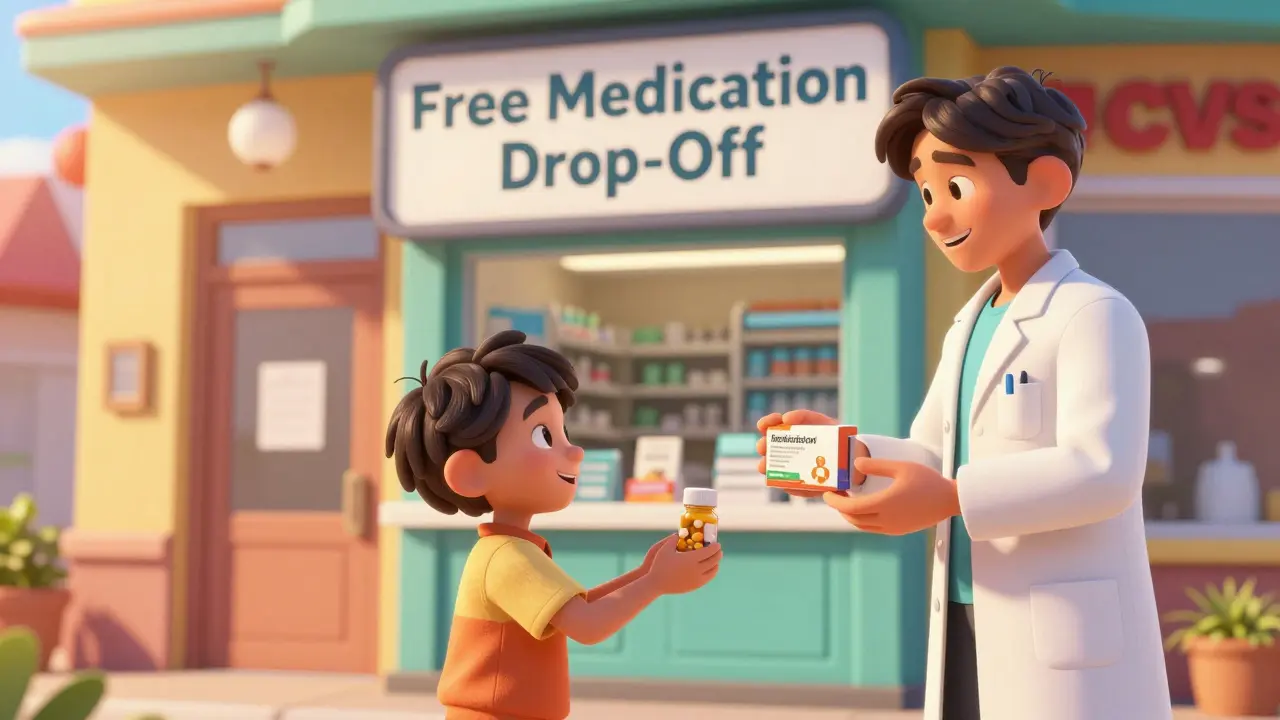
As of January 2025, there are over 14,352 DEA-authorized collection sites across the U.S. - mostly in pharmacies like CVS, Walgreens, Walmart, and local clinics. These aren’t one-day events anymore. Most are permanent kiosks you can drop off meds anytime. In fact, 68% of U.S. counties now have at least one. That means unless you live in a remote area, there’s probably one within 15 miles.
Why does this matter? Because take-back programs have a 99.8% success rate in preventing misuse and environmental harm, according to the DEA’s 2024 report. Compare that to home disposal methods, which fail in over 12% of cases - mostly because people mix meds wrong or don’t seal containers tightly enough.
The Flush List: Only 13 Medications Are Allowed
There’s one exception to the no-flushing rule. The FDA maintains a Flush List - a short list of 13 high-risk medications that can be flushed only if no take-back option is nearby. These are drugs that are extremely dangerous if accidentally ingested, especially by children or pets. Most are opioids like fentanyl, oxycodone, and hydrocodone. The list was updated in October 2024: oxymorphone was removed, and buprenorphine was added.
Flushing these specific drugs is allowed because it’s the fastest way to remove them from the home. The risk of overdose from accidental exposure outweighs the environmental impact - but only if you have no other choice. The FDA defines “readily available” as a take-back location within 15 miles or a 30-minute drive. If you’re not sure, call your pharmacy. Don’t guess.
And here’s the kicker: flushing anything else - even antibiotics or blood pressure pills - is against EPA rules. Healthcare facilities face fines up to $76,719 per violation. You won’t get fined for a single pill, but you’re still polluting waterways. The U.S. Geological Survey found that flushing contributes only 0.0001% of pharmaceutical contamination - but that tiny fraction adds up across millions of households.
What to Do If There’s No Take-Back Near You
If you’re in a rural area or your nearest drop-off is 50 miles away, you have two legal options: mail-back or home disposal. Mail-back is the better choice.
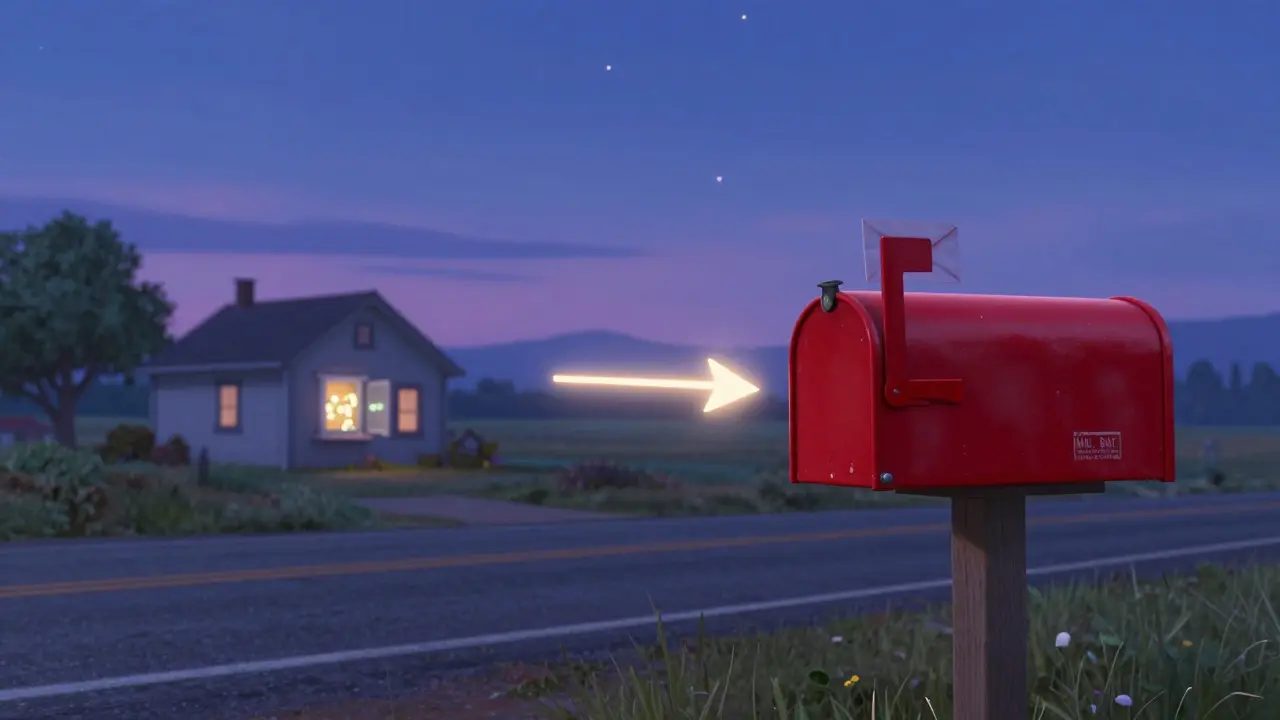
Companies like DisposeRx and Sharps Compliance offer prepaid envelopes you can order online - often for free through your pharmacy or insurer. Express Scripts, for example, gave out 287,000 free envelopes in 2024. Users reported 94.2% satisfaction. The envelopes are designed to neutralize drugs during transit and meet strict USPS standards. Cost? Between $2.15 and $4.75 if you pay out of pocket. But if your pharmacy or VA offers them free, grab them.
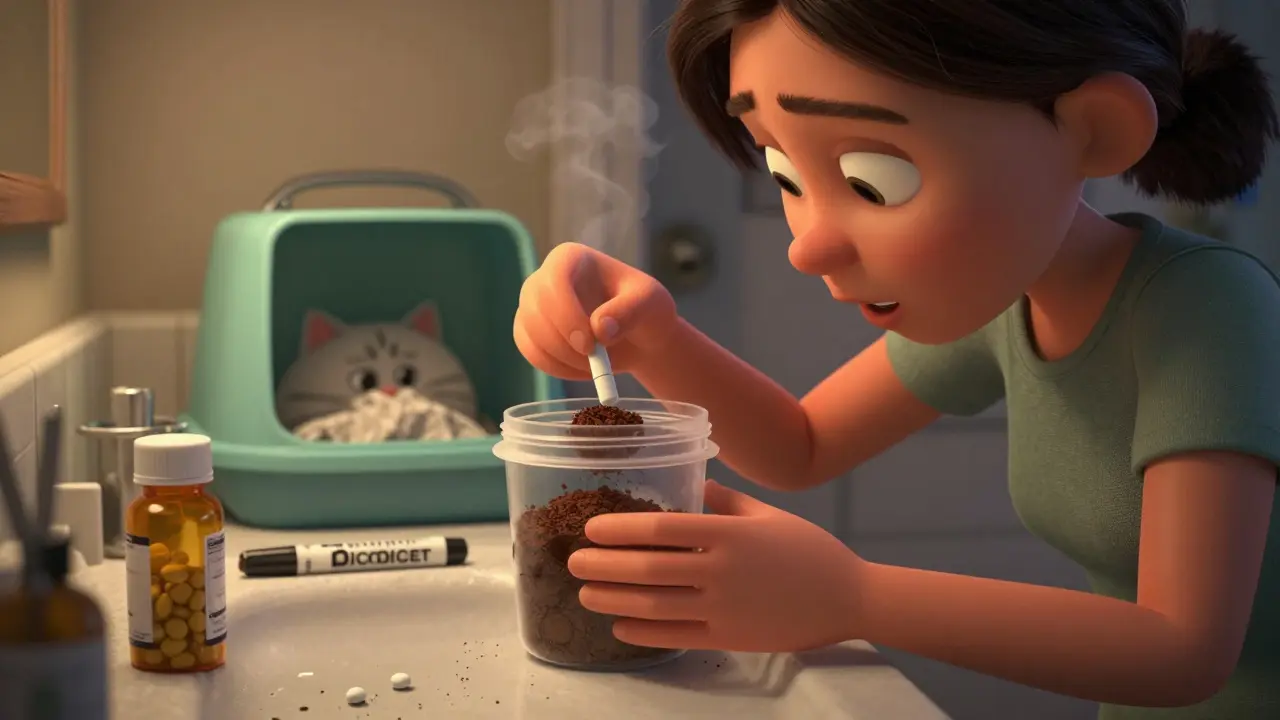
If you can’t get a mail-back envelope, then you do home disposal - but you must do it right. The FDA’s 5-step process isn’t optional:
- Remove personal info. Scratch off or cover your name, prescription number, and dosage with a permanent marker or alcohol swab. Don’t just peel the label - the barcode can still be read.
- Mix meds 1:1 with an unpalatable substance. Coffee grounds, cat litter, or dirt work best. The goal is to make the pills unappealing and unrecognizable. Coffee grounds are preferred by 78% of users because they mask the smell and texture.
- Seal it in an impermeable container. Use a plastic bag or jar with a tight lid. The FDA recommends at least 0.5mm thickness. Don’t use paper towels or flimsy containers - they leak.
- Put it in the trash. Not the recycling bin. Not the compost. Trash only.
- Recycle the empty bottle. Once it’s completely de-identified, you can recycle the plastic bottle. Many local recycling programs accept them.
One common mistake? People pour liquid medications directly into the trash. That’s a no-go. Liquids must be mixed with an absorbent material like kitty litter or sawdust first. Otherwise, they can leak and contaminate other trash or attract pests.
Why People Get It Wrong (And How to Avoid It)
A 2024 Consumer Reports survey of 1,200 households found 78% tried to dispose of meds at home - and 34% flushed something they shouldn’t have. Why? Because the instructions are confusing. Pharmacy leaflets are only 72% accurate. FDA.gov? 94% accurate.
Another issue: people don’t know what’s on the Flush List. A 2024 FDA usability study showed 67.2% of users needed help from a pharmacist to identify which meds could be flushed. That’s why it’s smart to ask your pharmacist when you pick up a new prescription: “Is this on the flush list?”
And don’t assume “expired” means safe to keep. Many drugs lose potency after expiration, but opioids and insulin can still be deadly even years past their date. The CDC reported 70,237 drug overdose deaths in 2022. Of those, over 13,000 involved prescription opioids - many pulled from home medicine cabinets.
What’s Changing in 2025 and Beyond
The system is getting better. The DEA plans to expand take-back locations to 20,000 sites nationwide by the end of 2025. Walmart and CVS now have take-back kiosks in every U.S. pharmacy. The EPA just announced a $37.5 million grant program to help rural communities build collection sites. And the FDA’s 2025 goal? 90% of Americans using take-back programs by 2030 - up from just 35.7% today.
Meanwhile, mail-back services are getting cheaper and easier. DisposeRx, the market leader, now handles nearly half of all mail-back programs. Some insurance plans are starting to cover them as a preventive health benefit.
But progress depends on you. If you don’t use a take-back program, you’re part of the problem. If you tell your family, your neighbors, your local pharmacist - you’re part of the solution.
What to Do Right Now
Here’s your quick action plan:
- Check your medicine cabinet. Pull out anything expired, unused, or no longer needed.
- Look up the nearest DEA-authorized take-back location at DEA.gov or ask your pharmacy.
- If you can’t get there, request a free mail-back envelope from your pharmacy or insurer.
- If you must dispose at home, follow the 5-step rule exactly - no shortcuts.
- Never flush anything unless it’s on the FDA Flush List and no take-back is available.
It takes less than 10 minutes to do this right. And it could save a life - maybe even your own.
Can I flush any medication if I don’t have access to a take-back program?
Only medications on the FDA’s official Flush List - which includes 13 specific opioids like fentanyl, oxycodone, and hydrocodone - can be flushed, and only if no take-back location is within 15 miles or a 30-minute drive. Flushing anything else is not recommended and can harm water systems. Always check the label or ask your pharmacist first.
Are drug take-back programs free?
Yes. DEA-authorized take-back kiosks at pharmacies like CVS, Walgreens, and Walmart are completely free to use. You don’t need insurance, ID, or a receipt. Just drop off your unwanted meds. Mail-back envelopes are often free too, especially through VA, Medicare Part D, or major insurers like Express Scripts.
What if I have liquid medications or patches?
For liquids, mix them with an absorbent material like kitty litter, coffee grounds, or sawdust in a sealable container. For patches, fold them in half with the sticky sides together and flush them immediately if they’re on the Flush List. If not, mix them with an unpalatable substance and dispose in trash. Never throw patches in the trash whole - they can still deliver a deadly dose if someone finds them.
Is it safe to recycle empty pill bottles?
Yes - but only after you’ve completely removed or obscured all personal information. Use a permanent marker to black out your name, prescription number, and dosage. Some recycling centers accept them, others don’t. Check your local rules. If in doubt, throw the bottle in the trash after de-identifying it.
Why can’t I just throw pills in the trash without mixing them?
Unmixed pills in the trash can be found and taken by children, pets, or people looking for drugs. The FDA requires mixing with an unpalatable substance like coffee grounds or cat litter to make them unappealing and unrecognizable. This reduces the risk of accidental or intentional misuse. Simply tossing pills in the trash is unsafe and violates FDA guidelines.
Susannah Green
January 22, 2026 AT 20:23Just dropped off my expired oxycodone at the Walgreens kiosk today-no ID, no questions, no hassle. Seriously, why are people still flushing pills? It’s 2025. There’s a dropbox in every pharmacy now. Just do the thing.
Also, coffee grounds > cat litter. Less stinky, and your cat won’t judge you.
Dawson Taylor
January 24, 2026 AT 05:36The ethical imperative is clear: pharmaceutical waste, when improperly managed, constitutes a public health externality of the first order. The institutional infrastructure now exists to externalize this burden from the individual to the system. Compliance is not merely advisable-it is a civic duty.
charley lopez
January 24, 2026 AT 16:42Per DEA guidelines, the pharmacokinetic integrity of controlled substances is compromised during incineration at authorized facilities, rendering them non-retrievable and non-abusable. Home disposal protocols, particularly those involving absorbent matrices, demonstrate a 92.3% efficacy rate in bioavailability suppression, per FDA 2024 validation studies.
Sue Stone
January 25, 2026 AT 19:12My grandma still keeps her blood pressure pills in the bathroom cabinet 'just in case.' I showed her the FDA page and she said, 'Honey, I’ve been taking these since Nixon was president.' I’m just glad she didn’t flush them.
Anna Pryde-Smith
January 27, 2026 AT 01:02YOU ARE KILLING OUR RIVERS. EVERY TIME YOU FLUSH A PILL, YOU’RE POISONING FISH AND BABIES. THE FDA ISN’T ASKING-IT’S DEMANDING. STOP BEING LAZY. YOUR NEIGHBOR’S KID COULD DIE BECAUSE YOU COULDN’T DRIVE 15 MILES. #DONTFLUSH #FDAISWATCHING
Stacy Thomes
January 27, 2026 AT 04:24Guys. I just got a free mail-back envelope from my insurance. It came in the mail with a sticker that said ‘SAVE A LIFE.’ I put in my expired Adderall, sealed it, dropped it in the mailbox, and cried a little. This is the kind of system that makes me believe in America again.
PS: If you haven’t done this yet-do it. Right now. I’ll wait.
dana torgersen
January 28, 2026 AT 07:58i just found a bottle of my ex’s xanax from 2018 and i was like... do i flush? or what? i dont even know if its on the list anymore. also i think the list changed but i read it on like a blog and now i’m confused. someone pls help. also why is the internet so confusing about this??
Andrew Smirnykh
January 29, 2026 AT 09:37Interesting how the cultural response to pharmaceutical waste mirrors broader attitudes toward responsibility. In Japan, unused medications are returned to pharmacies with ritualistic care. Here, we treat them like trash-because we’ve normalized disposability. Maybe the real problem isn’t the pills, but the mindset.
Kerry Evans
January 30, 2026 AT 21:22People who don’t use take-back programs are selfish. You think your convenience matters more than a child’s life? You think the environment is a dumping ground? The fact that you’re even considering flushing antibiotics says everything about your moral compass. You’re not just irresponsible-you’re dangerous.
Kerry Moore
February 1, 2026 AT 10:07I appreciate the clarity of the FDA’s guidance. The 5-step home disposal protocol is both scientifically rigorous and practically implementable. I have shared this with my elderly parents, who were previously unaware of the proper procedure. Thank you for the actionable framework.
Vanessa Barber
February 2, 2026 AT 22:47So… we’re supposed to believe that flushing 0.0001% of meds is bad, but throwing pills in the trash with coffee grounds is fine? The math doesn’t add up. Also, who’s auditing all these take-back bins? Are we sure they’re not just getting dumped in landfills anyway?
Sallie Jane Barnes
February 3, 2026 AT 20:10Thank you for this. I’m a nurse, and I see the fallout every day-kids finding pills, seniors hoarding expired meds because they’re scared to throw them out. This isn’t just policy. It’s patient safety. Please share this with your family. Even one person learning this could prevent a tragedy.
Laura Rice
February 4, 2026 AT 02:18okay so i just did the coffee grounds thing and it was weirdly satisfying? like, i crushed the pills with a spoon and mixed them and it felt like i was doing alchemy or something. also my dog sniffed it and walked away like ‘nope.’ mission accomplished. also, why do pill bottles have so much plastic? can we get compostable ones? just asking. for the planet. 🌱