
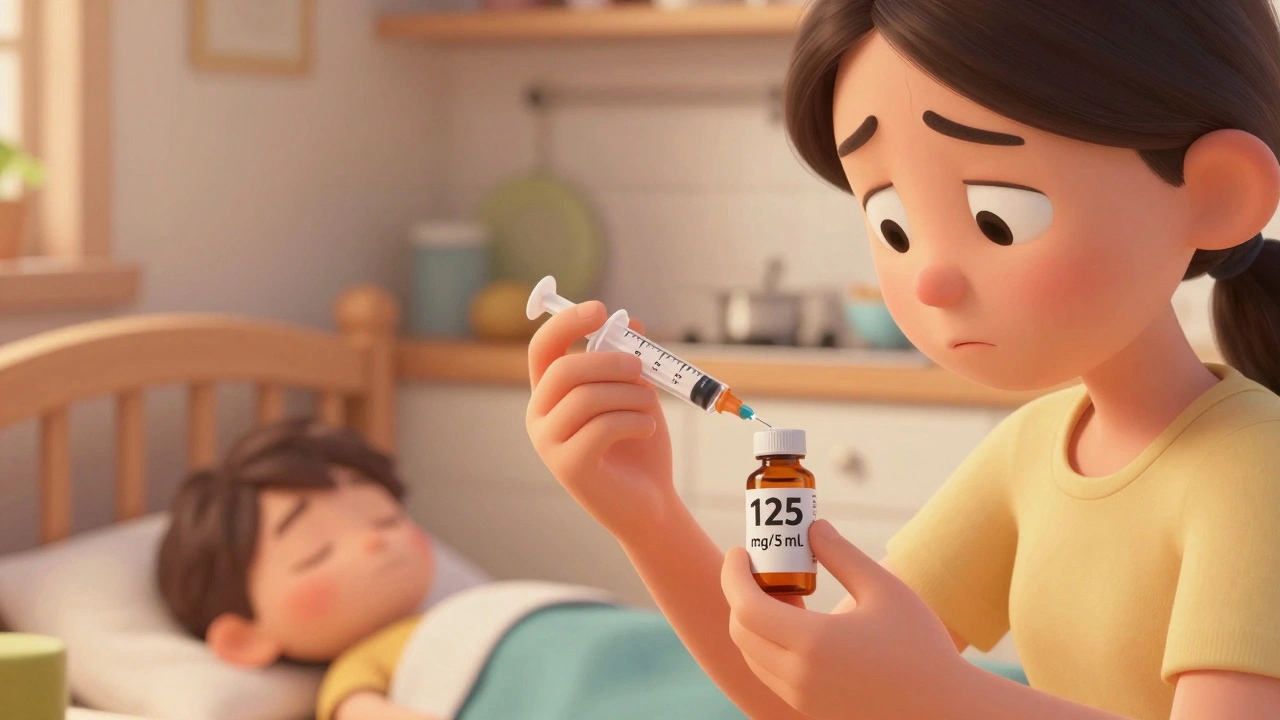
Getting the right dose of liquid medicine isn’t just about following the label-it’s about understanding exactly what it says. A single mistake can mean too much medicine, too little, or worse. In the U.S., around 1.3 million injuries each year come from medication errors, and nearly half of those involve liquid prescriptions given to children. The good news? Most of these mistakes are preventable. The key is learning how to read the label the right way.
What You’ll Find on a Liquid Prescription Label
Every liquid medication bottle has three critical pieces of information you need to spot right away: the concentration, the dosage amount, and the total volume of the bottle.
The concentration tells you how much medicine is in each milliliter. It’s usually written like this: 125 mg/5 mL. That means every 5 milliliters of liquid contains 125 milligrams of the active drug. Don’t confuse this with the total amount in the bottle. A bottle might hold 100 mL, but that doesn’t mean you take 100 mL. You take only what’s prescribed-maybe 5 mL, maybe 10 mL.
The dosage instruction tells you how much to take each time. It might say: Take 10 mL every 6 hours. That’s your dose. Always match this number to the measuring device you’re using. Never guess. Never use a kitchen spoon.
The total volume is the full amount of liquid in the bottle, like 100 mL or 240 mL. This number is there so you know how long the bottle will last. But it’s not your dose. People often mix this up-thinking the bottle’s total volume is the amount they should take. That’s dangerous.
Why Milliliters (mL) Are the Only Unit You Should Trust
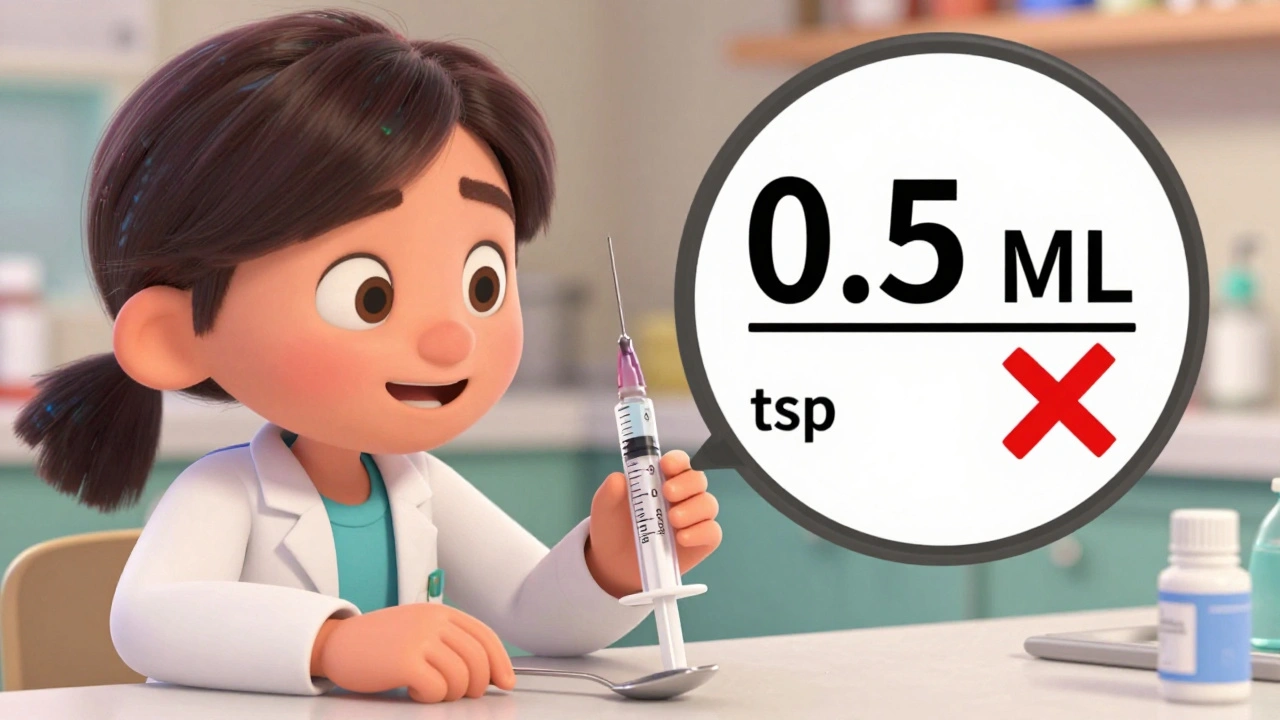
Look at the label. If you see tsp or tbsp, that’s a red flag. Those stand for teaspoons and tablespoons. But household spoons aren’t accurate. A teaspoon can hold anywhere from 2.5 mL to 7.5 mL. A tablespoon? It can range from 5 mL to 20 mL. That’s a 200% difference. One spoon might be fine. The next one could give you double the dose-or half.
The FDA and the National Council for Prescription Drug Programs (NCPDP) have been pushing for milliliters only on labels since 2015. Why? Because milliliters are exact. A 5 mL dose is always 5 mL. No guessing. No variation.
Studies show that when labels use only mL, dosing errors drop by more than 50%. In one study, parents using teaspoons were twice as likely to give the wrong dose compared to those using mL-measured devices. For kids, that’s not just inconvenient-it’s life-threatening.
How to Read Numbers on the Label Correctly
Numbers on labels follow strict rules to avoid deadly mistakes.
- Always use a leading zero: Write 0.5 mL, never .5 mL. Without the zero, someone might miss the decimal and give 5 mL instead of 0.5 mL-that’s ten times too much.
- Never use trailing zeros: Write 5 mL, never 5.0 mL. That extra zero can make someone think it’s a more precise dose than it is, leading them to use a device that measures to tenths of a milliliter when they don’t need to.
- Leave space between number and unit: Write 5 mL, not 5mL. That space helps your eyes separate the number from the unit, reducing misreads.
These aren’t just suggestions. They’re standards backed by research from Johns Hopkins and the FDA. In one study, following these rules cut 10-fold dosing errors by 47%.
What Comes With the Bottle Matters Too
A prescription label is only half the story. The measuring device that comes with the medicine is the other half.
Look for a syringe, cup, or dropper marked in milliliters. If it’s marked in teaspoons or tablespoons, ask for a new one. Most pharmacies will give you a free, accurate measuring device if you ask.
Not all devices are created equal. Some measure down to 0.1 mL. Others only go to 1 mL. Make sure the device matches the dose you need. If your child’s dose is 0.8 mL, you need a syringe that can measure that precisely. A cup marked only in 5 mL increments won’t work.
Also check the device’s maximum capacity. Some droppers max out at 5 mL. If your dose is 10 mL, you’ll need to use it twice. Don’t try to eyeball it. Use the device as it’s meant to be used.
What to Do If You’re Still Confused
Even with perfect labels, confusion happens. Health literacy is a real barrier. One study found only 12% of U.S. adults have strong health literacy. If you’re unsure, don’t guess.
Ask your pharmacist to show you how to measure the dose. Say: “Can you show me how to use this syringe?” Then, repeat it back: “So, I draw up to the 7.5 mL line, right?” This is called the “teach-back” method. It reduces errors by 63%.
If you don’t have a measuring device, don’t use a kitchen spoon. Go to a pharmacy and buy a dosing syringe or cup. They cost less than $2. Many pharmacies give them away for free.
And if the label says something like 240 mg/5 mL and your dose is 120 mg, you need to give half the volume: 2.5 mL. That’s basic math. If you’re not sure, ask. There’s no shame in it. Medication safety isn’t about being smart-it’s about being careful.
What’s Changing in 2025
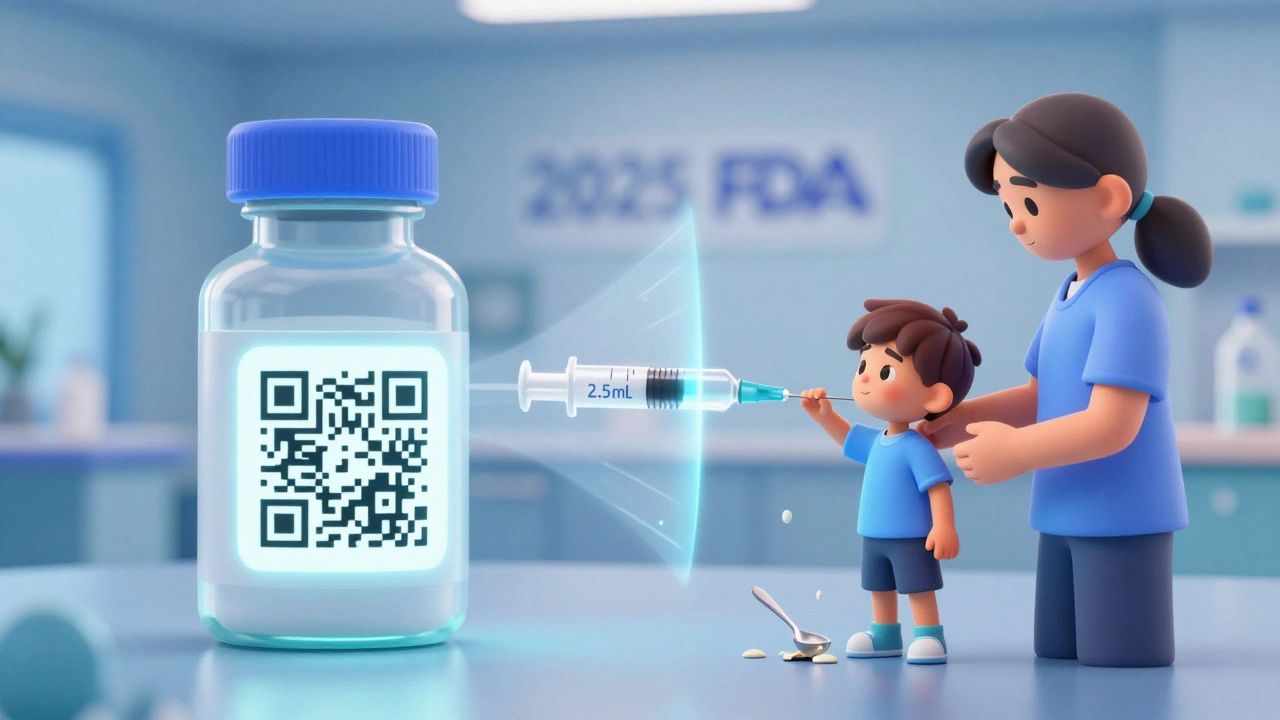
The system is getting better. By 2025, Medicare Part D will start penalizing pharmacies that don’t follow the mL-only standard. The FDA is also testing new labels with pictograms-simple drawings showing how to use the syringe. Early tests show these reduce errors by 37%.
Some pharmacies, like Amazon Pharmacy and McKesson’s Medly, now include QR codes on labels. Scan it, and a short video plays showing exactly how to measure the dose. It’s still new, but it’s growing.
Meanwhile, the American Academy of Pediatrics is training pediatricians to teach parents how to measure doses during routine checkups. That’s a big shift. Instead of waiting for a mistake to happen, they’re trying to stop it before it starts.
Real Stories, Real Mistakes
One parent on Reddit wrote: “I used my kitchen spoon for my baby’s fever medicine for three days. The label said 5 mL. My spoon held 7 mL. No wonder he was so sleepy.”
Another said: “I gave my 4-year-old 10 mL because the bottle said 500 mL. I thought that was the dose. Turns out, 500 mL was the whole bottle. I panicked and rushed to the ER.”
On the flip side, someone wrote: “The label said 160 mg/5 mL. The cup had clear mL lines. The dose was highlighted. I felt confident.”
It’s not about being perfect. It’s about being aware. A simple question to your pharmacist can save a hospital visit.
Final Checklist Before Giving Liquid Medicine
- ✅ Is the dose written in mL only? No tsp or tbsp?
- ✅ Is the number written as 0.5 mL (not .5 mL)?
- ✅ Is the number written as 5 mL (not 5.0 mL)?
- ✅ Is there space between the number and unit: 5 mL (not 5mL)?
- ✅ Are you using the device that came with the bottle? Not a spoon?
- ✅ Did you check the concentration? (e.g., 125 mg/5 mL) and match your dose to that?
- ✅ Did you ask the pharmacist to show you how to measure it?
If you can answer yes to all of these, you’re doing it right. If even one is no-stop. Call your pharmacy. Ask for help. It’s better to wait five minutes than risk giving the wrong dose.
Katherine Chan
December 9, 2025 AT 07:18Just read this and my heart sank-I used a kitchen spoon for my daughter’s antibiotics last winter. No idea how much I was actually giving her. Thanks for laying this out so clearly. I’m going to the pharmacy tomorrow to get a proper syringe.
Philippa Barraclough
December 10, 2025 AT 11:29The distinction between concentration and total volume is something that even healthcare professionals occasionally conflate, particularly in fast-paced clinical environments. The cognitive load involved in parsing decimal placements, unit notation, and volume scaling under stress is nontrivial, and the absence of standardized visual cues exacerbates the risk of misinterpretation. It is therefore not merely a matter of patient literacy but systemic design failure that has allowed ambiguous notation to persist for so long.
Tim Tinh
December 11, 2025 AT 22:55man i had no idea about the leading zero thing. i’ve seen .5ml on so many labels and never thought twice. just now i checked my kid’s cough syrup and it said .75ml. yikes. gonna call my pharmacy and ask if they can swap the label. also why do they even put tsp on there if it’s illegal??
Olivia Portier
December 13, 2025 AT 21:01My grandma used to measure medicine with a dessert spoon and swore by it. She’s 82 and still alive, so I thought it was fine. Turns out she got lucky. I’m printing this checklist and taping it to the fridge. If you’re reading this and you’re unsure-just ask. No one’s gonna judge you. We’ve all been there.
Tiffany Sowby
December 14, 2025 AT 00:24So now we’re blaming parents for not being pharmacists? The system is broken. Labels should be foolproof, not require a degree in math and a PhD in reading tiny print. And why are we still using bottles that leak? My kid’s syringe always drips. Someone’s getting paid to make this hard.
Katherine Rodgers
December 15, 2025 AT 12:26Oh wow, 50% fewer errors with mL-only labels? Shocking. I guess the FDA just discovered that people can’t read. Next they’ll ban cooking instructions because people think "a pinch" means 3 grams.
Lauren Dare
December 17, 2025 AT 04:01It’s not about literacy-it’s about cognitive ergonomics. The absence of a leading zero violates ISO 80000-1:2009, and trailing zeros in dosing contexts are explicitly flagged as high-risk in WHO’s 2017 Medication Safety Guidelines. The fact that this still requires education suggests institutional negligence, not user incompetence.
Lola Bchoudi
December 17, 2025 AT 07:44My pharmacy gave me a syringe with 0.1mL increments. I asked for one that only goes to 1mL because my kid’s dose is 0.8mL and I don’t want to overthink it. They said no-that’s the only one they have. So now I’m using a 1mL syringe and filling it to 80%. I’m not a scientist, but I can count to 80. Maybe they should make these things simpler.
Morgan Tait
December 19, 2025 AT 02:49QR codes on labels? That’s just the beginning. Soon they’ll implant microchips in kids’ tongues so the medicine can auto-dose. Meanwhile, Big Pharma keeps selling syrup with tsp markings because it’s cheaper. Wake up, people. They don’t want you to be safe-they want you to be dependent.