
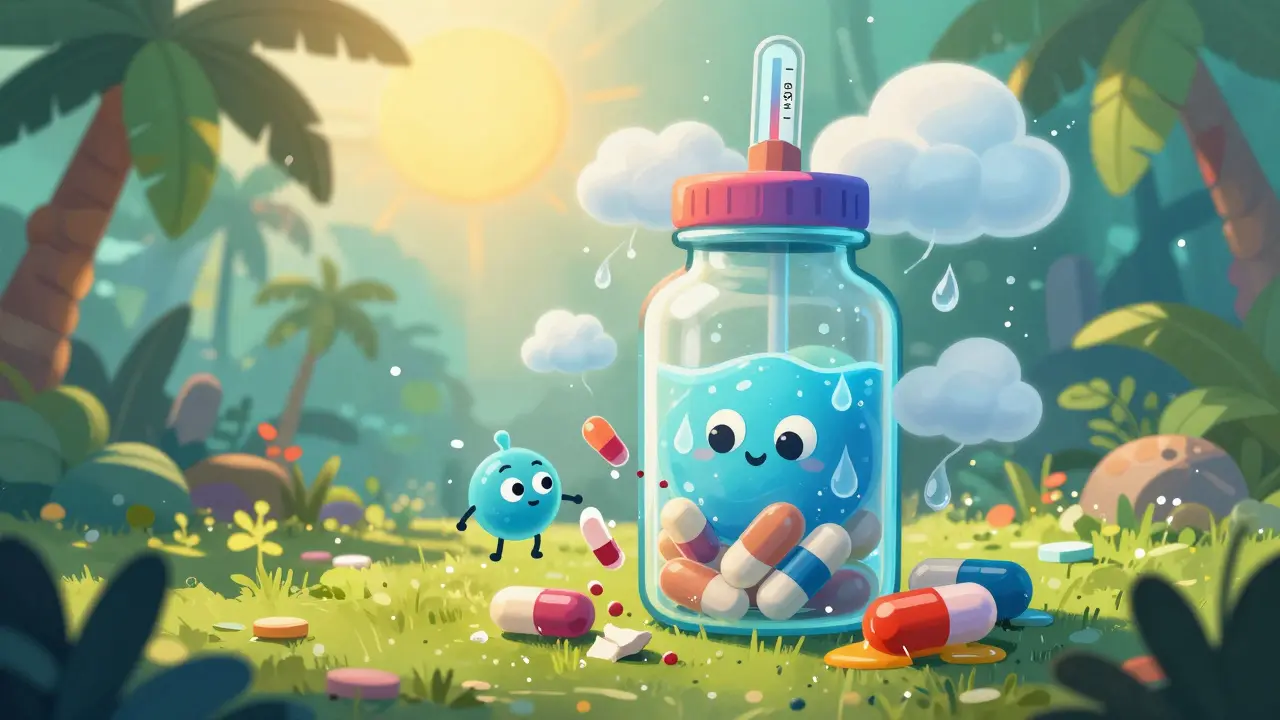
When you're traveling to or living in a tropical region, your medications aren't just sitting on a shelf-they're under siege. High heat and humidity don't just make you sweat; they can quietly destroy the pills, capsules, and inhalers you rely on. A tablet that looks fine might have lost half its strength. An inhaler that still clicks could be delivering almost no medicine. And that antibiotic you packed? It might not kill the infection at all. This isn't speculation-it's science. And it’s happening every day in places like Southeast Asia, sub-Saharan Africa, and the Caribbean.
Why Tropical Humidity Destroys Medicines
Most people think heat is the enemy of medicine. But in tropical climates, humidity is the silent killer. Relative humidity levels often hit 70-95%, and temperatures stay above 25°C year-round. These conditions trigger chemical reactions inside your pills that break down the active ingredients. The main culprit? Hydrolysis. That’s just a fancy word for water breaking chemical bonds. About 70% of all humidity-related drug failures come from this single process.
Take lamotrigine, a common epilepsy drug. A 2022 study showed that after just four weeks at 75% humidity, its ability to release into the body dropped by 22-38%. Amoxicillin, an antibiotic, can absorb up to 10% of its own weight in water under those conditions. That’s not just moisture-it’s a chemical wrecking ball. The result? Potency drops by 50% in 30 days. You’re not just taking a pill-you’re taking a placebo.
It’s not just tablets. Orally disintegrating tablets (ODTs) swell and turn gummy. Capsule shells soften and stick together. Dry powder inhalers clump so badly that only a fraction of the dose reaches the lungs. Freeze-dried vaccines? They turn to mush if humidity climbs above 20%. Even the packaging can fail. Blister packs with poor barriers let moisture in. Paper labels peel. Bottles with loose caps become humidity traps.
Which Medications Are Most at Risk?
Not all drugs are equally vulnerable. Some are like ironclad tanks. Others? They’re made of sugar and paper. Here’s what you need to watch out for:
- Antibiotics-especially tetracycline and amoxicillin. These degrade 3.5 times faster at 75% RH than at 40% RH. Visible color changes? That’s a red flag.
- Antifungals-like fluconazole. Moisture causes them to clump and lose effectiveness, leading to treatment failures.
- Pediatric formulations-syrups, chewables, and ODTs. Kids’ meds often have sugar and moisture-loving excipients. One study found 24% of degraded drugs were pediatric.
- Insulin and biologics-even if refrigerated, condensation from poor storage can ruin them.
- Desiccant-sensitive drugs-any medication with microcrystalline cellulose (MCC) or lactose. MCC holds up better than lactose under humidity, but both need protection.
The WHO estimates that 30% of medications in tropical regions degrade before reaching patients. That’s not a small number. That’s millions of doses that do nothing-while people still get sick.
What’s the Right Storage Environment?
The science is clear: for most medications, the sweet spot is 30-45% relative humidity and 15-25°C. Anything above 60% RH is dangerous. Above 70%? You’re in damage zone.
Temperature matters too. For every 10°C rise above 25°C, degradation rates double. So if your room hits 32°C (common in tropical cities), your pills are aging 2-3 times faster than they should.
Light is another factor. About 65% of drugs break down under UV exposure. That’s why amber bottles exist. But if you transfer pills to a clear plastic container? You’re undoing the manufacturer’s protection.
WHO and USP guidelines say: if a drug says “controlled room temperature,” it must stay below 30°C and 65% RH. Refrigerated drugs? Keep them between 2-8°C-but watch for condensation. Moisture on the outside of a cold bottle? That’s moisture seeping into your pills.
How to Protect Your Medications (Practical Steps)
You don’t need a lab to keep your meds safe. Here’s what actually works:
- Use airtight containers-Transfer pills from their original bottles into hard, sealable plastic containers with rubber gaskets. Glass jars with metal lids work too. Avoid ziplock bags-they’re not airtight.
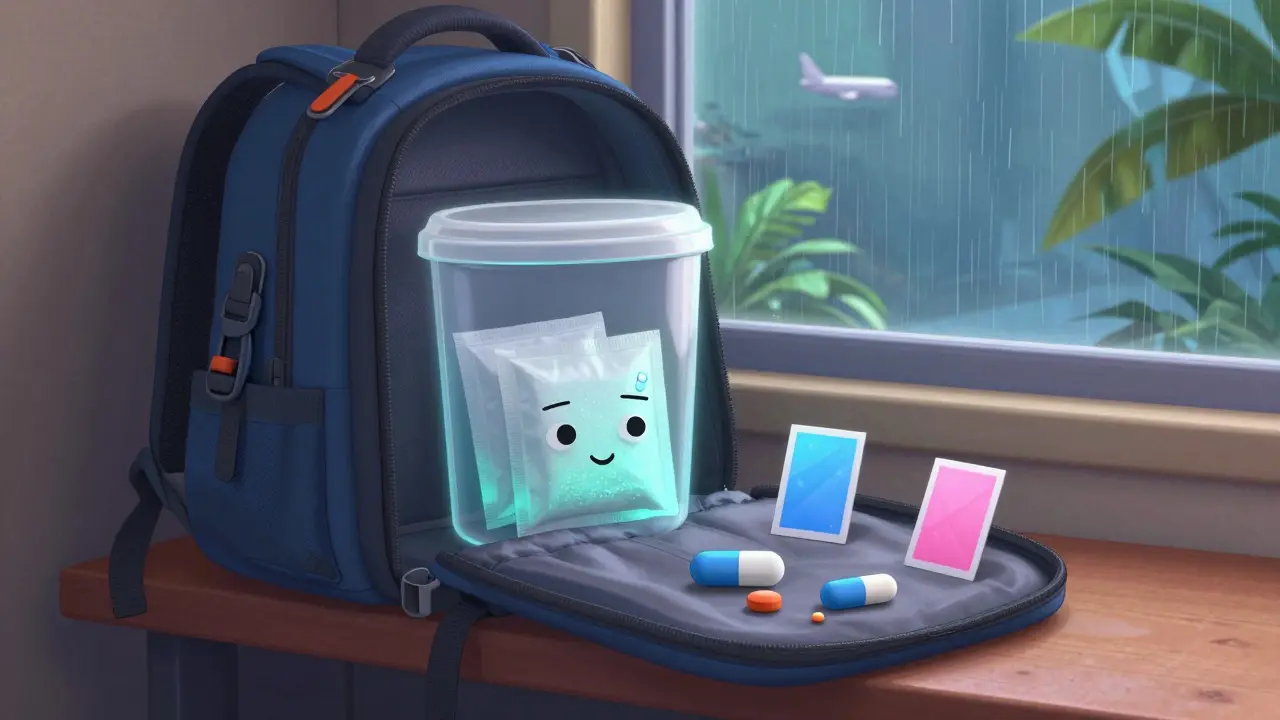
- Add silica gel desiccants-Put 1-2 grams of silica gel (the little white packets you find in shoeboxes) into every 100 mL of container space. Replace them every 30 days in humid climates. You can buy bulk silica gel online or from pharmaceutical suppliers.
- Never store meds in the bathroom-Showers, sinks, and steam keep humidity above 80%. That’s worse than a rainforest.
- Keep them off the floor-Moisture rises. Store containers on shelves, not under sinks or near windows.
- Use humidity indicator cards-These cost pennies. They turn from blue to pink when humidity hits 55%. If it’s pink? Change your desiccants immediately.
- Avoid direct sunlight-Even if you’re storing in a cabinet, make sure it’s not near a window. Use opaque containers if possible.
For travelers: pack your meds in a small, sealed container with 2-3 desiccant packets. Carry them in your carry-on. Checked luggage can sit in hot cargo holds for hours. Don’t risk it.
Advanced Solutions for Homes and Clinics
If you’re living long-term in a tropical area, or running a small clinic, here’s what’s proven to work:
- Desiccant closets-Modified metal cabinets with 5kg silica gel canisters inside. They maintain 35-45% RH for under $120. Used successfully in Uganda and the Philippines.
- Dry cabinets-These are like mini-fridges for dryness. They hold 5-15% RH and stabilize temperature within ±0.5°C. Used in hospitals. Cost $2,500-$15,000. Worth it for insulin, vaccines, or expensive drugs.
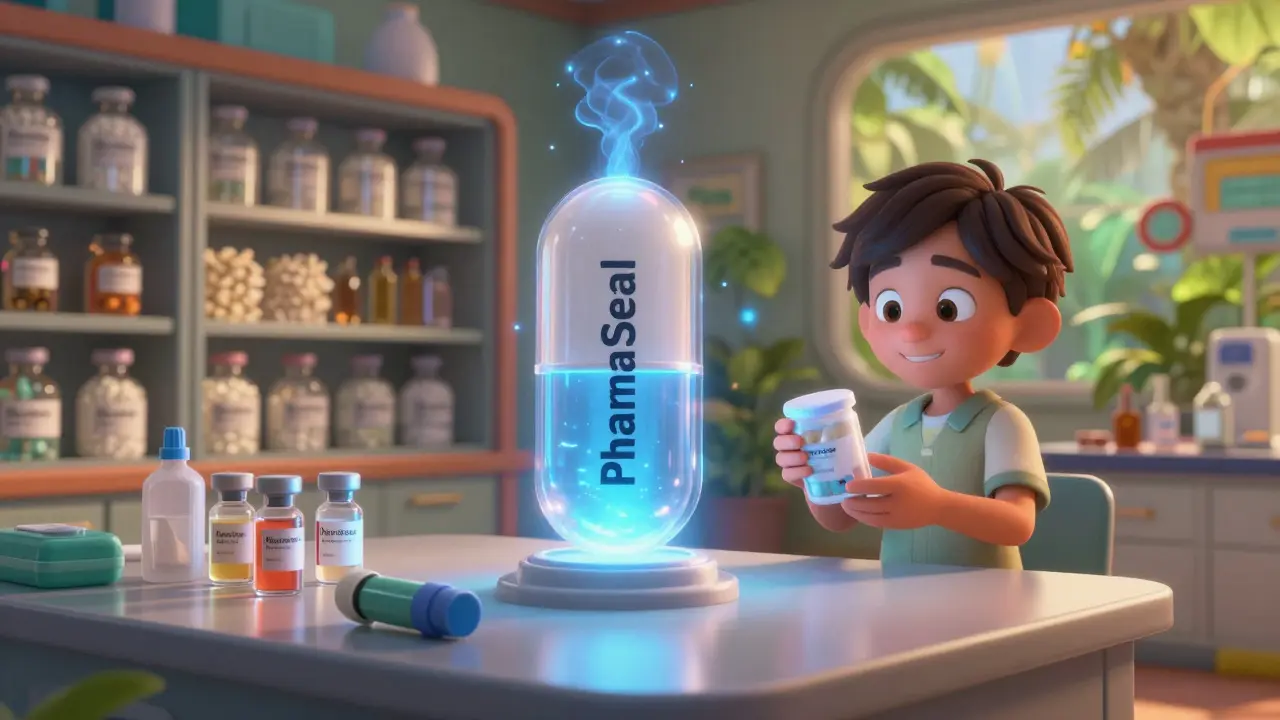
- PharmaSeal systems-A WHO-backed reusable desiccant canister that lasts 6 months and costs just $0.85 per unit. Deployed in 32 countries. Simple. Effective.
- Activ-Polymer™ technology-New bottle caps with moisture-scavenging polymers. They keep internal humidity below 30% RH for 18 months. Used in blister packs distributed by the Gates Foundation across Africa.
The Gates Foundation’s Humidity-Proof Packaging Initiative has already distributed 500 million desiccant-integrated blister packs. Result? A 58% drop in degradation. That’s not luck. That’s engineering.
What to Do If You Suspect Degradation
Here’s how to tell if your meds are compromised:
- Change in color-Yellowing, darkening, or uneven patches.
- Change in texture-Tablets that crumble, capsules that feel sticky, powders that clump like wet sand.
- Odd smell-A sour or musty odor means mold or chemical breakdown.
- Failure to work-If a drug you’ve taken before suddenly stops working, degradation is likely.
If you see any of these signs? Stop using it. Don’t take chances. A degraded antibiotic can lead to a deadly infection. A weak antimalarial can trigger drug resistance. Always replace suspect meds.
What’s Changing in the Future
Pharma companies are finally catching up. The ICH is drafting new guidelines called Q1H-specifically for tropical storage-expected in 2025. That means future drugs will be tested under real tropical conditions, not just lab settings.
Innovations are coming fast. MIT researchers developed a graphene oxide coating that cuts moisture permeability by 99.7%. That’s next-level. But right now, the best tools are simple: desiccants, airtight containers, and awareness.
Don’t wait for a new drug label. Don’t assume your pharmacy’s storage is perfect. Take control. Your health depends on it.
Can I store my medications in the fridge to avoid humidity?
Only if the medication label says "refrigerate." For most pills, refrigeration causes condensation when you take them out, which can be worse than humidity. If you must refrigerate, seal the container tightly with desiccant packets inside to prevent moisture from forming on the surface. Never store non-refrigerated drugs in the fridge.
Are silica gel packets safe to use with medications?
Yes, as long as they’re not ingested. Silica gel is non-toxic and FDA-approved for use in pharmaceutical packaging. Just don’t eat them-they’re not candy. Replace them every 30 days in tropical conditions. You can buy bulk food-grade silica gel online in larger quantities for better value.
How do I know if my humidity indicator card is working?
Humidity indicator cards change color at specific thresholds. Blue means dry (below 55% RH). Pink means wet (above 55% RH). If it’s pink, your desiccants are saturated and need replacing. Some cards show multiple color zones-use the most saturated color as your guide. Keep them visible in your storage container so you can check weekly.
Do all blister packs protect against humidity?
No. Standard aluminum blister packs offer near-perfect protection (99.9% moisture barrier). But many cheaper blister packs use PVC or PVDC, which allow moisture to pass through. Look for packaging labeled "aluminum foil backing" or "high-barrier blister." If you’re unsure, transfer pills to an airtight container with desiccants.
Is it safe to use expired medication if it looks fine?
No. Expiration dates are based on stability testing under controlled conditions. In tropical humidity, drugs degrade faster-even before the expiration date. If you’ve stored pills in a humid environment, they may be ineffective long before the printed date. Never take expired medication, especially antibiotics or heart drugs. Replace them.
Can I reuse desiccant packets?
Only if you reactivate them. Silica gel can be dried in an oven at 120°C for 2-3 hours to restore its absorbency. Let it cool completely before putting it back in your container. But for most people, it’s easier and safer to replace them monthly. Reusing old packets risks incomplete drying and contamination.
Erin Pinheiro
February 22, 2026 AT 17:21also why is everyone so calm about this? we’re basically taking placebo pills and calling it healthcare.
Michael FItzpatrick
February 24, 2026 AT 09:22Brandice Valentino
February 26, 2026 AT 07:35Also, why is the Gates Foundation the only one doing this? Shouldn’t Big Pharma be *paying* for this? Or are they just waiting for us to die so they can sell us the next version?
Larry Zerpa
February 27, 2026 AT 22:41Also, the Gates Foundation? Please. They’re not saving lives - they’re building brand equity under the guise of charity. Real change happens when local pharmacists get trained, not when billionaires drop silica gel packets like confetti.
Gwen Vincent
March 1, 2026 AT 13:04Also, humidity cards? Game changer. I keep one on my nightstand now. It’s like a little health alarm. I wish more people knew about this. It’s not complicated. Just… don’t ignore moisture. It’s silent. And deadly.
Nandini Wagh
March 3, 2026 AT 03:13And you want me to believe the WHO’s 30% degradation stat? That’s probably low. I’d bet 60%. Because nobody’s auditing the back alleys. Nobody’s testing the pills that never made it to a ‘controlled room temperature.’ You’re talking about lab conditions while people are surviving on hope and expired tetracycline.
Also - ‘PharmaSeal systems’? Cute. But if your medicine doesn’t get to the person, none of this matters. Stop optimizing packaging and start fixing logistics.
Holley T
March 4, 2026 AT 08:48And don’t get me started on the ‘amber bottles’ advice. If you can’t afford a sealed container, you’re not going to buy an amber one. You’re going to put it in a tin can with a rubber band. And that’s fine. We need systemic change, not Pinterest-level hacks. This article reads like a corporate whitepaper with a conscience.
Ashley Johnson
March 5, 2026 AT 23:59