

Imagine a patient walking into a pharmacy and claiming they need their medication early because their insurance allows it, or perhaps they've simply "lost" a few pills. To a busy pharmacist, this might seem like a routine request. But beneath the surface, this is where dispensing errors and dangerous drug misuse patterns often start. When a patient gets a script too early or takes two different brands of the same drug from two different doctors, the risk of overdose or severe drug interactions skyrockets.
Preventing these mistakes isn't just about saying "no" to a patient; it's about building a system that catches errors before the medication ever leaves the counter. Whether you're a provider or a pharmacist, the goal is to move away from treating refill requests as unexpected emergencies and start seeing them as predictable events that require a strict, standardized process.
The Real Danger of Early Refills and Duplicate Therapy
When we talk about Duplicate Therapy, we're referring to a situation where a patient takes multiple medications from the same therapeutic class. This often happens when a patient sees multiple specialists who aren't communicating. For example, one doctor might prescribe a generic ACE inhibitor for blood pressure, while another prescribes a brand-name version of the same class. The result? A dangerous overdose of the active ingredient.
Early refills are a different kind of red flag. While a few days' grace period is normal, a pattern of requesting refills every 20 days for a 30-day supply suggests something is wrong. It could be a sign of Drug Diversion-where medication is sold or given away-or a sign of addiction. In the worst cases, this leads to stockpiling, which increases the risk of accidental poisoning or intentional overdose.
Implementing a Three-Tiered Refill Protocol
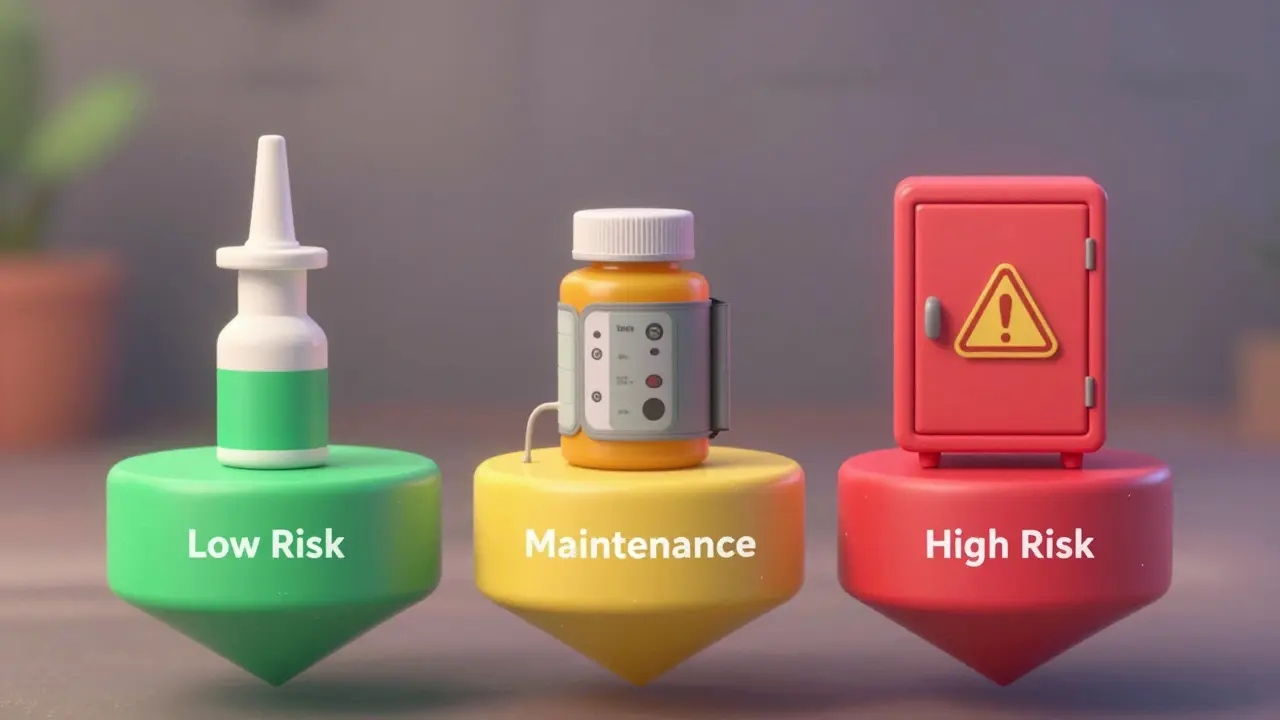
You can't treat a nasal spray the same way you treat an opioid. To keep things efficient without sacrificing safety, the American Academy of Family Physicians suggests a tiered system. This allows staff to handle low-risk requests quickly while flagging high-risk ones for a doctor's review.
- Low-Risk Tier: These are medications with very few side effects and no potential for abuse (like steroid nasal sprays). These can be approved quickly by a nurse or medical assistant based on a simple checklist.
- Maintenance Tier (3-Month Meds): This covers chronic conditions like hypertension or diabetes. The rule of thumb here is: if the patient has been seen for a check-up within the last three months, the refill can be approved for another 90 days.
- High-Risk Tier: This includes Controlled Substances and medications requiring frequent lab monitoring. These should never be automated. They require a direct provider review and a strict adherence to timing.
By categorizing meds this way, you reduce provider burnout. In some health systems, using these protocols has allowed nearly 90% of refill requests to be handled by support staff, leaving doctors to focus on the 10-15% of cases that actually need clinical judgment.
| Risk Level | Example Medications | Approval Authority | Typical Constraint |
|---|---|---|---|
| Low | Nasal steroids, eye drops | Nursing/Admin staff | Basic identity check |
| Medium | Statins, Metformin | Nurse/MA with Protocol | Visit within last 90 days |
| High | Opioids, Benzodiazepines | Prescribing Physician | Zero early refills without prior approval |
Leveraging Technology to Close the Gaps
Human memory is fallible, which is why Electronic Health Records (EHR) are your best defense. A common mistake is simply renewing a script without looking at the fill history. To stop this, providers should use specific flagging phrases. Instead of a generic "Refill OK," use a note like "Cancel all prior" to kill automatic reminders and reset the clock.
For pharmacists, the biggest blind spot is "pharmacy hopping," where a patient uses three different stores to hide the fact that they are getting duplicate therapy. This is where a Clinical Viewer becomes essential. These tools allow pharmacists to see prescriptions filled at other locations through publicly funded drug programs, exposing gaps in care or dangerous overlap in medication.
Integrating Clinical Decision Support (CDS) tools can also alert staff when a lab test is overdue. If a patient needs a kidney function test before their next dose of a specific medication, the system should "pend" the refill and automatically trigger a lab order. This turns a potential error into a proactive health check.
Dealing with Difficult Patient Requests
Patients will often use "insurance logic" to pressure you into an early refill. You've probably heard, "My insurance lets me get it 5 days early, so why won't you?" While some insurance plans do allow a small window to prevent patients from running out of meds over a weekend, this isn't a license to consistently refill early.
When a patient pushes back, the conversation should shift from "rules" to "safety." Explain that the timing is designed to monitor the drug's effect on their body. For controlled substances, a firm policy is key. Many pharmacies implement a "2 days early, and that's it" rule. If the patient claims they lost their medication, the response should be a requirement for a police report or a direct consultation with the prescribing doctor, not a courtesy refill.

Practical Steps for a Safer Workflow
To actually stop these mistakes, you need a workflow that doesn't rely on a person remembering to check a box. Start by auditing your current refill process and implementing these specific changes:
- Predict the Event: Instead of waiting for a phone call, identify patients on fixed monthly doses and prepare their scripts a week in advance. This eliminates the "emergency" rush that leads to errors.
- The "Profile Review" Habit: Every single refill must start with a profile review. Do not assume that because the drug was appropriate last month, it is appropriate today. Look for changes in therapy or discontinued meds.
- Mandatory Evaluations: For high-risk patients, include a clause in their treatment agreement stating that early refills are forbidden unless they agree to a specialist evaluation for substance use.
- Clear Communication: Use the "cancel all prior" method in the EHR to ensure that no outdated scripts are floating around that could be filled by mistake.
Why do insurance companies allow early refills?
Most insurance plans allow a 30-day supply to be filled about 5 days early. This is a convenience feature to ensure patients don't run out of medication over a weekend or holiday. However, this is not intended for habitual early use, and pharmacists should still monitor for patterns of misuse.
How can I tell if a patient is "pharmacy hopping"?
Look for gaps in the time they access your services. If a patient only comes to you every other month but claims they are taking a daily medication, they are likely using another pharmacy. Utilizing a Clinical Viewer to see fills from other providers is the most effective way to confirm this.
What is the best way to handle a request for a "lost" medication?
For non-controlled substances, a one-time exception may be appropriate. However, for controlled substances, you should require the patient to contact the prescribing physician for a new authorization. Establishing a policy that requires a police report for lost controlled substances often deters those attempting to stockpile.
Can nurses legally approve refills?
Yes, provided there is a written, evidence-based protocol approved by the provider. By using a tiered system (Low, Medium, High risk), nurses can handle routine refills while flagging any that fail specific criteria (like an overdue lab test) for the doctor's attention.
What is the difference between therapeutic duplication and a drug interaction?
Therapeutic duplication occurs when a patient takes two different drugs that do the exact same thing (e.g., two different beta-blockers), leading to an overdose of that effect. A drug interaction occurs when two different types of drugs react with each other, potentially neutralizing one or creating a toxic byproduct.
Troubleshooting Common Refill Hurdles
Even with a system, things go wrong. If you find that your staff is still struggling with refill delays, look at the "turnaround time." Many patients complain about 24-48 hour waits. If this is happening, it's usually because the provider is the bottleneck. Shift the authority to a protocol-based system where a nurse can approve a maintenance med in 10 minutes, leaving the doctor only the complex cases.
If you suspect a patient is intentionally bypassing your safety checks, it's time to move to a "hard stop" approach. This means no early refills under any circumstance without a signed letter from the physician explaining the medical necessity. When the rules are absolute and applied to everyone, patients are less likely to try to negotiate their way into a dangerous mistake.