
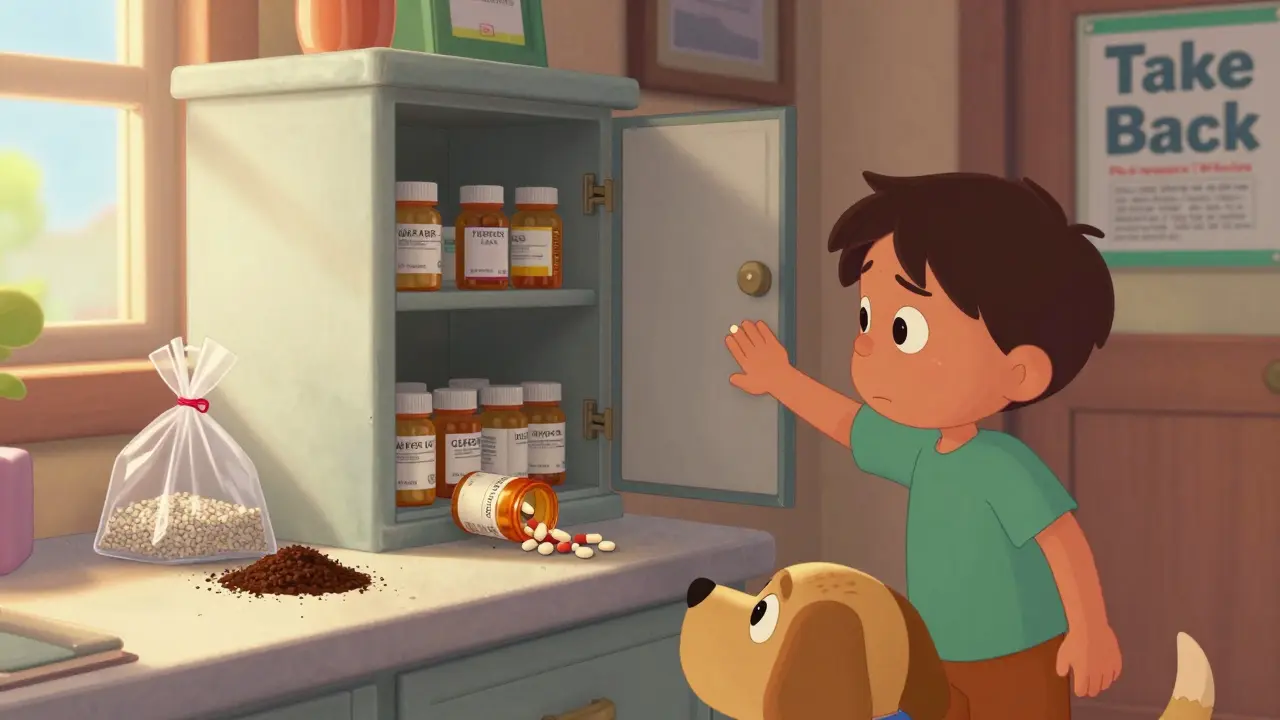
Keeping expired medications in your medicine cabinet isn’t just messy-it’s dangerous. Outdated pills, liquids, and patches can end up in the hands of kids, pets, or people looking for a quick high. They can also leak into your water supply if flushed or tossed in the trash the wrong way. The good news? You don’t need to be a scientist to dispose of them safely. With a few simple steps, you can protect your family and the environment-even if you live in a small town with no take-back site nearby.
Why You Can’t Just Throw Them in the Trash
Many people think tossing old pills in the garbage is fine. It’s not. When medications sit in landfills, rainwater can wash them into groundwater. A 2022 study found that 15-20% of common drugs like ibuprofen, antidepressants, and antibiotics still show up in landfill runoff. That means traces of your painkillers could end up in rivers, lakes, or even your tap water. And it’s not just about the environment. Unused opioids, sedatives, and stimulants left in plain sight are a major source of drug misuse. The DEA reports that 23% of diverted prescription opioids come from homes where medications weren’t properly disposed of. Kids rummaging through cabinets, teens finding a bottle of Xanax, or an elderly neighbor accidentally taking the wrong pill-these aren’t rare accidents. They happen every day.The Gold Standard: Drug Take-Back Programs
The safest way to get rid of expired meds? Use a drug take-back program. These are organized by the DEA and run through pharmacies, hospitals, or police stations. You drop off your meds-no questions asked-and they’re destroyed in high-temperature incinerators that neutralize every chemical. In the U.S., there are over 14,000 permanent drop-off locations. Most Walgreens, CVS, and Walmart pharmacies have kiosks near the pharmacy counter. These accept pills, patches, and capsules, but not liquids, inhalers, or needles. The DEA also runs National Prescription Drug Take Back Day twice a year-in April and October. In October 2022 alone, over 1 million pounds of medication were collected nationwide. If you’re in Wellington, New Zealand, or anywhere else, check your local pharmacy or public health department. Many cities have year-round drop boxes. You can also use the DEA’s online locator tool to find the nearest site. No ID? No problem. You don’t need to give your name or show a prescription.What to Do If There’s No Take-Back Option Nearby
Not everyone lives close to a drop-off point. Rural areas, small towns, and apartment complexes often lack easy access. That’s where home disposal comes in. The FDA and EPA agree: if you can’t get to a take-back site within a week, here’s how to do it right. Step 1: Take pills out of their original bottles. Don’t leave them in the bottle with your name on it. That’s a privacy risk. Remove the pills or capsules, but leave the bottle for now. Step 2: Mix them with something unappetizing. Use a 1:1 ratio. For every standard prescription bottle (15-30ml), add one cup (240ml) of used coffee grounds, cat litter, or dirt. These materials make the meds look and smell gross-enough to scare off anyone who might dig through your trash. Step 3: Put the mixture in a sealed container. Use a resealable plastic bag (at least 2-mil thick) or an empty margarine tub. Seal it tight. This stops leaks and keeps kids or pets from getting into it. Step 4: Scrub off your personal info. Grab a permanent marker and cover every bit of writing on the bottle: your name, the pharmacy, the prescription number. If you don’t have a marker, use duct tape. This isn’t optional. Identity theft and drug diversion both start with a discarded pill bottle. Step 5: Toss it in the trash-not the recycling. Put the sealed container in your regular household trash. Recycling bins are for clean plastic, paper, and glass. Medications contaminate recycling streams and can’t be processed safely.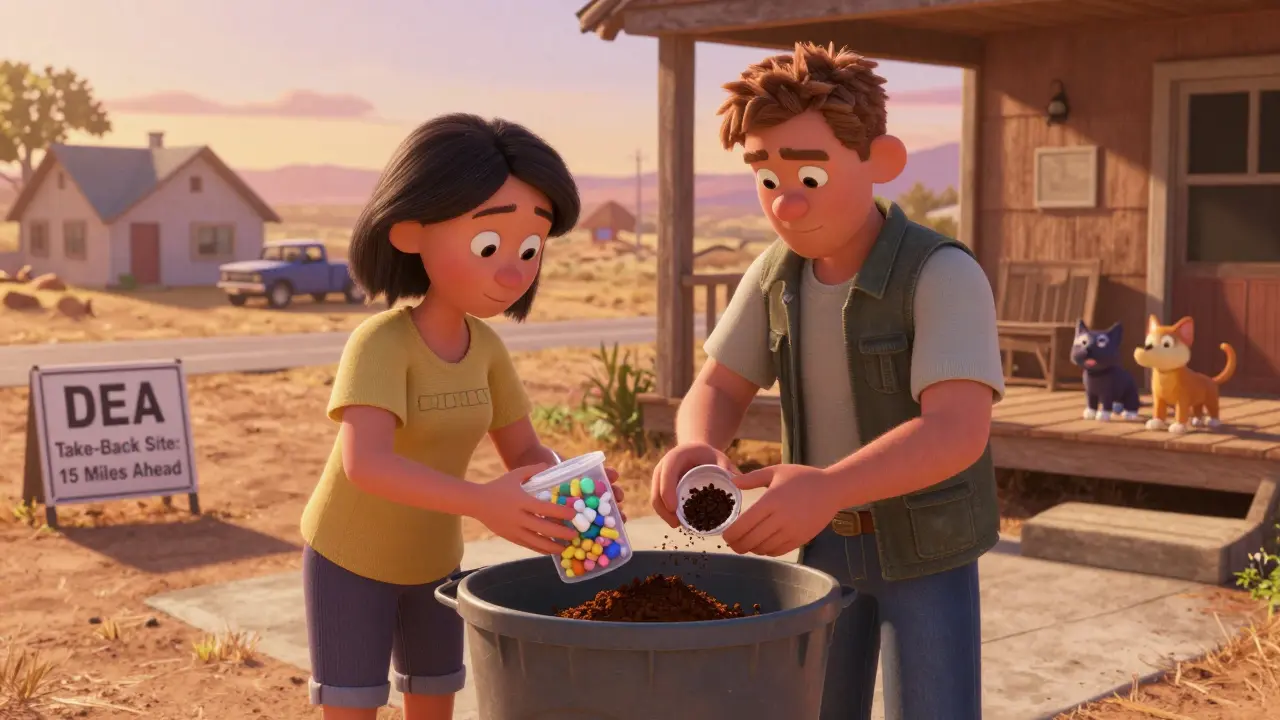
Special Cases: Liquids, Inhalers, Needles, and Insulin
Not all meds are the same. Here’s how to handle the tricky ones. Liquids (syrups, eye drops, etc.): Pour them into a sealable bag with coffee grounds or cat litter. Mix well. Don’t pour them down the sink. Even small amounts can add up over time. Inhalers (albuterol, Advair, etc.): These are pressurized. If crushed or heated in a trash compactor, they can explode. Take them to a medical waste facility or a pharmacy that accepts hazardous waste. Some fire stations will take them too. Needles and sharps: Never put loose needles in the trash. Use a rigid plastic container like an empty laundry detergent bottle with a tight lid. Tape it shut. Label it “SHARPS-DO NOT RECYCLE.” Drop it off at a pharmacy or hospital that handles medical waste. Many pharmacies give these containers for free. Insulin and other refrigerated meds: These can leak or spoil. Mix them with absorbent material (coffee grounds work) right away. Place in a sealed bag and toss in the trash. Don’t wait.What NOT to Do
There are a few old habits you need to break.- Don’t flush unless it’s on the FDA’s flush list. Only 15 medications qualify-mostly high-risk opioids like fentanyl patches and oxycodone. Flushing anything else contributes to water pollution.
- Don’t crush pills. This creates dust that can be inhaled or spread around. The only exception is if you’re using a special disposal product like DisposeRx.
- Don’t pour meds down the drain. Even if you think it’s “just a little,” it adds up. One person’s tiny pour is another’s contaminated well.
- Don’t leave them in a clear container. A pill bottle with your name on it is a magnet for theft or misuse.
Real-World Tips from People Who’ve Done It
People sharing their experiences online have a few tricks that make the process easier.- Use a permanent marker before removing pills. Mark over your info while the bottle is still full. It’s easier than trying to scribble after the pills are gone.
- Keep a disposal kit. Store a small bag of coffee grounds and a few ziplock bags in your medicine cabinet. You’ll be ready the moment something expires.
- Ask your pharmacist. Most pharmacists will give you free disposal bags or point you to the nearest drop-off. They’re trained for this.
- Check your state’s rules. Some states now require drug manufacturers to fund disposal programs. You might get free mail-back envelopes.
What’s Changing in 2026?
The system is getting better. In 2025, U.S. law will require all new prescription bottles to include disposal instructions on the label. The FDA is also testing a mobile app that shows real-time drop-off locations. And thanks to opioid settlement funds, more than $1.2 billion is being invested in disposal infrastructure over the next five years. In Wellington, local pharmacies are expanding their take-back kiosks. The Ministry of Health is pushing for more rural drop-off points. By 2030, over 90% of households in the U.S. and New Zealand will have access to a nearby disposal option.Final Thought: It’s Not Just About Safety-It’s About Responsibility
Disposing of expired meds isn’t a chore. It’s a small act that prevents harm. One less pill in a teenager’s backpack. One less toxic leak into a river. One less chance for someone to accidentally take the wrong medicine. You didn’t mean for this to happen. But now that you know, you can fix it. And that’s what matters.Can I flush expired medications down the toilet?
Only if the medication is on the FDA’s official flush list, which includes powerful opioids like fentanyl patches and oxycodone. For all other drugs, flushing is discouraged because it pollutes water supplies. The EPA estimates that flushing contributes to 12% of pharmaceutical contamination in U.S. waterways. Always use the mixing method instead.
What if I don’t have coffee grounds or cat litter?
Use dirt, sand, or even powdered laundry detergent. The goal is to make the mixture unappealing and unrecognizable. Avoid sugar, salt, or flour-they can still look like food. Mix in enough material so the pills are completely covered and the mixture looks messy, not like pills in a liquid.
Can I recycle the empty pill bottles?
Yes, but only after you’ve completely removed all personal information and wiped out any residue. Rinse the bottle, then check with your local recycling program. Some cities accept #1 or #2 plastic bottles, but others don’t due to contamination risks. If in doubt, toss it in the trash after scrubbing off labels.
Are drug take-back programs free?
Yes. All DEA-authorized take-back sites offer free disposal. You don’t need insurance, ID, or a receipt. The program is funded by federal and state agencies. Even if you’re not a patient at that pharmacy, you can drop off meds from any household.
What should I do with expired insulin?
Mix expired insulin with coffee grounds or cat litter immediately. Place it in a sealed, leak-proof bag, then put it in your household trash. Never refrigerate it for disposal. Don’t throw away syringes or pen needles with the insulin-separate them and place sharps in a rigid plastic container like a detergent bottle.
How often should I clean out my medicine cabinet?
Do it at least once a year. Spring or fall works well. Check for expired pills, old prescriptions, and unlabeled containers. If you’re unsure if a medicine is still good, ask your pharmacist. Never guess-when in doubt, dispose of it properly.
trudale hampton
March 22, 2026 AT 06:57Been doing the coffee grounds thing for years. Works like a charm. No more weird pills lurking in the back of the cabinet.
Just toss the sealed bag in the trash and forget about it. Simple. Safe. Done.
Chris Dwyer
March 23, 2026 AT 07:30Y’all are overcomplicating this. I keep a small ziplock with cat litter in my bathroom cabinet. When something expires, I dump it in, seal it, toss it. Took me 30 seconds. No drama. No guilt. Just done.
Also, if you’re worried about the bottle? Scrub it with a paper towel and a Sharpie. Boom. Privacy secured.
Paul Cuccurullo
March 24, 2026 AT 16:52Let me be perfectly clear: failing to dispose of expired medications is not negligence-it’s a public health hazard of the highest order. The water we drink, the soil we grow food in, the air our children breathe-all of it is quietly poisoned by our apathy.
Every pill flushed, every bottle tossed unmarked, every syringe carelessly discarded-it’s not just irresponsible. It’s immoral.
And yet, here we are, debating whether to use coffee grounds or sand like this is a Pinterest project. We’ve lost our moral compass.
Thankfully, the DEA and FDA are stepping in. But we must do better. We must act with urgency. We must treat this not as a chore, but as a sacred duty to humanity.
Desiree LaPointe
March 25, 2026 AT 03:37Oh wow, so we’re now treating expired ibuprofen like it’s nuclear waste? Really? You’re telling me I need to mix my Advil with cat litter like it’s a DIY horror movie prop?
And don’t get me started on the ‘seal it in a 2-mil bag’ nonsense. You’re gonna get sued for emotional distress if your trash bag rips.
Also, who even has coffee grounds lying around? I’m a single mom who barely remembers to water her cactus. Don’t shame me for not being a sustainability guru.
Thomas Jensen
March 25, 2026 AT 09:09Here’s the truth they don’t want you to know: the government doesn’t care about your meds. They’re just using this ‘take-back’ program to track who’s taking what.
I read a whistleblower report last year-pharmacies are feeding data to Big Pharma and the DEA to build profiles on chronic pain patients.
And those ‘free disposal kiosks’? They’re bait. They want you to drop off your oxy, then they flag your name and send your doctor a ‘concern’ notice.
Don’t be fooled. If you can’t trust your local police station with your pills, why would you trust them with your medical history?
My advice? Burn them. In a metal bucket. Outside. Wear a mask. And pray.
shannon kozee
March 25, 2026 AT 16:05Empty bottles can be recycled after scrubbing off labels and rinsing. Check your city’s guidelines. Some take #1 and #2 plastic. Others don’t. If unsure, toss it.
For liquids, mix with cat litter. For sharps, use a detergent bottle. Done.
Natali Shevchenko
March 26, 2026 AT 11:07You know, I’ve been thinking about this whole thing-how we treat expired medicine like trash, but it’s still, in a way, part of us. It’s the chemical residue of our pain, our anxiety, our insomnia, our broken bones.
We don’t just dispose of pills-we dispose of moments. Moments of healing. Moments of desperation.
And yet, we treat the bottle like a disposable object. We scrub the label like erasing a memory.
Maybe we should treat it with more reverence. Maybe the act of disposal should be ritualistic, not robotic.
Not because it’s safer, but because it’s human.
Maybe we need to mourn the pills as much as we dispose of them. Because they were once hope. Now they’re just… gone.
Nishan Basnet
March 27, 2026 AT 17:21As someone from India, I’ve seen how communities handle this differently. In rural areas, people often return unused meds to local clinics or pharmacists-no kiosks needed. It’s built into the culture.
Here in the US, we’ve turned a simple act into a bureaucratic chore. Maybe we need to go back to trusting local pharmacists, not just tech solutions.
Also, I’ve used powdered milk as a mixing agent-it works fine if you’re out of coffee grounds. Just make sure it’s dry and clumpy.
Allison Priole
March 28, 2026 AT 03:28Okay so I just did this last week and I’m telling you, it’s way easier than you think.
I had like 3 bottles of old painkillers and a half-used eye drop thing and I just dumped them in a bag with some used kitty litter I had lying around (I’m not even a cat person, I just keep it for emergencies) and sealed it with duct tape and threw it in the trash.
And then I scribbled over the bottle with a black marker and threw that in recycling.
It took 5 minutes and I didn’t even break a sweat.
Also I didn’t even know about the coffee grounds thing until now but I’m definitely doing it next time.
Like… why is this even a blog post? It’s just… don’t be dumb.
Sandy Wells
March 28, 2026 AT 21:41This entire guide is ridiculous
You think people care about this
Most of us just flush it and move on
And if you’re worried about kids or pets
Then maybe don’t leave pills in the cabinet in the first place
Stop overthinking everything
It’s just medicine
Not a national security threat