
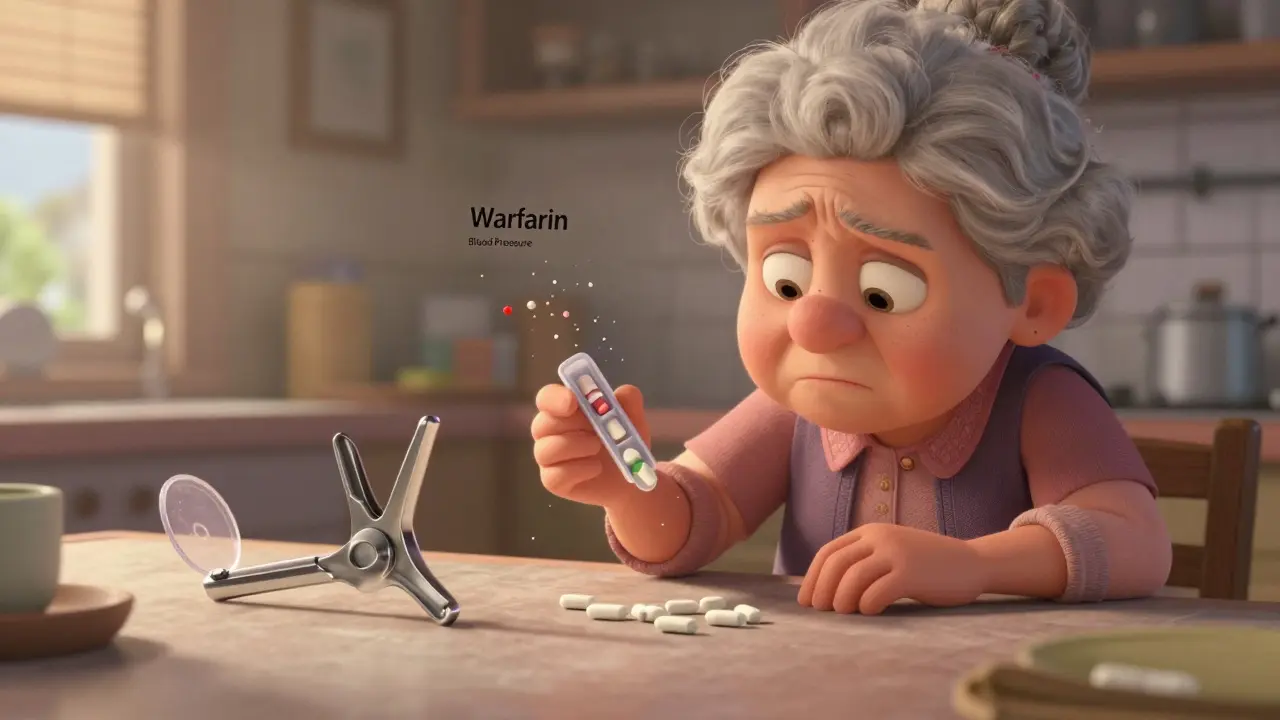
Splitting or crushing pills might seem like a simple fix-maybe you’re trying to save money, make it easier to swallow, or adjust a dose. But if you’re not careful, you’re risking serious contamination, wrong doses, or even poisoning. This isn’t just a theory. Real people have been harmed by it. In 2023, a care home in Ohio saw 14 residents affected by warfarin cross-contamination because the same pill splitter was used for multiple drugs without cleaning between uses. That’s not rare. It’s a known problem.
Why Contamination Happens
Pills aren’t just little chunks of medicine. They’re engineered with coatings, time-release layers, and precise chemical balances. When you crush or split them improperly, you’re breaking that design. Dust from crushed tablets can cling to surfaces, tools, or even your fingers. If that dust gets on another pill-or worse, gets inhaled-it can cause unintended side effects. For example, crushing a chemotherapy drug like cyclophosphamide can release toxic particles. Studies show healthcare workers have tested positive for trace amounts on their gloves after open crushing, even when they thought they were being careful. The same goes for splitting. If you use a knife, scissors, or just snap a tablet with your fingers, you’re likely getting uneven halves. One half might have 60% of the dose. The other, 40%. That’s not a minor difference. For drugs like blood thinners, seizure medications, or heart pills, even a 10% variation can be dangerous.What Pills Should Never Be Split or Crushed
Not all pills are created equal. About 98% of extended-release, enteric-coated, or hazardous drugs should never be split or crushed. That includes:- Extended-release tablets (like OxyContin, Metformin XR, or Adderall XR): Crushing them releases the full dose all at once, which can be fatal.
- Enteric-coated pills (like aspirin EC or omeprazole): These are designed to dissolve in the intestine, not the stomach. Crushing them can cause stomach irritation or make the drug useless.
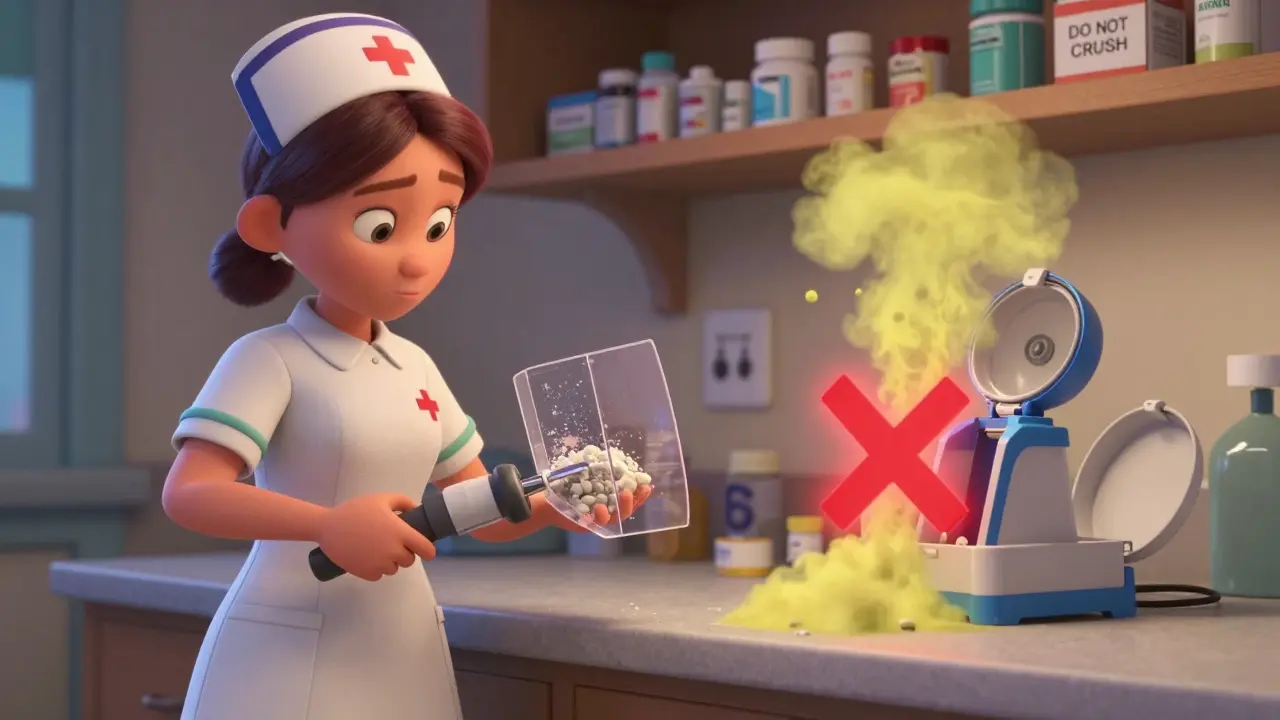
- Hazardous drugs (chemotherapy, immunosuppressants, hormone therapies): These can aerosolize and contaminate the air, surfaces, or your skin. NIOSH lists over 100 drugs in this category.
- Capsules: Never open or crush capsules unless the label says it’s safe. Many contain powders or beads that are meant to be released slowly.
The FDA’s 2023 guidelines say you should always check the label or ask your pharmacist before splitting or crushing anything. If it doesn’t have a score line, assume it’s unsafe to split.
The Right Tools for the Job
If a pill is safe to split, use a proper pill splitter-not a knife, not a pair of scissors. Look for one with:- A stainless steel blade with a 0.05mm tolerance for precision
- A v-shaped holder that keeps the pill centered
- A retractable blade to reduce accidental cuts
- A clear cover to contain dust
Brands like Silent Knight and Med-Plus Pro are designed to meet ISMP and FDA standards. They’re not expensive-most cost under $20. But using a cheap, untested splitter can increase dose variability by up to 30%.
For crushing, only use a closed-system crusher. These are sealed containers that trap all powder inside. Standard open crushers? They release up to 28% of the medication into the air. That’s not just contamination-it’s occupational exposure. OSHA’s 2025 Hazardous Drugs Standard now requires closed-system devices for all NIOSH-listed drugs.
Cleaning Between Uses
This is where most people fail. Even if you use the right tool, if you don’t clean it between pills, you’re creating a contamination chain.Here’s the step-by-step cleaning protocol:
- Wash your hands with soap and water before handling any medication.
- Put on disposable gloves.
- After splitting or crushing, wipe the splitter or crusher with a 70% isopropyl alcohol wipe. Don’t just rinse it. Alcohol kills residue and evaporates cleanly.
- Let it air dry completely before storing.
- Never use the same tool for different patients unless it’s been cleaned and dried. In care homes, assign one splitter per resident to avoid cross-contamination.
A 2022 study found that only 35% of care staff cleaned their splitters between different medications-even though the guidelines say it’s mandatory. That’s why 17.8% more contamination happens when tools are shared.
Don’t Pre-Split or Pre-Crush
It’s tempting to split a week’s worth of pills at once. But the FDA says: don’t. Once you split a tablet, the exposed surface begins to degrade. Moisture, light, and air can break down the active ingredient. Some medications lose potency within hours. Others become unstable and clump together.Split or crush pills immediately before taking them. If you’re a caregiver, do it right before giving the dose. Store whole pills in their original containers, away from heat and humidity. If you’re unsure, ask your pharmacist about stability. Some drugs are safe for up to 7 days after splitting-but only if stored in a sealed, dry container. Most aren’t.
What to Do If You’ve Already Crushed or Split Something Unsafe
If you’ve already crushed a pill that shouldn’t have been crushed-like a time-release capsule or a chemotherapy tablet-don’t panic. But do this:- Stop immediately. Don’t take it.
- Wash your hands and any surfaces that touched the powder.
- Dispose of the crushed pill safely. Don’t flush it. Don’t throw it in the trash. Take it to a pharmacy drop-off program.
- Call your pharmacist or doctor. Tell them exactly what you did. They’ll tell you if you need to take a replacement dose or watch for side effects.
There’s no shame in making a mistake. But ignoring it can be dangerous.
How to Know If Your Pill Is Safe to Split
You don’t need to guess. Here’s how to find out:- Look for a score line: A deep, clear groove down the middle usually means it’s designed to be split.
- Check the label: Some packages say “Do Not Crush or Split.”
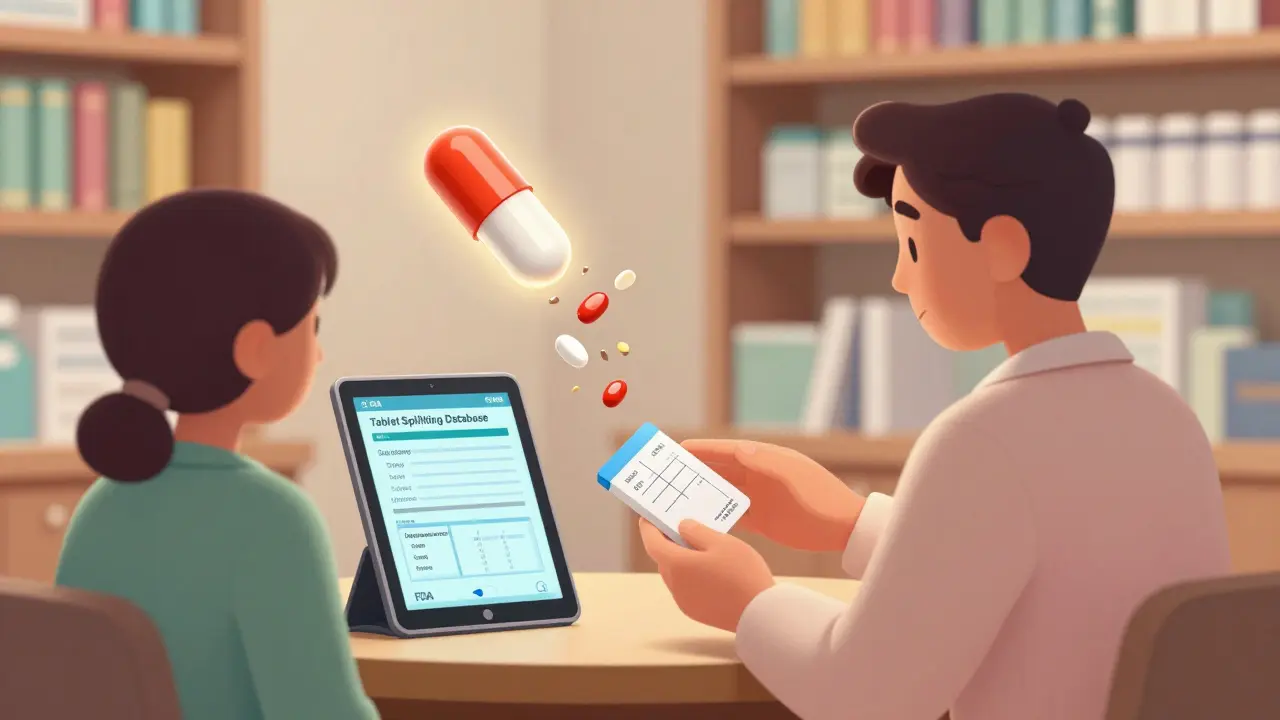
- Ask your pharmacist: They have access to databases that list splitability for every drug. Don’t rely on Google.
- Check the FDA’s Tablet Splitting Database: It’s updated regularly and lists which drugs are safe to split.
Even if a pill is scored, it might still be unsafe. For example, some extended-release tablets have a score line for manufacturing reasons-but splitting them still ruins the release mechanism.
What Happens When You Don’t Follow the Rules
In 2024, the Joint Commission found that improper pill splitting and crushing was among the top 10 medication safety issues in hospitals and nursing homes. The results? Hospitalizations, overdoses, and even deaths.One case involved an elderly woman on warfarin. Her caregiver used the same splitter for her blood thinner and her blood pressure pill. The warfarin residue caused her INR levels to spike. She ended up in the ER with internal bleeding.
Another case: a nurse crushed a patient’s antidepressant and mixed it into applesauce. The drug was enteric-coated. The patient vomited the entire dose. The depression relapsed.
These aren’t outliers. They’re predictable.
Who’s Responsible?
It’s easy to blame the caregiver, the nurse, or the patient. But the system shares the blame. Pharmacies often don’t warn patients. EHR systems don’t always flag “DO NOT CRUSH” alerts. Some pharmacies still sell unmarked pills without safety instructions.But you can take control. Always ask:
- Can this pill be split or crushed?
- Is there a safer alternative-a liquid form, a different dosage?
- Do I have the right tool?
- Have I cleaned it properly?
Pharmacists are your best resource. Don’t be afraid to ask. Most are happy to show you how to do it safely.
Final Tip: When in Doubt, Don’t
If you’re unsure whether a pill can be split or crushed-don’t do it. There’s almost always another way. Talk to your doctor about switching to a different formulation. Ask your pharmacist about liquid versions. Many medications now come in smaller doses or dissolvable tablets.It’s not about convenience. It’s about safety. A split pill might save you $5 a month. But if you get sick because of contamination? The cost is much higher.
Can I split a pill without a splitter?
No. Using scissors, knives, or your fingers increases the risk of uneven doses and contamination by up to 60%. Always use a dedicated pill splitter with a stainless steel blade and v-shaped holder. Even a cheap, FDA-compliant splitter costs less than a coffee and is far safer.
Is it safe to crush pills for elderly people who have trouble swallowing?
Only if the pill is specifically labeled as crushable. Most extended-release, enteric-coated, or hazardous drugs should never be crushed. Ask your pharmacist for a liquid version or a dissolvable tablet instead. Crushing can make the drug ineffective or dangerous.
How do I clean a pill splitter after use?
Wipe all surfaces with a 70% isopropyl alcohol wipe. Let it air dry completely. Never rinse it with water-moisture can leave residue or cause rust. Clean it between every different medication. Never share splitters between patients without cleaning.
Can I split my pills ahead of time for the week?
The FDA advises against it. Once split, pills are exposed to air and moisture, which can reduce potency or cause instability. Split pills only right before taking them. If you need a weekly system, ask your pharmacist about blister packs or pre-split doses from a pharmacy.
What should I do if I accidentally crush a hazardous drug?
Stop immediately. Wash your hands thoroughly. Avoid touching your face. Clean the area with alcohol wipes. Do not flush the powder. Take the residue to a pharmacy take-back program. Contact your doctor or pharmacist right away to see if you need medical monitoring or a replacement dose.
Are there pills that are safe to crush but still need special handling?
Yes. Even some non-hazardous pills can create fine dust that’s hard to clean. Always use a closed-system crusher for any crushed medication. Wear gloves. Clean the surface afterward. Dust from any pill can trigger allergies or respiratory irritation in sensitive people.
Alec Amiri
January 21, 2026 AT 16:23Y’all are out here crushing chemo pills like they’re M&Ms. I’ve seen nurses do this and I swear to god, one time a guy crushed OxyContin and took it-ended up in the ICU. No joke. Just stop. Buy the damn liquid form. It’s not that expensive.
Also, why are people using scissors? Are we in 1998? Get a $12 pill splitter. Amazon has them. I bought one for my grandma. She’s 82 and still alive. Coincidence? I think not.
Lana Kabulova
January 23, 2026 AT 14:16Wait-so you’re telling me that if I split a pill without a score line, I could be giving someone a 60/40 dose of warfarin? And that’s not even the worst part? The dust? The airborne particles? The fact that you can’t even see it? That’s not negligence-that’s biological roulette. And yet pharmacies still hand out unmarked pills like candy. This is a public health failure. Someone needs to sue the FDA. Or at least write a letter. I’m writing a letter.
Philip House
January 24, 2026 AT 12:27People don’t realize that pills are engineered like microchips. You don’t crack open a CPU to ‘make it easier.’ You don’t crush a time-release capsule like it’s a vitamin. It’s not stubbornness-it’s physics. And yet, here we are, treating medicine like a DIY project. We’ve outsourced responsibility to Google. And now people are dying because they thought ‘it’s just a pill.’
It’s not a pill. It’s a system. And you’re breaking it.
Also, ‘just wash it with water’? No. Water leaves residue. Alcohol evaporates. That’s why it’s 70%. Basic chemistry. I’m not even mad. Just disappointed.
Ryan Riesterer
January 24, 2026 AT 14:23NIOSH Class I hazardous drugs have a dermal exposure limit of 0.001 μg/m³. A single crushed tablet of cyclophosphamide can exceed that by 300x in an unsealed environment. The closed-system crusher isn’t a luxury-it’s a biocontainment protocol. OSHA’s 2025 standard isn’t regulatory overreach. It’s damage control.
And yes, the 28% aerosolization rate from open crushers is peer-reviewed. The data is public. You’re not being paranoid. You’re being statistically literate.
Jasmine Bryant
January 25, 2026 AT 01:15so i split my mom's blood pressure pill last week with a knife bc she said it was too big to swallow and now im terrified?? is she gonna die?? i cleaned it with a paper towel and i feel so bad
also she's on warfarin too so idk if i contaminated it??
Liberty C
January 26, 2026 AT 04:36Oh, so now we’re turning pharmacies into pill-crushing laboratories? Because clearly, the solution to America’s healthcare crisis is more manual labor for elderly caregivers who can’t afford the $300 liquid version of a $5 pill. Let me guess-the FDA’s real agenda is to sell more pill splitters. Or maybe it’s Big Pharma’s way of making us dependent on their ‘safe’ formulations. Either way, it’s a scam. I’ve been crushing my Adderall since 2015. I’m fine. And I’ve got a PhD in common sense.
Also, why are we still using ‘score lines’? That’s a 1950s design. We need smart pills. Or at least QR codes.
shivani acharya
January 26, 2026 AT 06:17Okay but what if I told you the whole pill-splitting thing is a lie? Like, what if the government doesn’t want us to split pills because then we wouldn’t need to buy new ones every month? And what about the fact that the same company that makes the splitters also makes the pills? Coincidence? I think not. And why do they say ‘don’t crush’ but never say why? Because they’re hiding something. The dust? The dust is just a cover. The real danger is the microchips in the pills that track your compliance. I read it on a forum. A guy in Poland said his cousin’s neighbor’s dog got sick after licking a crushed pill. That’s not science. That’s control.
Also, I tried using a coffee grinder once. It worked fine. I just washed it with vinegar. No alcohol needed. I’m not scared of dust. Dust is just air with attitude.
Sarvesh CK
January 26, 2026 AT 17:47There is a deeper philosophical question here: if we treat medicine as a disposable, modifiable object, what does that say about our relationship with our own bodies? We are conditioned to optimize, to fix, to bypass discomfort-even when doing so risks our integrity. The pill is not merely a chemical compound; it is a covenant between science and suffering. To crush it is to break that covenant without understanding its weight.
Perhaps the real issue is not the splitter, but the expectation that we should endure illness without adaptation. Liquid forms, dissolvable tablets, transdermal patches-these are not luxuries. They are dignities. And dignity should not be contingent on income, education, or access to a $20 tool.
We are not failing because we lack tools. We are failing because we lack compassion.
Hilary Miller
January 27, 2026 AT 05:53My grandma uses a Silent Knight splitter. She’s 89. Still walks her dog. No hospital visits. Just clean tool, one pill at a time. Simple. Done.
Also, if you’re crushing pills for a pet? Don’t. Just ask your vet for a liquid. Cats hate dust.
Margaret Khaemba
January 27, 2026 AT 14:57My cousin in India just told me they use a mortar and pestle for pills there. No cleaning. Just wipe with a cloth. I freaked out. But she said, ‘We’ve been doing it for generations.’ So… is it safe? Or are we overcomplicating it? I just want to know if my mom’s pills are gonna kill her or not. Help.
Malik Ronquillo
January 29, 2026 AT 08:02Why are we even talking about this? Just take the pill whole. If you can’t swallow it, you’re not trying hard enough. My grandma swallowed whole aspirin at 90. You just need grit. Also, I crushed a pill once. No big deal. Didn’t die. So chill.
Also, the FDA is just trying to sell more splitters. I know this. I’m not dumb.
Brenda King
January 29, 2026 AT 15:48Just want to say thank you for this post. I’m a home health aide and I’ve seen so many mistakes. I always use the alcohol wipe now. Even if it’s just for one pill. And I always ask the pharmacist. They’ve saved my butt more than once. You’re not being paranoid-you’re being responsible. And that’s worth something.
Also, if you’re splitting for cost? Ask about generics. Sometimes the 10mg is the same price as the 20mg you split. Just sayin’.
Keith Helm
January 30, 2026 AT 15:47Per FDA Guidance Document 2023-07, Section 4.2: ‘Any physical alteration of a pharmaceutical dosage form without explicit manufacturer or regulatory approval constitutes a deviation from labeled indications and may result in therapeutic failure or adverse events.’
Recommendation: Consult prescribing physician prior to modification. Document all alterations in patient record. Use only validated devices. Maintain cleaning logs.
Compliance is not optional.