
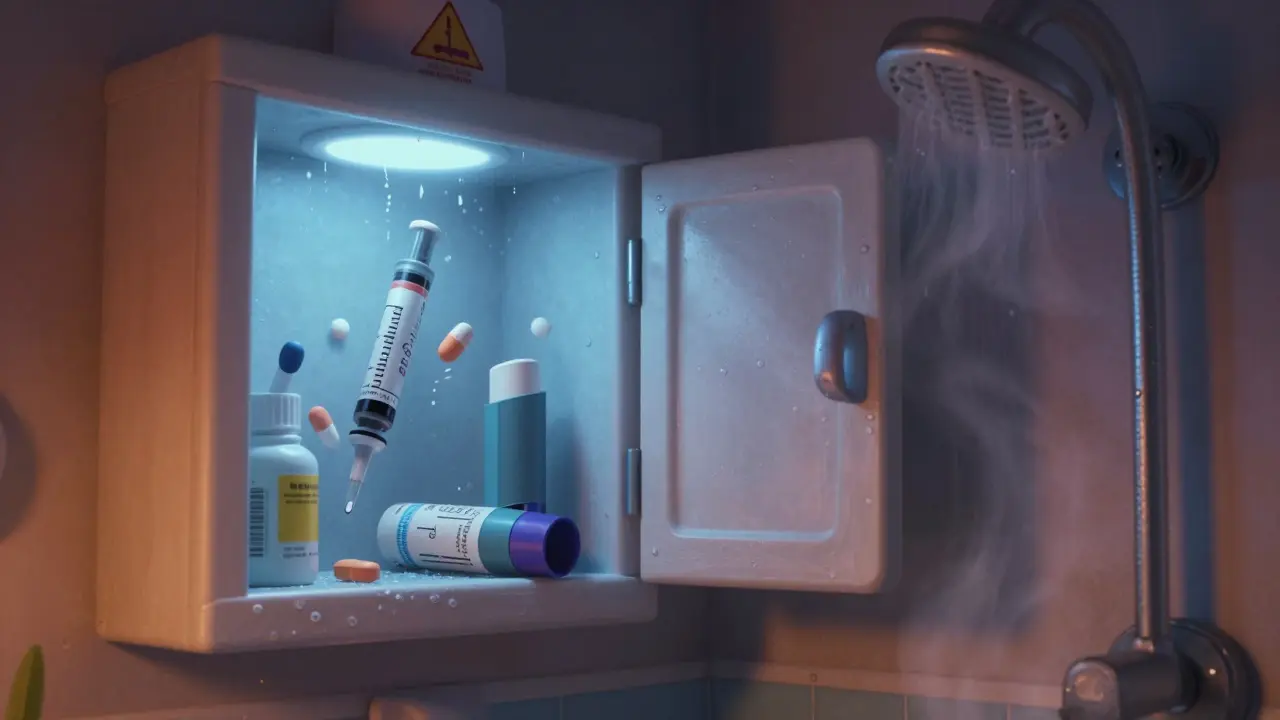
Most people assume that if a medication hasn’t passed its expiration date, it’s still safe and effective. But that’s not always true. Medication expiration isn’t just about time-it’s about conditions. Heat and humidity can wreck your pills, liquids, and inhalers long before the date on the bottle. If you keep your meds in the bathroom, near the stove, or in a hot car, you might be taking medicine that’s already lost its power-or worse, turned harmful.
Why Heat and Humidity Break Down Medicines
Drugs aren’t like canned food. They’re complex chemical formulas designed to stay stable under specific conditions. The pharmaceutical industry tests medications under controlled environments: 20-25°C (68-77°F) and 35-65% humidity. That’s the sweet spot. Outside of that range, things start to fall apart.
Heat speeds up chemical reactions. Moisture acts like a solvent, breaking down coatings and triggering reactions inside tablets. Together, they’re a one-two punch. A pill that looks fine might be 30% weaker. A liquid might separate. An inhaler could explode.
Take aspirin, for example. When it gets wet, it breaks down into salicylic acid and acetic acid-the same stuff in vinegar. That doesn’t just make it less effective. It can irritate your stomach more than the original pill. Insulin? One day at 37°C (98.6°F) and it can lose up to 20% of its potency. For someone with diabetes, that’s not a small drop. That’s a risk of hospitalization.
Which Medications Are Most at Risk?
Not all meds react the same way. Some are tough. Others are fragile.
High-risk medications:
- Insulin - Must be refrigerated until opened, then kept below 25°C. Heat causes proteins to denature. Once degraded, it won’t lower blood sugar.
- Nitroglycerin - Used for chest pain. Breaks down fast above 25°C. A weakened dose could mean a heart attack isn’t stopped in time.
- Thyroid meds - Like levothyroxine. Even slight heat exposure can change absorption. You might think your dose is right, but your body isn’t getting what it needs.
- Antibiotic suspensions - Liquid amoxicillin loses 30-40% potency in just 72 hours at room temperature. Taking it could mean your infection doesn’t clear-and bacteria get stronger.
- Biologics - Monoclonal antibodies, like those for cancer or autoimmune diseases. These are proteins. Heat above 8°C ruins their structure. Once broken, they’re useless.
- EpiPens - If exposed to temperatures over 30°C, the spring mechanism can fail. In an allergic emergency, that’s deadly.
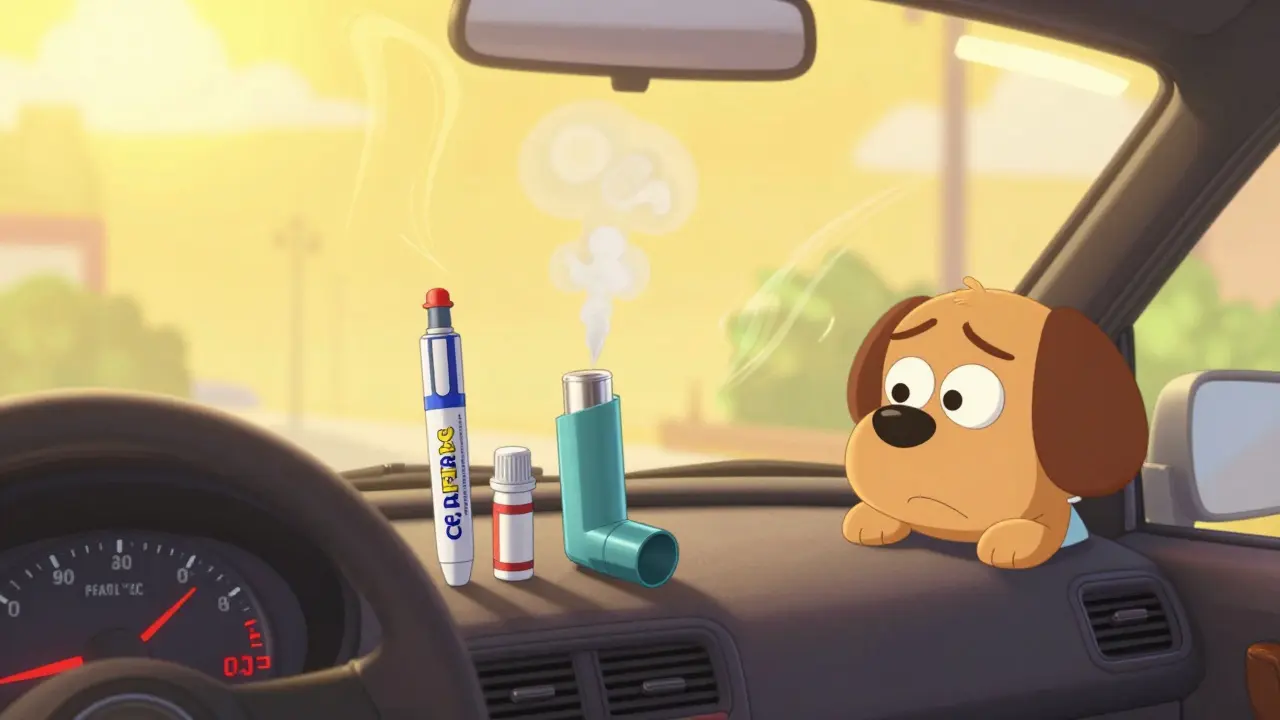
- Inhalers - Pressurized canisters can burst if left in a hot car. Temperatures above 49°C (120°F) turn them into projectiles.
On the flip side, solid tablets like ibuprofen, acetaminophen, and most statins hold up pretty well. Even at 30°C, they often keep 90%+ potency for months. But that doesn’t mean they’re invincible. Moisture can still cause them to stick, crack, or change how fast they dissolve.
Where You’re Probably Storing Your Meds (And Why It’s Wrong)
Most people store meds in the bathroom. It’s convenient. But it’s the worst place.
During a hot shower, humidity spikes to 70-90%. That’s way above the 60% limit most drugs can handle. Add the warmth from the water and the heater, and you’re hitting 30°C+-exactly where insulin and nitroglycerin start failing.
The kitchen is almost as bad. Near the sink? Humidity. Near the oven? Heat. A countertop above a dishwasher? That’s a 40°C+ zone during cleaning cycles. Studies show 89% of people don’t realize their storage habits are damaging their meds.
And don’t forget the car. On a 30°C day, the inside of a parked car can hit 60°C. That’s hotter than an oven. Leaving a bottle of insulin, EpiPen, or asthma inhaler in the glovebox for an hour could render it useless.
How to Tell If Your Medicine Is Damaged
There’s no app that scans your pills. No device that tells you if your tablet lost potency. But there are visible signs.
- Tablets that are sticky, discolored, or crumbly
- Capsules that are cracked, swollen, or leaking
- Liquids that are cloudy, separated, or have particles
- Odors that are sour, chemical, or unusual
- inhalers that feel lighter than usual or don’t spray properly
If you see any of these, don’t take it. Even if it’s not expired. You can’t taste or feel whether a drug is still working. That’s why experts say: When in doubt, throw it out.
How to Store Medicines Right
Here’s what actually works:
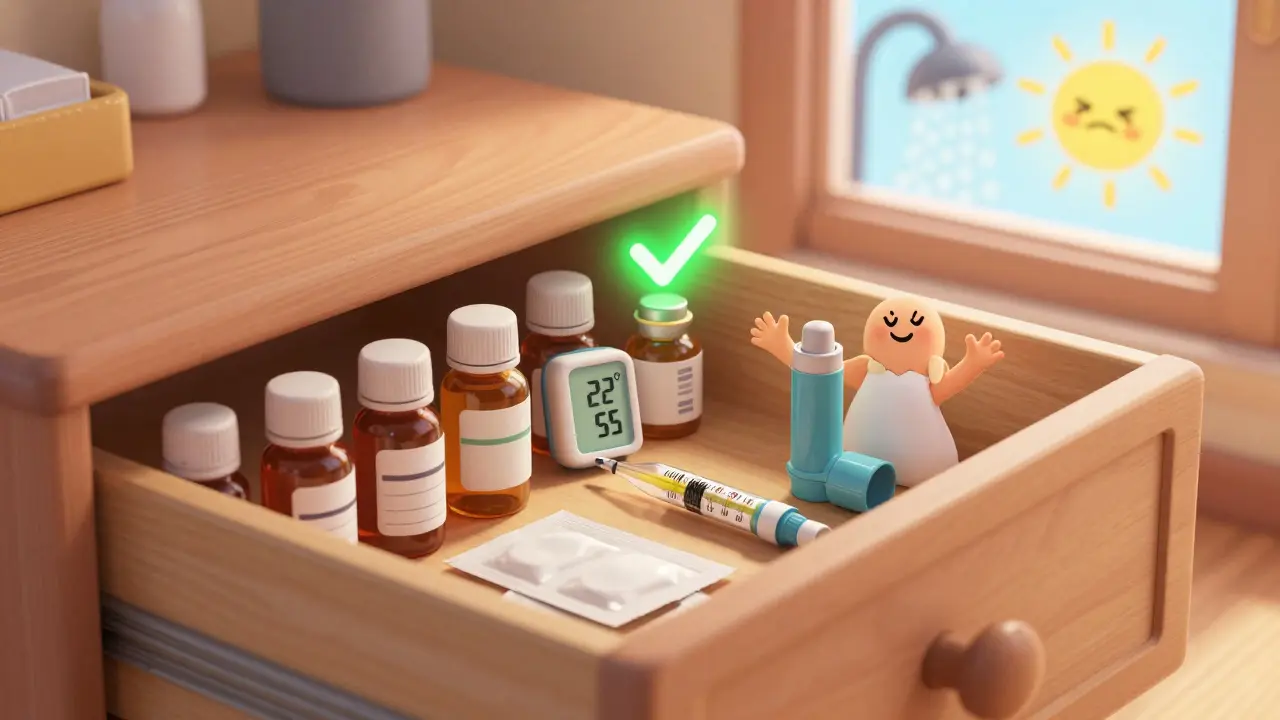
- Keep meds in a cool, dry place-like a bedroom drawer or closet.
- Avoid windows. Sunlight degrades many drugs.
- Leave pills in their original bottles. The caps are designed to seal out moisture.
- Use a desiccant packet if your bottle has one. Don’t throw it away.
- If you’re traveling, carry sensitive meds in a cooler with a cold pack-not in your purse or backpack.
- For insulin, EpiPens, or biologics: buy specialized cooling wallets from the pharmacy. They’re cheap and effective.
- Check your local pharmacy. Some offer free temperature-monitoring devices for high-risk meds.
The ideal temperature range? 15-25°C (59-77°F). Humidity? Below 60%. That’s not luxury-it’s basic safety.
The Real Danger: Not Just Ineffectiveness
Most people worry about meds not working. But the bigger risk? They work too well-or in the wrong way.
Extended-release pills are designed to release their dose slowly. Heat can break the coating. Suddenly, you get the whole dose at once. That’s an overdose waiting to happen.
Antibiotics that are weak don’t just fail. They let bacteria survive. Those survivors multiply. And now, you’ve helped create drug-resistant superbugs.
Insulin that’s degraded? Blood sugar spikes. Diabetic ketoacidosis. Emergency room visits. Long-term nerve damage. All because someone left their pen in the sun.
The FDA says using expired medicine is risky. But what they don’t say loud enough is: Using improperly stored medicine is just as dangerous.
What’s Changing? What’s Next?
Pharmacies are starting to respond. More medications now come with desiccants, dark bottles, and humidity-resistant packaging. Some high-end insulin pens now have temperature sensors built in.
But the biggest gap? Patient education. A 2020 study found that 91% of healthcare workers knew how to store meds properly. Only 37% of patients did.
Climate change is making this worse. Heatwaves are longer. Homes are hotter. In places like Wellington, where summer temperatures regularly hit 30°C, the old advice-“just keep it in the cabinet”-isn’t enough anymore.
Next time you refill a prescription, ask: “How should I store this?” Don’t assume. Don’t guess. Ask. It’s the only way to know your medicine will do what it’s supposed to.
Can I still use medicine after its expiration date if it looks fine?
No. Expiration dates aren’t arbitrary. They’re based on stability testing under ideal conditions. Even if a pill looks normal, heat and humidity may have already damaged it. You can’t see or smell degradation. Taking it could mean you’re getting less than half the dose-or a harmful chemical byproduct. Always replace expired meds.
Is it safe to store pills in a pill organizer?
Only if you’re using it for short-term use-like a week or two-and keeping it in a cool, dry place. Pill organizers expose meds to air and moisture every time you open them. Long-term storage in them increases degradation risk, especially for humidity-sensitive drugs like nitroglycerin or antibiotics. Keep your original bottles for long-term storage.
Do refrigerated meds need to be kept cold all the time?
It depends. Most refrigerated meds (like insulin) can be kept at room temperature for a short time after opening-usually 28 days. But check the label. Some, like certain biologics, must stay refrigerated even after use. Never leave them in a hot car or on a windowsill. If you’re unsure, call your pharmacy.
Can I freeze medicine to make it last longer?
No. Freezing can destroy the structure of many medications, especially liquids, suspensions, and biologics. It can cause crystals to form, separate ingredients, or break down protective coatings. Only freeze if the label specifically says to. Most meds are not designed for freezing.
What should I do if I think my medication has been damaged?
Stop using it immediately. Don’t try to fix it or guess if it’s still okay. Take it to your pharmacy-they can safely dispose of it. Ask for a replacement. If you’re on a life-saving drug like insulin, EpiPen, or heart medication, contact your doctor right away. They may need to adjust your treatment while you get a new supply.
Andrew Poulin
March 6, 2026 AT 12:17Heat and humidity wreck meds faster than you think. I left my insulin in the car for an hour during a heatwave. Didn't think twice. Ended up in the ER. Don't be me.
Weston Potgieter
March 7, 2026 AT 14:29Bathroom storage is a joke. Everyone does it. Why? Because it's convenient. But guess what? Your aspirin isn't aspirin anymore. It's vinegar with side effects. And no one cares until they're sick.
Vikas Verma
March 7, 2026 AT 19:30Pharmaceutical stability is governed by strict environmental parameters. Deviation beyond 25°C and 60% relative humidity triggers irreversible molecular degradation. For critical biologics, even transient exposure compromises therapeutic efficacy. Proactive storage protocols are non-negotiable for patient safety.
Sean Callahan
March 9, 2026 AT 13:17i just realized i’ve been keeping my epi pen in my purse all summer… like in the car all day… oh god. i think i might’ve killed myself. lol. not funny. i’m getting a new one today. pls someone tell me if i’m overreacting??
Ferdinand Aton
March 10, 2026 AT 23:30Actually, the FDA says most expired meds are still fine. You're scaring people over nothing. I've taken 5-year-old ibuprofen. Felt fine. Your fearmongering is worse than the heat.
Tim Hnatko
March 12, 2026 AT 20:07My grandma always stored her meds in a locked drawer in her bedroom. No bathroom. No kitchen. Just cool, dark, dry. She’s 87 and still sharp. Maybe she knew something we forgot.
Roland Silber
March 13, 2026 AT 15:17Great breakdown. One thing missing: humidity isn't just about showers. In places like Florida or Southeast Asia, even your bedroom can hit 70% humidity. A simple silica gel packet from your shoebox can make a huge difference. Keep it in the bottle. Don't toss it. It's not trash - it's insurance.
Also, if you're using a pill organizer, wash it weekly. Residue builds up. Moisture clings. It's a hidden degradation hotspot.
Patrick Jackson
March 15, 2026 AT 00:51My heart dropped when I read about insulin degrading in heat. I cried. Not because I'm dramatic - but because my brother almost died last summer. His EpiPen failed. He went into anaphylaxis. The spray was weak. The med was dead. We thought it was a fluke. Turns out, the car seat was 130°F.
I now carry a cooling wallet. It cost $12. It saved his life. I'll never forget that. If you're reading this… please, please, please check your meds. Don't wait for a crisis.
💔
Adebayo Muhammad
March 16, 2026 AT 01:55Let’s be clear: This isn’t about storage. This is about systemic negligence. The pharmaceutical industry designs packaging for idealized, climate-controlled environments - which exist only in corporate brochures. Meanwhile, 60% of Americans live in homes without AC. Climate change isn’t an abstract threat - it’s a pharmacokinetic crisis. And yet, we’re told to “just keep it in the drawer.” The drawer is a myth. The system is broken. The FDA is complicit. You’re not being careless - you’re being exploited.