
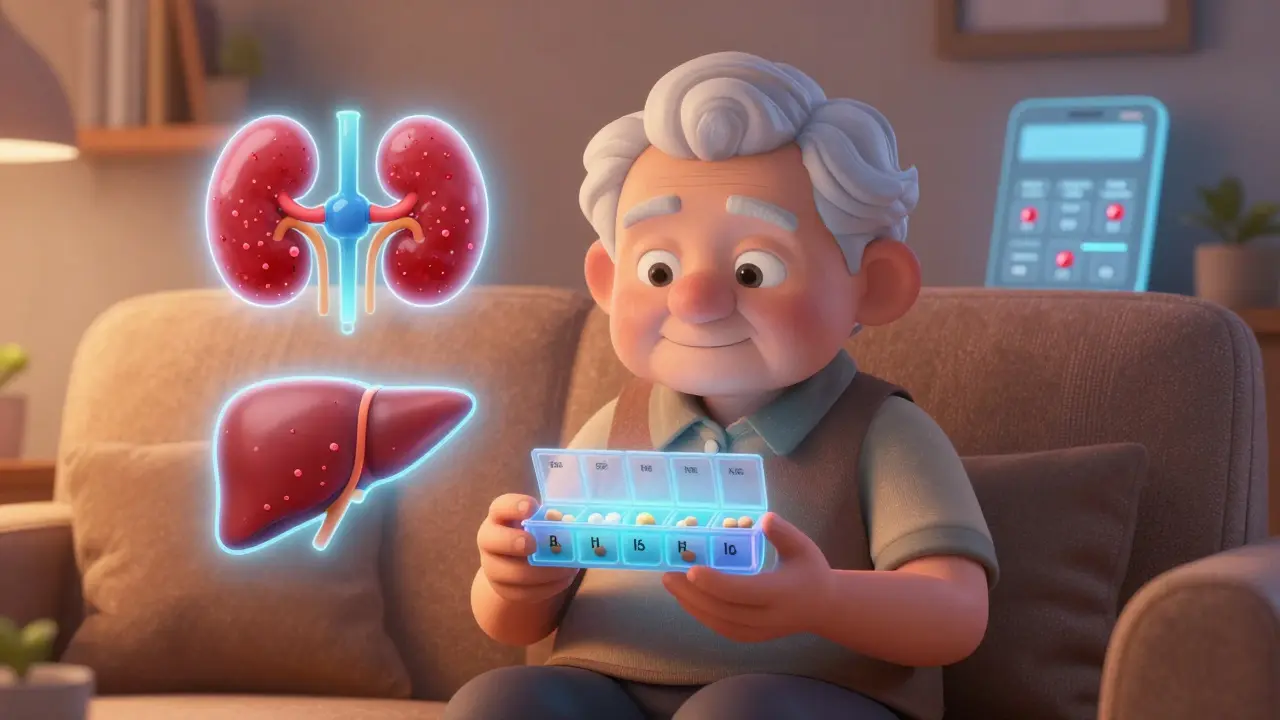
By the time you reach 65, your body no longer processes medications the same way it did at 30. What worked fine in your 50s might now make you dizzy, confused, or even land you in the hospital. This isn’t about being weak or old-it’s about biology. As we age, every system that handles drugs changes: kidneys slow down, the liver loses efficiency, body fat increases, and brain receptors become more sensitive. These aren’t small tweaks-they’re major shifts that can turn a safe dose into a dangerous one.
Why Your Kidneys Can’t Keep Up
Your kidneys are the main filters for most medications. After age 40, your glomerular filtration rate (GFR)-the measure of how well your kidneys clear waste-drops by about 0.8 mL/min per year. By 80, that’s a 30-50% drop. That means drugs like digoxin, warfarin, and many antibiotics stick around longer in your system. They don’t get flushed out. So if you’re still taking the same dose you did at 60, you’re basically overdosing.Doctors used to check serum creatinine alone to judge kidney function. That’s not enough. Creatinine levels can look normal even when kidney function has tanked, especially in older adults with less muscle mass. The right way is to calculate creatinine clearance using the Cockcroft-Gault equation. If your clearance is under 60 mL/min, nearly 40% of common prescriptions need a lower dose. Skipping this step is one of the top reasons seniors end up in the ER.
Your Liver Isn’t What It Used to Be
The liver breaks down about half of all medications. But by age 70, blood flow to the liver drops by 30-40%. That means drugs like propranolol, lidocaine, and even some painkillers take longer to be processed. Their half-lives stretch out. You might take your pill at 8 a.m. and still feel its effects at midnight.Some drugs rely on liver enzymes called CYP450 to break them down. These enzymes become less active with age. By 75, CYP2D6 activity drops by 25%. That’s huge for medications like codeine, antidepressants, and beta-blockers. A standard dose can build up to toxic levels. This is why older adults are more likely to have bad reactions to drugs that were perfectly fine earlier in life.
Body Fat Changes Everything
As you age, you lose muscle and gain fat. Between ages 25 and 75, men go from 25% body fat to 35-40%. Women jump from 35% to 45-50%. That matters because some drugs dissolve in fat. Diazepam, amitriptyline, and other lipid-soluble drugs get stored in fat tissue and then slowly leak back into your bloodstream. That’s why you might feel sleepy for days after a single dose of a sleeping pill that used to wear off in hours.This also affects dosing. A standard 5 mg dose of diazepam for a 30-year-old might be the same for an 80-year-old-but the older person’s body holds onto it much longer. The result? Accumulation. Drowsiness. Falls. Confusion. That’s why geriatric pharmacists often start with half the usual dose for these drugs and wait to see how the body reacts.
Protein Binding and Free Drug Levels
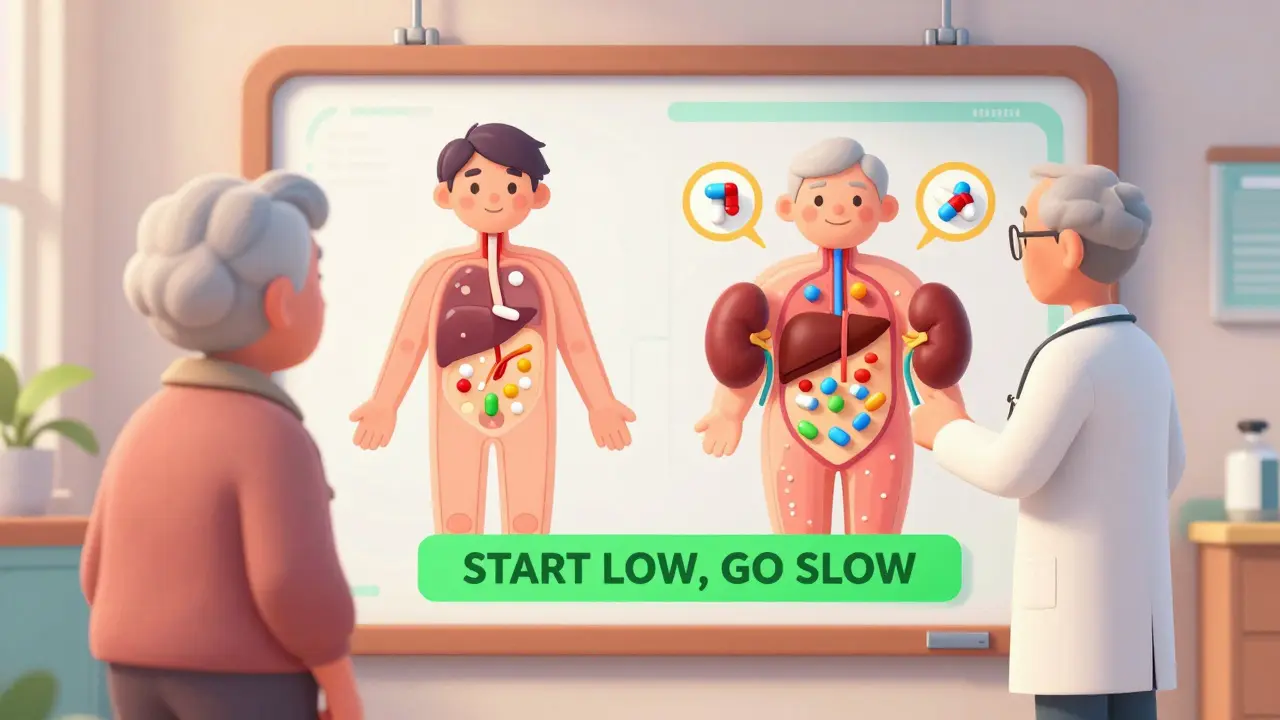
Many drugs, like warfarin and phenytoin, attach to proteins in the blood so they don’t act right away. But as you age, your liver makes less albumin-the main protein that binds drugs. Serum albumin drops from 4.5 g/dL in your 20s to 3.8 g/dL by 80. That means more of the drug floats around unbound, active, and ready to hit your tissues.Even if your total drug level looks normal on a blood test, the free (active) portion could be 15-20% higher. That’s why warfarin doses often need to be lowered by 20-30% in older adults. A standard 7 mg daily dose might be too much. Five to six mg is often enough. Too high, and you risk bleeding. Too low, and clots form. It’s a tight line-and aging makes it harder to walk.
Your Brain Gets More Sensitive
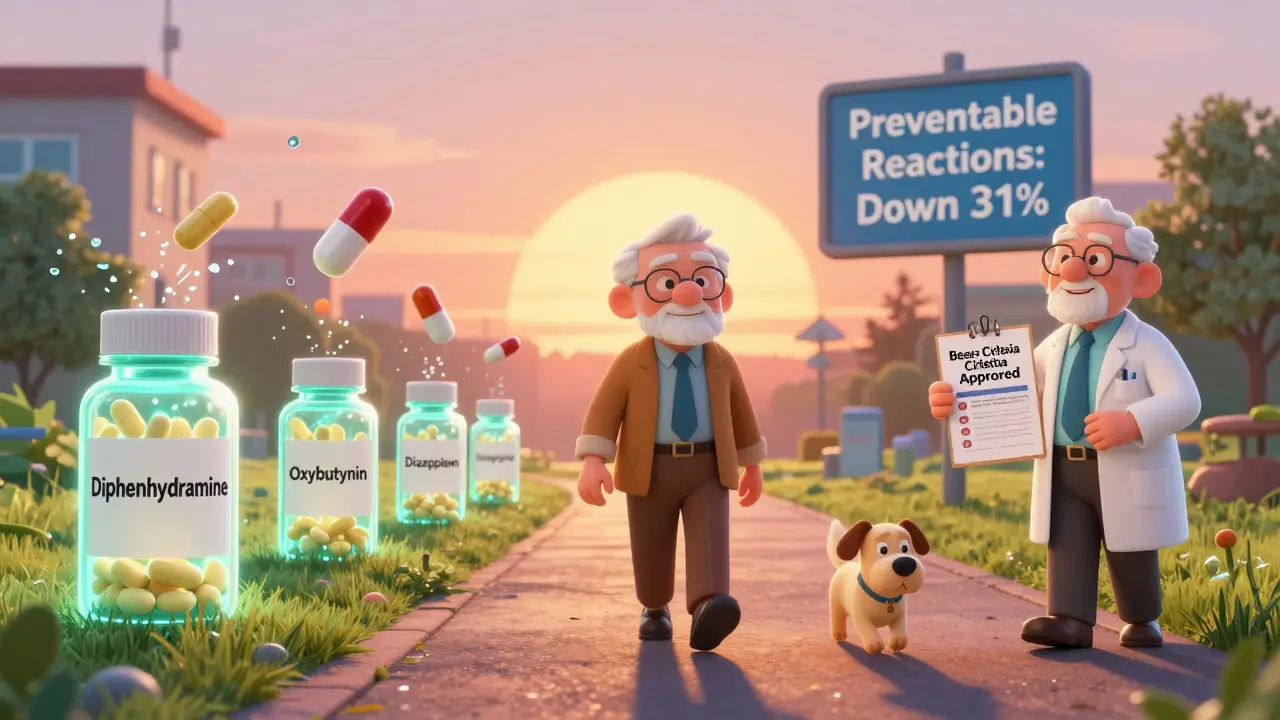
This might be the most dangerous change of all. Your brain becomes more sensitive to drugs that affect the nervous system. Benzodiazepines like lorazepam or diazepam? They can cause severe confusion, memory loss, and falls in seniors-even at low doses. Anticholinergics like diphenhydramine (Benadryl) or oxybutynin? They double or triple the risk of delirium, urinary retention, and constipation in people over 75.Studies show that 25% of older adults on anticholinergic drugs develop confusion, compared to just 5-8% of those under 60. That’s why the American Geriatrics Society Beers Criteria lists 30+ drugs to avoid or use with extreme caution in seniors. Diphenhydramine? Avoid. Amitriptyline? Use only if no other option. Oxybutynin? Try alternatives first.
Even common OTC meds can be risky. Cold and sleep aids often contain diphenhydramine or doxylamine. They’re labeled “gentle” or “for seniors”-but that’s marketing, not science. They’re still anticholinergics. And they’re still dangerous.
Why Standard Doses Don’t Work Anymore
Most drug trials are done on healthy adults under 65. That means the dosing you see on the bottle? It’s based on people who aren’t like you. Only 12% of phase 3 clinical trial participants are over 75. So when you’re prescribed a drug, you’re essentially being treated with data from someone 20-30 years younger.The FDA now requires pharmacokinetic studies in older adults for new drugs-but that doesn’t help with the 90% of medications already on the market. That’s why the “start low, go slow” rule is critical. For seniors over 75, begin with 25-50% of the standard dose. Wait a week. See how you feel. Then, if needed, increase slowly.
One Reddit user shared how their 82-year-old mother became confused on 25 mg of hydroxyzine. After cutting it to 10 mg, the confusion vanished. That’s not rare. It’s predictable. And it’s preventable.
What You Can Do Right Now
- Ask your doctor or pharmacist to run a creatinine clearance calculation-not just a creatinine blood test.
- Review every medication you take, including supplements and OTCs. Use the FDA Beers Criteria app (downloaded over 250,000 times) to check if any are risky for seniors.
- Track your anticholinergic burden. Use the Anticholinergic Cognitive Burden Scale. If your score is over 3, your dementia risk increases by 50% over seven years.
- Ask: “Is this drug still necessary?” Many seniors take meds for conditions that no longer exist-or that have been replaced by better options.
- Never stop a drug without talking to your doctor. But do question every pill you’re handed.
The Bigger Picture
The problem isn’t just individual pills. It’s a system built for younger bodies. In the U.S., preventable drug reactions send 177,000 seniors to the hospital every year. Medicare spends $12 billion annually treating side effects from medications that could’ve been avoided with proper dosing.There’s hope. New tools like DosemeRx and START/STOPP criteria are helping doctors make smarter choices. The FDA approved the first age-adjusted dosing algorithm for dabigatran in 2023, cutting major bleeding in 80+ patients by 31%. Researchers are now exploring senolytics-drugs that clear out aged, dysfunctional cells-to restore normal drug responses in older tissues.
But until clinical trials include more seniors, we’ll keep guessing. The best defense? Knowledge. Ask questions. Demand testing. Push for lower doses. Your body isn’t broken-it’s just different. And it deserves a prescription that matches who you are now, not who you were 30 years ago.
Why do seniors need lower doses of medication?
Seniors need lower doses because aging slows how the body absorbs, processes, and clears drugs. Kidneys filter less efficiently, the liver breaks down medications slower, body fat increases (trapping fat-soluble drugs), and brain receptors become more sensitive. Even a standard dose can build up to toxic levels, leading to falls, confusion, or organ damage.
What medications should seniors avoid?
The American Geriatrics Society Beers Criteria lists 30+ drugs to avoid or use with caution in seniors. These include benzodiazepines (like diazepam), anticholinergics (like diphenhydramine and oxybutynin), certain NSAIDs, and older antipsychotics. Even common OTC sleep aids and cold medicines often contain these risky ingredients. Always check the label or ask a pharmacist.
Is it safe to take Benadryl if I’m over 65?
No, it’s not recommended. Diphenhydramine (Benadryl) is a strong anticholinergic. In seniors, it increases the risk of confusion, memory loss, urinary retention, constipation, and falls by 3-5 times compared to younger adults. The Beers Criteria explicitly advises against its use in older people. Safer alternatives exist for allergies or sleep, like loratadine or melatonin.
How do I know if my kidney function is low enough to need a dose change?
Don’t rely on just your serum creatinine level-it can be misleading in older adults with low muscle mass. Ask for your creatinine clearance calculated using the Cockcroft-Gault equation. If your result is below 60 mL/min, you likely need lower doses for 40% of common medications, including blood pressure pills, antibiotics, and pain relievers.
Can aging make my medications stop working?
Yes, but not always in the way you think. Aging doesn’t usually make drugs less effective-it makes them too strong. Your body becomes more sensitive to their effects. For example, beta-blockers may not lower your heart rate as much as they used to, but they can still cause dangerous drops in blood pressure. Warfarin might work better than before, increasing bleeding risk. It’s about balance, not loss of effect.
What should I do if I feel dizzy or confused after starting a new medication?
Don’t ignore it. Dizziness, confusion, or memory lapses after starting a new drug are red flags-not side effects to “tough out.” Call your doctor or pharmacist immediately. These symptoms often mean the dose is too high for your aging body. Many times, cutting the dose in half or switching to a safer alternative resolves the issue within days.
laura Drever
January 13, 2026 AT 16:53Jesse Ibarra
January 14, 2026 AT 18:30Acacia Hendrix
January 16, 2026 AT 02:06Randall Little
January 16, 2026 AT 12:46Scottie Baker
January 17, 2026 AT 15:11Angel Molano
January 18, 2026 AT 10:09Pankaj Singh
January 18, 2026 AT 18:14jefferson fernandes
January 19, 2026 AT 12:11Vinaypriy Wane
January 19, 2026 AT 18:00Diana Campos Ortiz
January 20, 2026 AT 01:17Angel Tiestos lopez
January 21, 2026 AT 15:15John Tran
January 22, 2026 AT 03:19Kimberly Mitchell
January 23, 2026 AT 03:02sam abas
January 24, 2026 AT 20:20mike swinchoski
January 24, 2026 AT 23:02