
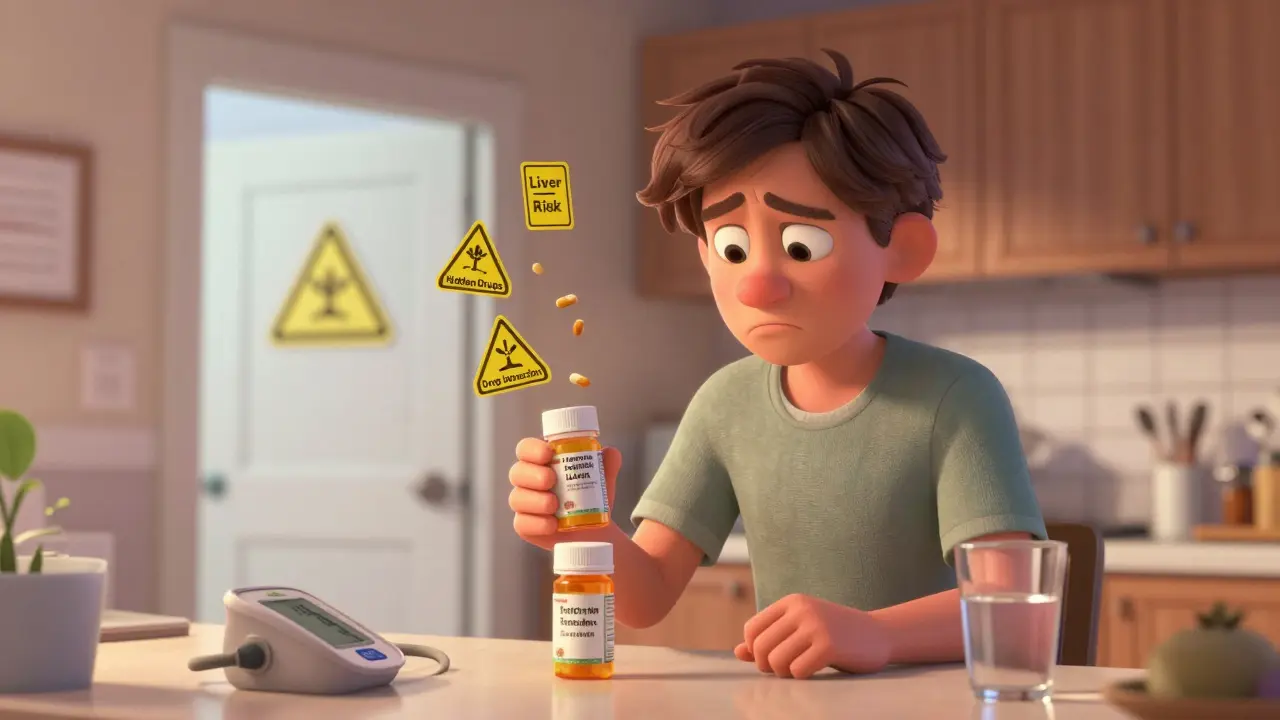
Every year, thousands of people in the U.S. take herbal supplements thinking they’re harmless-just nature’s version of medicine. But what they don’t realize is that some of these products contain hidden drugs, poison, or ingredients that can turn a routine medication into a life-threatening mix. The FDA doesn’t approve these supplements before they hit store shelves. That means you’re the first line of defense.
What the FDA Actually Does (and Doesn’t Do)
The FDA doesn’t test herbal supplements for safety or effectiveness before you buy them. That’s not a mistake-it’s the law. Under the Dietary Supplement Health and Education Act (DSHEA) from 1994, companies can sell anything labeled as a supplement without proving it works or is safe. The FDA only steps in after someone gets hurt. And even then, they’re stretched thin. With only 45 staff members regulating over 30,000 supplement companies, the odds of catching a dangerous product before it reaches you are slim.
What you see on the label? It might not be what’s inside. A 2013 study in JAMA Internal Medicine found that 15% of tested supplements contained undeclared pharmaceuticals-like statins, steroids, or erectile dysfunction drugs-hidden in what’s marketed as "natural". One product labeled as "herbal weight loss pills" was found to contain sibutramine, a banned appetite suppressant linked to heart attacks and strokes. Another, sold as "testosterone booster," had traces of anabolic steroids.
Herbal Products That Can Kill When Mixed With Medications
Some herbs are safe on their own. But when you’re on blood thinners, antidepressants, or heart meds, they can turn deadly.
- St. John’s Wort: Used for mild depression, it can make birth control, antidepressants, and HIV meds useless. It also reduces the effectiveness of warfarin, leading to dangerous clots.
- Ginkgo Biloba: Promoted for memory and circulation, it thins the blood. When taken with aspirin, ibuprofen, or warfarin, it can cause uncontrolled bleeding. One case report in the Journal of Clinical Pharmacy and Therapeutics described a patient who bled internally after combining ginkgo with warfarin-without telling their doctor.
- Green Tea Extract: High doses in weight loss pills have caused acute liver failure. The FDA has issued multiple warnings about liver damage linked to concentrated green tea extracts.
- Kava: Marketed for anxiety, it’s been tied to severe liver toxicity. Several countries have banned it. The FDA has warned consumers to avoid it, especially if you drink alcohol or take liver-metabolized drugs.
- Valerian Root: Often used for sleep, it can amplify the effects of sedatives, anesthesia, and alcohol. One patient nearly didn’t wake up after surgery because they didn’t tell their anesthesiologist they took valerian the night before.
These aren’t rare cases. Between 2018 and 2022, the FDA received over 14,000 reports of adverse events from supplements. The most common? Gastrointestinal issues, heart palpitations, and liver damage. But here’s the scary part: experts estimate only 1% of real incidents are ever reported.
Why Doctors Never Know What You’re Taking
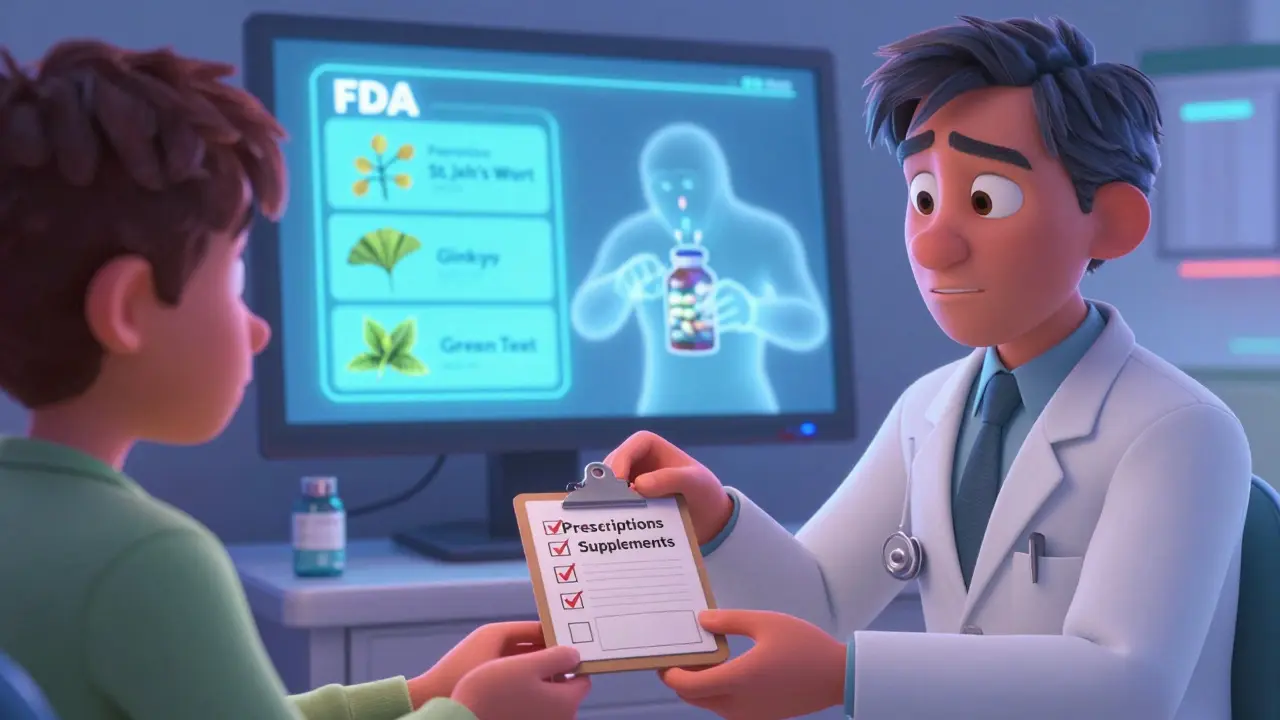
Most people don’t think of supplements as "medications." So when a doctor asks, "Are you taking any drugs?" they say no. But if you’re popping turmeric capsules, ashwagandha, or melatonin, you’re still taking something that affects your body.
A 2022 survey of 1.5 million doctors on the Sermo network found that 68% of physicians regularly treat patients who didn’t disclose supplement use. That’s not just negligence-it’s a safety gap. A patient on blood pressure meds who starts taking hawthorn berry might drop their pressure too low. Someone on thyroid medication who takes licorice root could develop dangerous electrolyte imbalances.
Doctors aren’t mind readers. If you don’t tell them, they can’t protect you.
How to Spot a Dangerous Supplement
Not all supplements are risky. But some red flags should make you pause:
- No "Supplement Facts" label: Legitimate products must list ingredients, amounts, and serving size. If it’s missing, walk away.
- Claims like "cures cancer," "boosts immunity," or "works like Viagra": These are illegal. If it sounds too good to be true, it is.
- Secret formulas or "proprietary blends": If the label doesn’t say how much of each herb is in there, you have no idea what you’re consuming.
- Latin names missing: Botanicals like "valerian" should be listed as Valeriana officinalis. If it’s not there, the product might be mislabeled or fake.
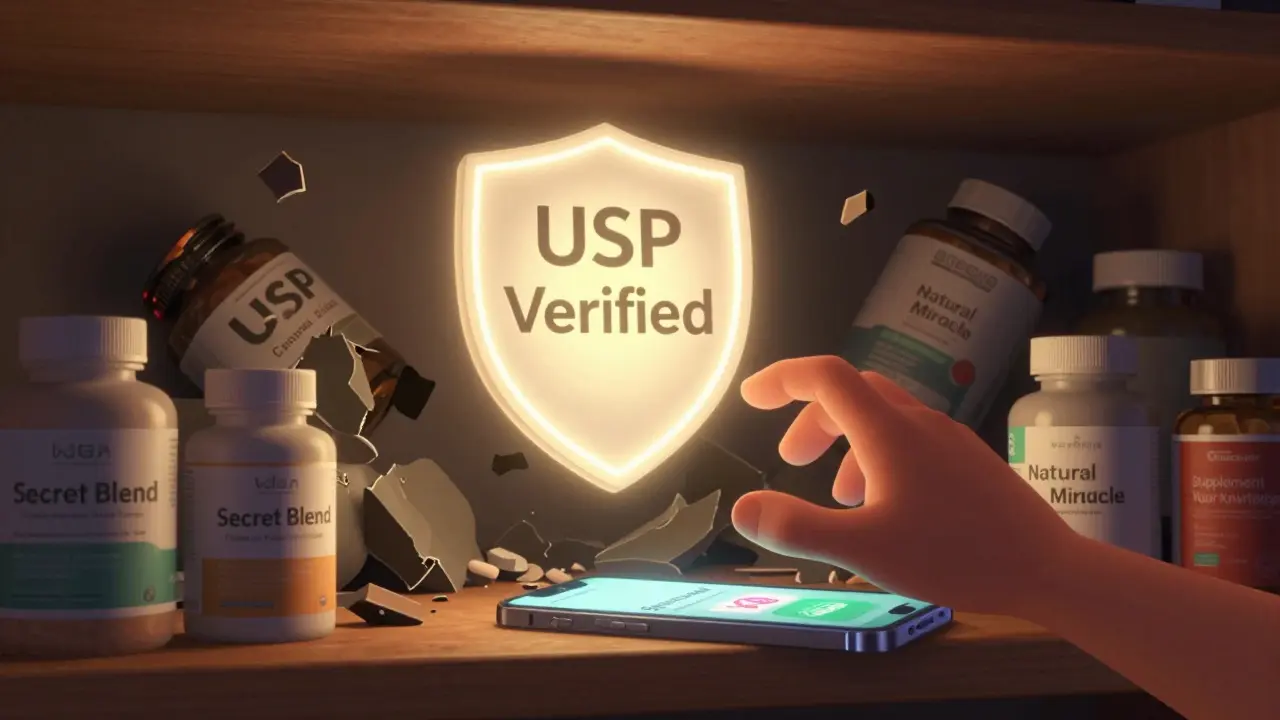
- No third-party verification: Look for seals from USP, NSF, or ConsumerLab. These groups test for purity, potency, and contamination. Products with USP verification are 94% accurate on label claims-non-verified ones? Only 67%.
The FDA maintains a public database of warning letters. You can search for your product by name. If a company got a letter for selling contaminated or misbranded goods, that’s a red flag you can’t ignore.
What You Should Do-Right Now
Here’s what actually works:
- Make a list: Write down every supplement, herb, vitamin, or tea you take-even if you think it’s "just a little." Include dosage and frequency.
- Bring it to every appointment: Don’t wait for your doctor to ask. Say: "Here’s what I’m taking. Can you check for interactions?"
- Use the FDA’s Safety Reporting Portal: If you feel sick after taking something, report it. Even if it’s minor. The more reports, the faster the FDA acts.
- Choose verified products: Pay a few extra dollars for USP or NSF certification. It’s not foolproof, but it cuts your risk by more than half.
- Check the FDA’s website weekly: New warnings pop up all the time. A product that was safe last month might be pulled this week.
The National Center for Complementary and Integrative Health offers a free app called "Supplement Your Knowledge" with 1,200+ science-backed fact sheets. Use it. It’s not marketing-it’s facts.
The Bottom Line
Herbal supplements aren’t inherently bad. But they’re not regulated like medicine. That means the burden of safety falls on you. If you’re taking any prescription drugs, have a chronic condition, or are planning surgery, you need to treat supplements like you would a new medication: with caution, disclosure, and verification.
There’s no such thing as "natural and safe" if it interacts with your body’s chemistry. The FDA can’t protect you. But you can protect yourself.
Do herbal supplements need FDA approval before being sold?
No. Unlike prescription drugs, herbal supplements don’t need FDA approval before being sold. The FDA only steps in after a product is on the market and found to be unsafe, mislabeled, or contaminated. Manufacturers are required to notify the FDA about new ingredients, but they don’t have to prove safety or effectiveness.
Can herbal supplements interact with prescription medications?
Yes, and these interactions can be dangerous. For example, St. John’s Wort can make birth control, antidepressants, and blood thinners ineffective. Ginkgo biloba can increase bleeding risk when taken with aspirin or warfarin. Green tea extract has caused liver failure in high doses. Always tell your doctor what you’re taking.
How do I know if a supplement is safe?
Look for third-party verification seals like USP, NSF, or ConsumerLab. These organizations test for purity, potency, and contamination. Also check the FDA’s warning letter database for your product name. Avoid supplements with secret formulas, exaggerated claims, or missing ingredient lists.
Why don’t doctors always know about my supplements?
Most people don’t consider supplements to be "medications," so they don’t mention them during appointments. A 2022 survey found that 68% of physicians treat patients who didn’t disclose supplement use. This creates serious risks, especially with blood thinners, heart meds, and antidepressants. Always proactively share your supplement list.
What should I do if I have a bad reaction to a supplement?
Stop taking it immediately and contact your doctor. Then, report the reaction to the FDA’s Safety Reporting Portal. Even if your symptoms seem minor, reporting helps the FDA track dangerous products. Between 2018 and 2022, over 14,000 adverse events were reported-but experts believe less than 1% of real incidents are ever reported.
caroline hernandez
February 4, 2026 AT 20:28Let’s be real-supplement regulation is a regulatory black hole. Under DSHEA, manufacturers don’t need to prove safety or efficacy. That’s not a loophole; it’s a structural failure. The FDA’s 45-person team is expected to police 30,000+ companies? That’s like assigning one cop to monitor a metropolis. We’re not just talking about ‘natural’ ginkgo here-we’re talking about adulterated products with sibutramine, anabolic steroids, and undisclosed antihypertensives. The burden of proof is inverted: consumers must prove harm after the fact. This isn’t oversight-it’s negligence by design.
Third-party verification (USP, NSF) isn’t optional anymore. If your supplement doesn’t have it, treat it like unverified software-don’t install it. And ‘proprietary blends’? That’s corporate obfuscation. If they won’t tell you how much of each ingredient is in there, they’re hiding something. Period.
Also, stop calling these ‘herbs.’ Many are pharmacologically active compounds with half-lives, CYP450 interactions, and dose-response curves. If you’re on warfarin and taking ginkgo, you’re not ‘being natural’-you’re playing Russian roulette with your coagulation cascade.
Jhoantan Moreira
February 5, 2026 AT 11:51Appreciate the deep dive! 🙌 Honestly, I used to think ‘natural’ meant ‘safe’-until my cousin ended up in the ER after mixing ashwagandha with her thyroid med. Turns out, it can mess with TSH levels. Scary stuff.
Now I always check USP seals and dump everything into my doctor’s notes. She even has a sticky note on her desk that says ‘SUPPLEMENTS = MEDS.’ 😅
Thanks for the nudge to be more vigilant. We all need that reminder sometimes 💚
Geri Rogers
February 7, 2026 AT 07:43OMG YES. I work in pharmacy and I’ve seen too many patients come in with liver enzymes through the roof because they were ‘just taking green tea extract for weight loss.’
And no, ‘just a little’ doesn’t cut it. One capsule a day? That’s still a concentrated dose. These aren’t chamomile tea bags. They’re bioactive compounds with pharmacokinetics. Your liver doesn’t care if it’s ‘natural’-it just metabolizes toxins.
Also, stop saying ‘I don’t take drugs.’ You’re taking supplements. They’re drugs. Period. If you’re on blood pressure meds and taking hawthorn, you’re literally self-prescribing a hypotensive cocktail. Your doctor can’t fix what they don’t know.
Pro tip: Print out your supplement list. Bring it. Don’t say ‘I think I take…’-show them. You’ll save lives. Including your own. 🚨
Prajwal Manjunath Shanthappa
February 7, 2026 AT 08:45Also, 'USP verified' is not a panacea. It's a minimum. And even that is inconsistently enforced. You need to go beyond verification-you need to interrogate the supply chain. Where is the raw material sourced? Who tested it? When? And under what conditions? These are not rhetorical questions-they are survival criteria.
Katherine Urbahn
February 7, 2026 AT 23:09Shelby Price
February 8, 2026 AT 02:28Jesse Naidoo
February 9, 2026 AT 17:28So… if I take melatonin every night, am I a drug user? I mean, it’s not like I’m doing cocaine. It’s just… sleep. But you’re saying it can mess with hormones? And I didn’t tell my doc because I thought it was ‘just a vitamin’? Oh god. I’m gonna die alone and unmonitored, aren’t I?
Daz Leonheart
February 11, 2026 AT 01:58Man, I never realized how many things I was taking that could be dangerous. I’ve been popping ashwagandha for stress and ginkgo for focus. Thought it was all chill. But now I’m scared to even take my multivitamin.
Just started writing down everything I take. Even the chamomile tea. Feels weird, but kinda empowering? Like I’m finally adulting.
Thanks for the wake-up call. I’m gonna print this out and stick it on my fridge.
Janice Williams
February 12, 2026 AT 15:49Roshan Gudhe
February 13, 2026 AT 11:01There’s a deeper question here, isn’t there? Beyond the chemistry of ginkgo and the pharmacokinetics of St. John’s Wort… we’re confronting a cultural delusion: that nature is inherently benevolent, and that science is an intrusion. We’ve replaced dogma with herbalism. We worship the plant, not the process.
But nature is indifferent. Poison ivy is natural. Botulinum toxin is natural. The deadliest substances on Earth were not synthesized in labs-they evolved in forests and oceans.
Perhaps the real danger isn’t the supplement. It’s the belief that ‘natural’ = moral, or pure, or wise. We’ve outsourced our responsibility to the earth, and now we’re surprised when the earth doesn’t care if we live or die.
Maybe the real remedy isn’t more labels or more FDA warnings.
Maybe it’s humility.