
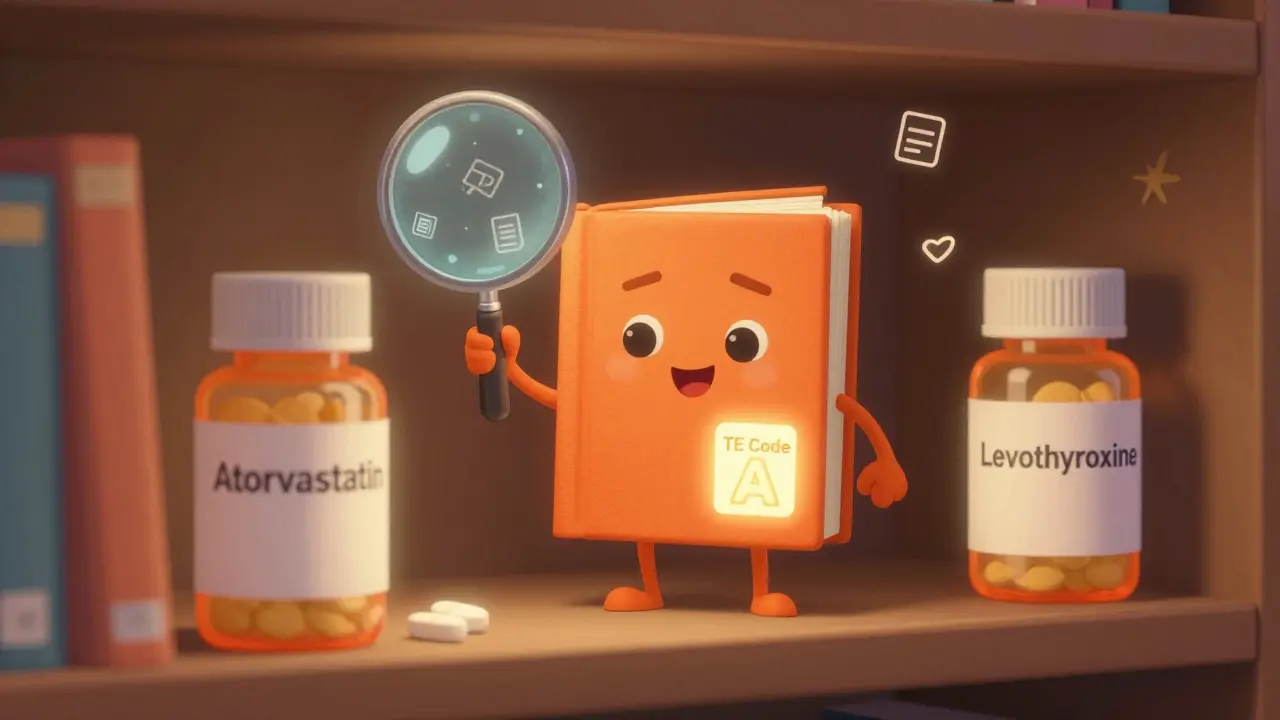
The FDA Orange Book is the official government list that tells pharmacists, doctors, and insurers which generic drugs can safely replace brand-name medicines. It’s not just a directory-it’s the rulebook that keeps the U.S. generic drug system running. Every time you pick up a cheaper version of your prescription, chances are the Orange Book made that swap possible.
What Exactly Is the FDA Orange Book?
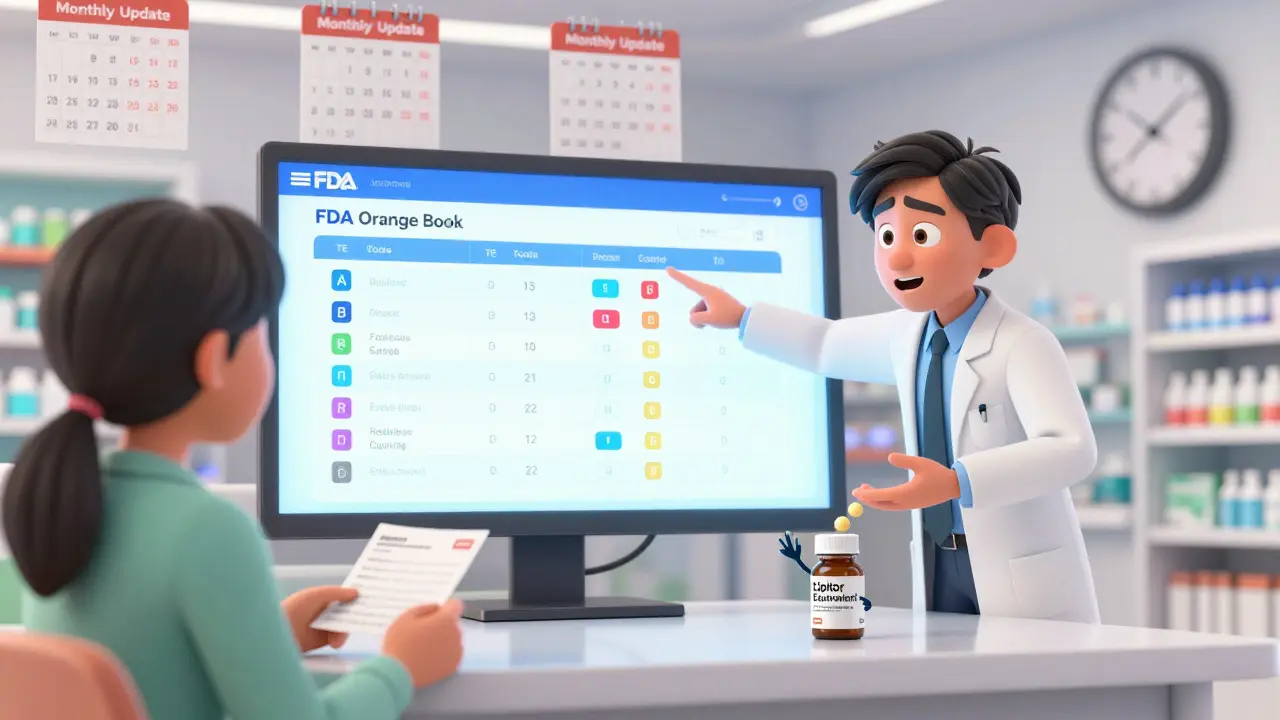
The full name is Approved Drug Products with Therapeutic Equivalence Evaluations. It’s published by the Food and Drug Administration (FDA) and updated every month. The Orange Book lists over 16,000 approved drug products, including both prescription and over-the-counter medicines. But it doesn’t just say what’s approved-it tells you whether a generic version is a true substitute for the brand-name drug.
It got its nickname because of the color of its original print cover. Today, it’s fully digital and free to access on the FDA’s website. The data inside comes from two main approval paths: New Drug Applications (NDAs) for brand-name drugs and Abbreviated New Drug Applications (ANDAs) for generics.
How Generic Drugs Get Listed
Generic drug makers don’t have to repeat the same expensive clinical trials that brand-name companies do. Instead, they file an ANDA, proving their version is bioequivalent to the original. That means it delivers the same amount of active ingredient into the bloodstream at the same rate.
The FDA picks one brand-name drug as the Reference Listed Drug (RLD). This is the gold standard. Every generic that wants to be approved must show it matches the RLD. Once approved, the generic gets listed in the Orange Book with a clear label: “RLD: No”.
For example, if you search for atorvastatin, you’ll see Lipitor listed as the RLD. Below it, you’ll find dozens of generic versions-all approved because they match Lipitor’s performance in the body.
Therapeutic Equivalence (TE) Codes: The Secret Key
Not all generics are treated the same in the Orange Book. Each one gets a Therapeutic Equivalence (TE) code, a two-letter rating that tells you how safe it is to swap.
- A codes mean the generic is therapeutically equivalent. These are the ones pharmacists can substitute without asking the doctor.
- B codes mean there’s uncertainty. Maybe the drug is hard to absorb consistently, like some extended-release pills or inhalers. These aren’t automatically interchangeable.
For instance, a generic version of levothyroxine might carry a B code because tiny differences in absorption can affect thyroid levels. Doctors often prefer to stick with the same brand in these cases.
TE codes are why some pharmacies won’t switch your generic without checking first. It’s not about cost-it’s about safety.
Patents and Exclusivity: The Hidden Rules
The Orange Book doesn’t just list drugs-it lists patents. Brand-name companies must submit patent information when they apply for approval. These include patents on the drug’s chemical structure, how it’s made, or how it’s used.
Each patent gets a number, an expiration date, and a use code (like U-123). These listings can delay generic entry. If a generic company challenges a patent, the FDA can hold off approval for up to 30 months while the legal case plays out.
This is where things get controversial. Some companies list dozens of patents on one drug-called “patent thickets”-to block competition. The FDA has cracked down on this in recent years, removing improperly listed patents to speed up generic access.
But here’s the catch: the FDA doesn’t decide if a patent is valid. It just lists what the brand company submits. That’s why lawsuits over Orange Book patents are so common.
Authorized Generics: The Gray Area
Not all generics are created equal-even if they’re made by the same company. An authorized generic is the exact same drug as the brand, just sold without the brand name. It’s made by the original manufacturer under their NDA, not an ANDA.
For example, when Pfizer sells a generic version of Viagra under its own name, it’s an authorized generic. It’s identical to the brand, but cheaper.
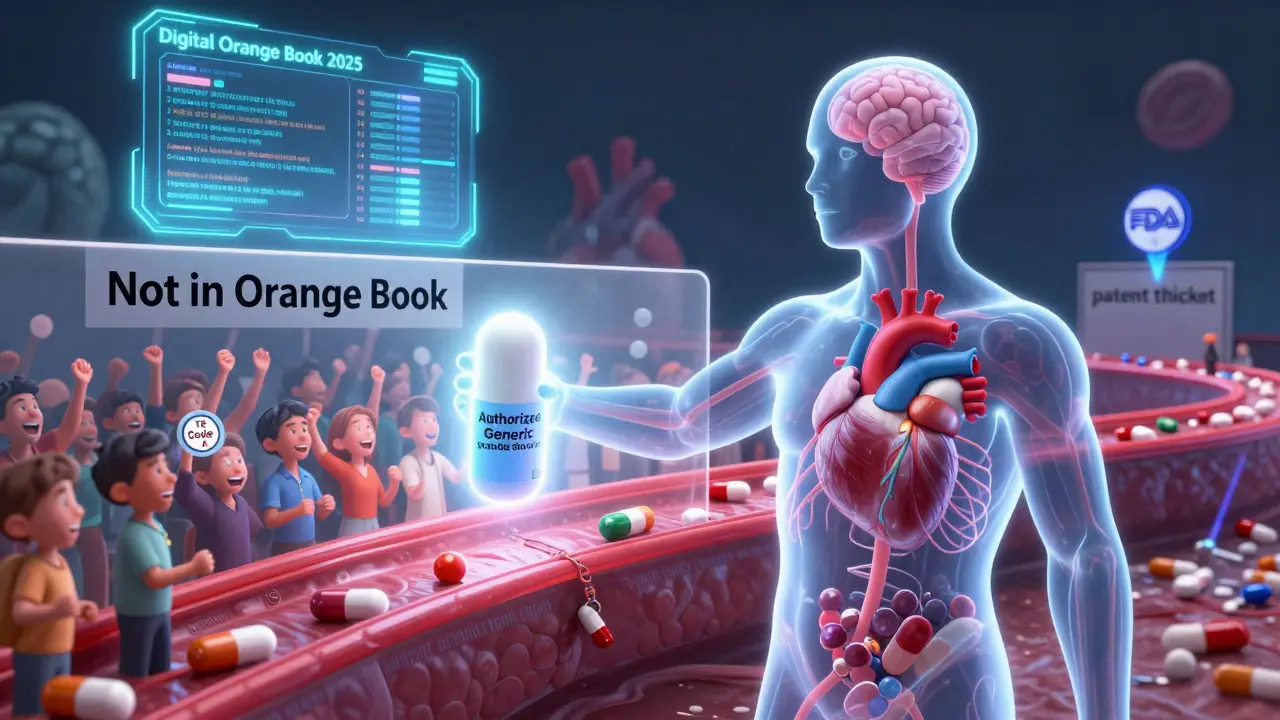
Here’s the twist: authorized generics aren’t listed in the Orange Book. They appear on a separate FDA list. That means if you’re looking for a generic version of a drug, you might miss out on the exact same product just because it’s not labeled as an ANDA.
What About Over-the-Counter Drugs?
The Orange Book includes OTC medicines, but they’re treated differently. The FDA doesn’t assign TE codes to them because they’re not meant to be swapped like prescriptions. A generic ibuprofen doesn’t need a code-it’s just ibuprofen.
Still, if you’re comparing different brands of allergy meds or pain relievers, the Orange Book can show you which ingredients are approved and in what strengths. It’s useful, but not for substitution decisions.
How to Use the Orange Book (Step by Step)
Here’s how to find what you need:
- Go to the Electronic Orange Book on the FDA website.
- Search by the drug’s brand name (like Advair) or active ingredient (like fluticasone/salmeterol).
- Look for the RLD-this is the original brand.
- Below it, you’ll see all approved generics. Check the TE code next to each one.
- Click on the patent tab to see what’s blocking generic entry.
Pharmacists use this daily. But even they get tripped up by complex products like inhalers or injectables, where bioequivalence is harder to prove. That’s why some states have extra rules about substitutions.
Why This Matters to You
Every time you save money on a prescription, the Orange Book helped make that happen. In 2022, 90% of U.S. prescriptions were filled with generics. That’s $67 billion saved in one year.
But if a generic is misclassified-or if a patent is listed incorrectly-you might not get the cheapest option. Or worse, you might get a drug that doesn’t work the same.
Doctors and pharmacists rely on this system. If you’re switching generics and notice a change in how you feel, check the TE code. A B code might mean you need to stick with the original.
What’s Changing in 2025?
The FDA is building a new Digital Orange Book, due by 2025. It will update in real time, not monthly. That means faster access to new generics and fewer delays.
They’re also making TE codes more detailed for complex drugs like inhalers and eye drops. Right now, a single “A” code hides big differences. The new system will break them down further so pharmacists can make smarter choices.
And the FDA is cracking down harder on patent listings that don’t make sense. If a company tries to list a patent for a method of use that’s not even approved, it’s getting removed.
This isn’t just bureaucracy. It’s about keeping the system fair-for patients, for manufacturers, and for the people who fill your prescriptions.
Is the FDA Orange Book the same as Drugs@FDA?
No. Drugs@FDA lists all drug applications-approved, pending, and rejected. The Orange Book only includes drugs that are approved and have therapeutic equivalence ratings. If a generic is still under review, it won’t show up in the Orange Book yet, even if it’s on Drugs@FDA.
Can a generic drug be pulled from the Orange Book?
Yes. If the FDA finds a generic doesn’t meet bioequivalence standards after approval, or if the manufacturer stops selling it, the product is moved to the Discontinued Drug Product List. It’s no longer considered available for substitution.
Why do some generics have different TE codes even if they’re made by the same company?
Because the formulation matters. A generic version of a pill might get an “A” code, but if the same company makes a liquid version of the same drug, it could get a “B” code due to differences in absorption. The Orange Book evaluates each dosage form separately.
Do state laws override the Orange Book’s TE codes?
Sometimes. Some states allow pharmacists to substitute only if the TE code is “A,” while others allow substitutions even for “B” codes with doctor approval. Always check your state’s pharmacy board rules-local laws can change what’s allowed at the counter.
How often is the Orange Book updated?
Monthly. New approvals, patent changes, and discontinued products are added by the 15th of each month. The FDA publishes the updated version online, and most pharmacy systems sync with it automatically.
What’s the difference between a generic and an authorized generic?
A generic is made by a different company under an ANDA. An authorized generic is made by the brand-name company itself, sold without the brand name, and listed under the original NDA. Both are chemically identical, but only generics appear in the Orange Book.
Are all generic drugs safe to substitute?
Only those with an “A” TE code. “B” codes mean the FDA has concerns about consistent performance-especially with drugs that have narrow therapeutic windows, like blood thinners or seizure medications. Always talk to your pharmacist if you’re unsure.
steve ker
January 12, 2026 AT 07:19The Orange Book is just bureaucratic theater. Everyone knows generics work. Stop overcomplicating it with TE codes and patent nonsense.
Pharmacists swap meds daily. Patients don't care about RLDs.
George Bridges
January 13, 2026 AT 02:05This is actually one of the most important but overlooked systems in American healthcare.
Most people have no idea how their $10 pill came to be, but this document makes it possible.
It’s not flashy, but it saves billions and keeps people on their meds.
Big props to the FDA team keeping this updated month after month.
Bryan Wolfe
January 15, 2026 AT 01:59OMG YES! I’ve been screaming about this for years!
The Orange Book is the unsung hero of affordable medicine.
Every time I see someone complain about drug prices, I want to hand them this link.
And the TE codes? Absolute genius.
It’s not just about cost-it’s about safety, precision, and trust.
Pharmacists are the real MVPs here-they’re the ones reading this stuff daily.
Also, authorized generics? Mind blown. I had no idea the brand company could sell their own generic.
And the 2025 Digital Orange Book? PLEASE let it be real.
Imagine real-time updates instead of waiting a whole month?
That’s the future we need.
Thank you for writing this. This should be required reading for every med student and pharmacy tech.
Lawrence Jung
January 15, 2026 AT 08:21TE codes are just a placebo for control freaks
Drug efficacy is a myth anyway
Placebo effect does 80% of the work
Who cares if it’s A or B
The system is rigged anyway
Big Pharma owns the FDA
And you think a spreadsheet fixes that?
Wake up
Alice Elanora Shepherd
January 15, 2026 AT 20:02Thank you for this incredibly clear breakdown.
As a pharmacist, I can’t tell you how often patients assume all generics are identical.
The TE code system is critical-and under-taught.
One thing I’d add: even with an “A” code, some patients still report differences.
It’s rarely clinical-more often psychological or due to fillers.
But we still document it, because trust matters.
Also, the authorized generic point is spot-on.
Many patients don’t realize they’re already taking one-just without the brand name.
And yes, state laws vary wildly.
In California, we can substitute “B” codes with provider consent.
In Texas? Not a chance.
Always check your state’s board guidelines.
This post should be pinned.
Thank you.
Christina Widodo
January 15, 2026 AT 23:54Wait so if a generic has a B code, does that mean it’s unsafe or just unpredictable?
Like, would it be dangerous to switch from an A to a B?
And why are inhalers and eye drops so tricky?
Is it because the delivery system affects absorption more than the drug itself?
Also, what’s the difference between bioequivalence and therapeutic equivalence?
I’m trying to understand this for a paper and I think I’m missing the link between the two.
Prachi Chauhan
January 17, 2026 AT 14:46So the Orange Book is like a cheat sheet for doctors and pharmacists to know which cheap pills will actually work like the expensive ones.
It’s not magic, just science with paperwork.
Patent thickets? That’s just big companies playing chess with lives.
And authorized generics? That’s like a restaurant selling their own version of their signature dish without the logo.
Same food, less branding.
Why hide it? Because money.
And the TE codes? They’re like traffic lights for substitution.
A = green, B = yellow, stop and think.
Simple.
But the system is broken when lawyers control the rules.
Not the science.
And the 2025 update? Long overdue.
Monthly updates? In 2025? LOL.
Real time. Please.
Jennifer Phelps
January 18, 2026 AT 02:47Authorized generics aren't listed? That's wild.
So if I'm looking for a generic and don't see it, I might be missing the exact same drug just because it's not labeled as an ANDA?
That feels like a loophole.
Why not just list them all?
Confusing.
beth cordell
January 20, 2026 AT 01:52This is so cool 🤯
Who knew a boring government document was saving us all money every day?
Also TE codes are genius 💡
And the 2025 Digital Orange Book? I’m already excited 🚀
Pharmacists are heroes 👏
Also authorized generics? Mind = blown 🤯
Why don’t more people know about this??
Sharing this with my mom who’s on 7 meds 😅