
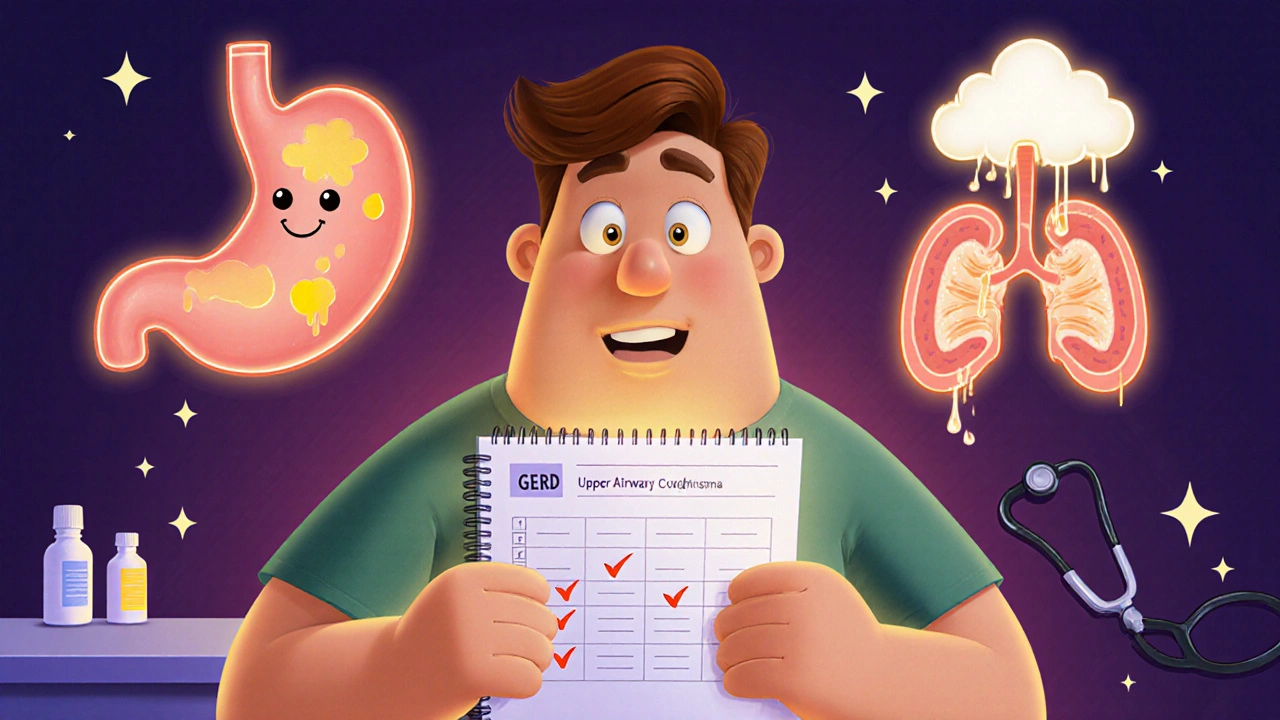
If you’ve been coughing for more than eight weeks, you’re not alone. About 1 in 10 adults deal with a chronic cough that won’t go away-no matter how many cough syrups they try. The frustrating part? Most of the time, it’s not a cold, flu, or infection. It’s something deeper. And the good news? In 80 to 95% of cases, the cause is one of three things: GERD, asthma, or postnasal drip (now called upper airway cough syndrome). But figuring out which one is the culprit? That’s where most people get stuck.
Start with the basics: What’s really going on?
Before jumping into tests or medications, you need a clear picture. A chronic cough isn’t just a symptom-it’s your body’s alarm system. It’s telling you something’s wrong in your airways, throat, or even your stomach. The first step? Rule out the red flags. If you’re coughing up blood, losing weight without trying, have a fever that won’t break, or your chest sounds strange when the doctor listens, you need urgent imaging. These could point to lung cancer, tuberculosis, or another serious condition. But if you’re otherwise healthy, the next step is simpler: check your meds.Did you start taking an ACE inhibitor like lisinopril or enalapril in the last six months? If so, that’s likely your culprit. About 5 to 35% of people on these blood pressure drugs develop a dry, hacking cough. Stopping the medication often fixes it within days to weeks. If you’re not on one, move to the big three.
Postnasal drip (upper airway cough syndrome)
This is the most common cause of chronic cough-responsible for 38 to 62% of cases. But here’s the twist: you might not feel like you have a runny nose. The drainage isn’t always obvious. Sometimes it’s just a tickle in the back of your throat, a need to clear your throat constantly, or a feeling like something’s dripping down. That irritation triggers your cough reflex.The diagnostic trick? A therapeutic trial. Not a test. A trial. Take a first-generation antihistamine like diphenhydramine (Benadryl) plus a decongestant like pseudoephedrine for two to three weeks. No fancy scans. No bloodwork. Just this combo. If your cough drops significantly in that time? You’ve got upper airway cough syndrome. Response rates are high-70 to 90% when it’s the real cause.
Why not just use nasal sprays? Because most over-the-counter steroid sprays (like Flonase) work slowly and aren’t enough on their own. You need the antihistamine to block the allergic trigger and the decongestant to reduce swelling. If it works, keep going for another week or two to make sure it’s not a fluke. If it doesn’t? Move on.
Asthma-especially cough variant asthma
Many people think asthma means wheezing and shortness of breath. But in 24 to 29% of chronic cough cases, the only symptom is coughing. That’s called cough variant asthma. It’s real. And it’s often missed because lung sounds are normal, and spirometry looks fine.The gold standard test? A methacholine challenge. You inhale a mist that makes your airways narrow if they’re reactive. If your FEV1 drops by 20% or more, you’ve got asthma. But here’s the catch: this test isn’t always needed. If your cough gets worse at night, after exercise, or around cold air or allergens, and you’ve got a history of allergies or eczema, you can start treatment right away.
Try an inhaled corticosteroid (like fluticasone) for four weeks. Add a long-acting bronchodilator if it’s not enough. If your cough improves by 50% or more? You’ve got asthma. About 60 to 80% of these patients respond. Don’t wait for wheezing to show up. Cough is the signal.

GERD-when your stomach is the problem
GERD is tricky. Only about half of people with GERD-related cough have heartburn. The rest have what’s called silent reflux. Stomach acid creeps up into the throat and irritates the nerves that control coughing. You might feel a lump in your throat, have hoarseness, or need to clear your throat all day.For years, doctors just prescribed high-dose proton pump inhibitors (PPIs) like omeprazole twice a day and waited. But here’s the problem: only 50 to 75% of people respond. And here’s the bigger problem-up to 40% of people get better on placebo. That means a lot of people are taking acid blockers for months with no benefit.
That’s why the American College of Gastroenterology updated its guidelines in March 2024. They now say: don’t start PPIs unless you have clear signs of reflux or a positive test. The Hull Airway Reflux Questionnaire (HARQ) can help. Score 13 or higher? You’ve got a good chance of laryngopharyngeal reflux. But even then, a two-week trial of PPIs is still the most practical first step. If you’re not better after four to eight weeks, stop it. Don’t keep taking it just because you’ve been told to.
The diagnostic sequence that works
You don’t need a CT scan, a sleep study, or a barium swallow right away. Start simple:- Check your meds-stop ACE inhibitors if you’re on them.
- Do a chest X-ray-normal in most cases, but rules out pneumonia, tumors, or fibrosis.
- Get spirometry-looks for airflow obstruction. If normal, move to next step.
- Trial for postnasal drip: antihistamine + decongestant for 2-3 weeks.
- If no improvement, try asthma treatment: inhaled steroid for 4 weeks.
- If still no improvement, try high-dose PPI for 8 weeks.
If none of these work? You’re in the 10 to 30% of cases that need deeper digging. That could mean a 24-hour pH impedance test, cough reflex sensitivity testing, or ruling out pertussis (whooping cough) with a nasal swab. But don’t skip the basics. Most people get better with this sequence.

Why most people fail
The biggest reason chronic cough lingers? People don’t follow through. They stop the antihistamine after three days because it made them sleepy. They quit the inhaler after two weeks because they didn’t feel “better.” They take PPIs inconsistently. Or they switch doctors every few months and start over with a new test each time.Also, many doctors still prescribe antibiotics. But only 1 to 5% of chronic cough cases are bacterial. Antibiotics won’t help. They just add side effects.
Another issue: confusion between GERD and UACS. They overlap in 30 to 50% of cases. You might have both. That’s why some people need a combination approach-antihistamine plus PPI-after the first trial fails.
What’s new in 2025
The field is changing fast. The term “postnasal drip” is fading. Doctors now say “upper airway cough syndrome” because it’s not just mucus-it’s nerve sensitivity. The Hull Cough Questionnaire is now the standard for measuring how much your cough affects sleep, work, and social life. A score above 15 means it’s severely impacting you.And there’s new medicine. Gefapixant, approved in late 2022, and camlipixant, under FDA review in 2024, are the first drugs designed specifically for chronic refractory cough. They block a nerve signal (P2X3) that makes your cough reflex too sensitive. In trials, they cut cough frequency by 18 to 25%. These won’t help if you have asthma or GERD-but if you’ve tried everything else? They’re a real option.
Even AI is getting involved. A 2023 study in Lancet Digital Health showed algorithms could tell apart asthma cough from GERD cough just by analyzing the sound. Accuracy? 87%. It’s not in clinics yet-but it’s coming.
What to do next
If you’ve had a cough for more than eight weeks:- Stop any ACE inhibitor if you’re on one.
- Get a chest X-ray and spirometry-ask your doctor for both.
- Try antihistamine + decongestant for two weeks. Keep a cough diary.
- If no change, start an inhaled steroid for four weeks.
- If still no change, try PPIs twice daily for eight weeks.
- If nothing works, ask about referral to a pulmonologist or ENT.
Don’t wait for the cough to get worse. Don’t keep buying cough syrup. Don’t assume it’s allergies. This is a solvable problem-but only if you follow the right steps.
Can chronic cough be caused by something other than GERD, asthma, or postnasal drip?
Yes, but it’s rare. About 10 to 30% of cases don’t respond to treatment for the three main causes. Other possibilities include chronic aspiration (breathing in food or liquids), pertussis (whooping cough), chronic bronchitis in smokers, or a condition called chronic refractory cough, where the nerves in the airways become overly sensitive. If the standard workup fails, further testing like pH impedance monitoring, high-resolution CT, or cough reflex sensitivity tests may be needed.
Do I need a CT scan if my chest X-ray is normal?
No, not unless you have red flags like weight loss, coughing up blood, or abnormal lung sounds. A normal chest X-ray rules out serious conditions like lung cancer or tuberculosis in 99.9% of cases. A CT scan exposes you to radiation equal to 74 chest X-rays and rarely finds anything new. Guidelines from the European Lung Foundation strongly advise against routine CT scans for chronic cough with a normal X-ray.
Why does my cough get worse at night?
Nighttime coughing is a classic sign of either asthma or GERD. When you lie down, stomach acid can more easily reflux into your esophagus and throat, triggering coughing. In asthma, airways naturally narrow at night, and mucus pools in the back of your throat. Postnasal drip can also worsen at night due to gravity and increased nasal congestion when lying flat. Tracking when your cough happens helps your doctor narrow the cause.
Can allergies cause chronic cough?
Yes, but indirectly. Allergies cause postnasal drip, which leads to coughing. They don’t directly cause coughing like asthma does. If you have seasonal allergies and your cough flares up in spring or fall, it’s likely tied to upper airway cough syndrome. Allergy testing isn’t needed unless you have other symptoms like sneezing, itchy eyes, or nasal congestion. Treating the nasal drip usually fixes the cough.
How long does it take for cough treatment to work?
It varies. For postnasal drip, improvement usually starts in 1 to 2 weeks. Asthma treatments take 2 to 4 weeks to show full effect. GERD treatment with PPIs can take up to 8 weeks. Don’t give up too soon. If you don’t see improvement after the full trial period, it’s time to move to the next step. Rushing through each trial leads to misdiagnosis.
Graham Moyer-Stratton
November 29, 2025 AT 04:29tom charlton
November 30, 2025 AT 21:50Jacob Hepworth-wain
December 1, 2025 AT 13:47Craig Hartel
December 1, 2025 AT 18:10Chris Kahanic
December 3, 2025 AT 09:36Geethu E
December 4, 2025 AT 13:03anant ram
December 5, 2025 AT 23:24king tekken 6
December 7, 2025 AT 22:06DIVYA YADAV
December 9, 2025 AT 11:46George Hook
December 11, 2025 AT 04:49Skye Hamilton
December 12, 2025 AT 23:07Maria Romina Aguilar
December 14, 2025 AT 13:01Brandon Trevino
December 16, 2025 AT 00:52Denise Wiley
December 16, 2025 AT 11:47Hannah Magera
December 17, 2025 AT 01:31