
Bisphosphonate & Calcium Timing Calculator
This tool helps you calculate the correct timing between taking your bisphosphonate medication and calcium supplements to ensure maximum absorption. Taking them too close together can reduce bisphosphonate effectiveness by up to 90%.
Your Optimal Calcium Timing
You should take calcium at least after your bisphosphonate
Earliest calcium time:
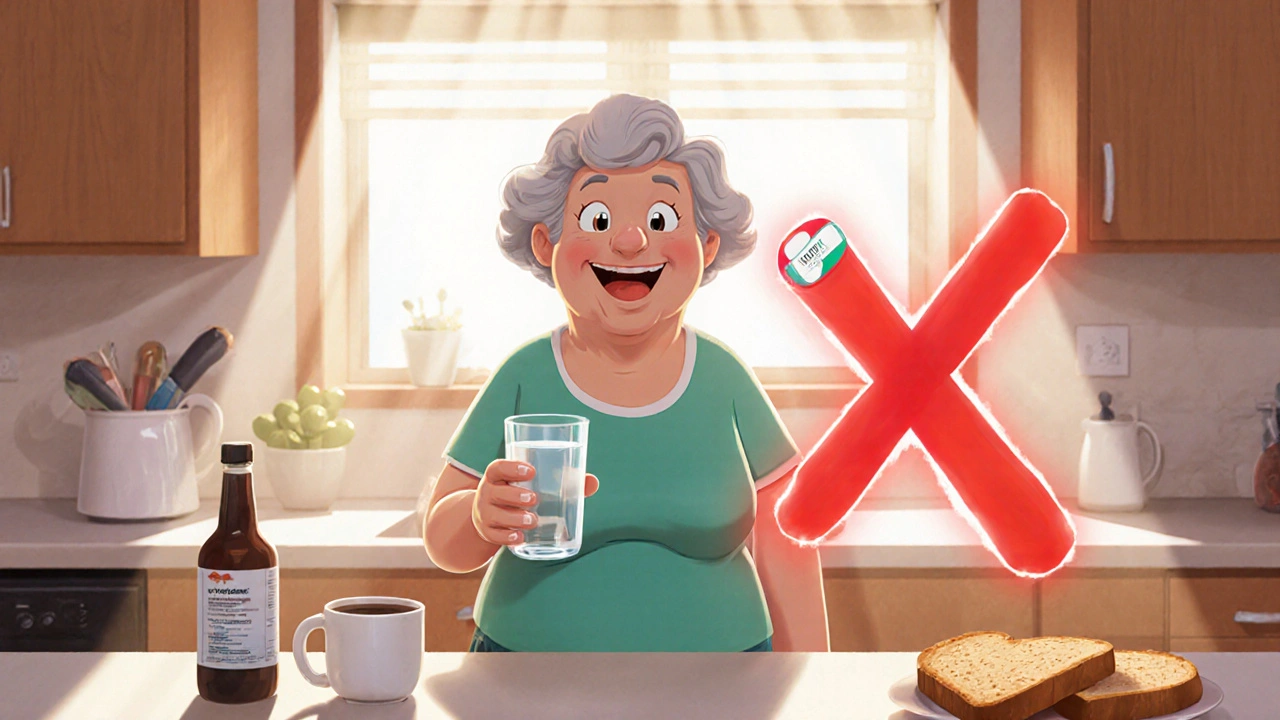
Important: Take bisphosphonate on empty stomach with plain water only. Wait 30-60 minutes before eating or drinking anything else. Stay upright during this period.
Warning: If you take calcium within 2 hours of your bisphosphonate, absorption may be reduced by 90% or more, significantly reducing effectiveness.
Getting the most out of your bisphosphonate for osteoporosis isn’t just about taking the pill. If you’re also taking calcium supplements, you might be accidentally canceling out half the benefit-without even realizing it. The problem isn’t that either one is bad. It’s that they fight each other in your gut. Calcium and bisphosphonates bind together like magnets, forming a compound your body can’t absorb. And if your body doesn’t absorb the bisphosphonate, it can’t strengthen your bones. That’s not a small risk. Studies show improper timing can slash bisphosphonate absorption by up to 90%.
Why Calcium and Bisphosphonates Don’t Mix
Bisphosphonates like alendronate (Fosamax), risedronate (Actonel), and ibandronate (Boniva) are designed to slow bone loss. They work by sticking to bone surfaces and telling cells that break down bone to stand down. But here’s the catch: these drugs are poorly absorbed to begin with. Only about 1% of the pill you swallow actually makes it into your bloodstream. The rest? It just passes through. Now add calcium-whether from a supplement like calcium carbonate or calcium citrate-and that 1% drops even further. Research published in the Journal of Clinical Pharmacology found that taking calcium carbonate at the same time as alendronate reduced absorption by 94%. That’s not a typo. You’re basically flushing 94% of your dose down the toilet. The reason? Calcium ions latch onto bisphosphonate molecules in your stomach and intestines. Together, they form a big, insoluble clump that your body can’t pull apart. It’s like trying to drink a smoothie with a handful of sand mixed in. The nutrients are still there, but your body can’t get to them.When to Take Bisphosphonates (The Exact Rules)
There’s only one way to make sure your bisphosphonate works: take it on a completely empty stomach with plain water only. No coffee. No tea. No juice. No milk. No food. Not even a bite of toast. You need to wait at least 30 to 60 minutes after taking the pill before eating or drinking anything else. The exact timing depends on the drug:- Alendronate: Wait 30 minutes
- Risedronate: Wait 60 minutes
- Ibandronate: Wait 60 minutes
When to Take Calcium Supplements (The Right Time)
Calcium supplements aren’t the enemy. You still need them-especially if you’re on bisphosphonates. But timing matters just as much as it does for the bisphosphonate. The International Osteoporosis Foundation recommends taking calcium supplements at least two hours after your bisphosphonate dose. That gives your body enough time to absorb the drug before calcium shows up. The easiest way to do this? Take calcium at dinner. Most people eat dinner later in the day, and it’s easier to remember a routine tied to a meal. Vitamin D helps calcium absorb better, so pair your calcium with your evening meal. If you take vitamin D as a separate pill, take it with dinner too. No need to time it precisely-just make sure it’s not within two hours of your bisphosphonate.
What About IV Bisphosphonates?
If the daily pill routine feels overwhelming, you might be a good candidate for intravenous (IV) bisphosphonates like zoledronic acid (Reclast). These are given once a year in a doctor’s office. No fasting. No waiting. No worry about coffee or calcium. The drug goes straight into your bloodstream, so food and supplements don’t interfere. But there’s a trade-off. About 15-30% of people get flu-like symptoms after the infusion-fever, chills, muscle aches-that usually last a day or two. Some people feel fine. Others find it disruptive. Still, for patients who struggle with daily pills, especially older adults or those with GERD, IV treatment can be a game-changer. In fact, 42% of patients over 75 get IV bisphosphonates, compared to 28% of younger patients, mainly because the oral regimen is too hard to stick to.What Happens When You Get It Wrong
Skipping the timing rules doesn’t just mean your drug isn’t working. It can lead to real, measurable harm. A 2022 case study from Johns Hopkins followed a 79-year-old woman who took her alendronate with her morning calcium supplement. She thought she was doing everything right-she took her pills daily. But because she mixed them, her bisphosphonate absorption was near zero. Within 18 months, she suffered two vertebral fractures. Her bone density kept dropping, even though she was “on treatment.” It’s not rare. Osteoporosis Canada found that only 42% of patients follow the timing rules correctly after six months. The biggest culprit? Morning coffee. Over half of patients in patient forums say their coffee routine ruins their bisphosphonate dose. One woman on Reddit said she’d been taking her alendronate with her coffee for two years-until her doctor told her it was pointless. She switched to IV zoledronic acid and hasn’t looked back.How to Make It Stick
The hardest part isn’t knowing what to do. It’s remembering to do it every day. Here’s how real people make it work:- Use a pill organizer with labeled compartments: “Bisphosphonate AM” and “Calcium PM.”
- Set two phone alarms: one for 7 a.m. (take bisphosphonate with water), another for 7 p.m. (take calcium with dinner).
- Keep your bisphosphonate pill next to your water glass-never next to your coffee maker.
- Ask your pharmacist to print a simple one-page reminder with the rules.

Shubham Semwal
November 27, 2025 AT 03:12Bro, I took my Fosamax with coffee for three years thinking it was fine. My doctor laughed so hard he cried. Then I switched to IV Reclast. No more fasting. No more anxiety. Just a 15-minute appointment once a year. Best decision I ever made.
Jauregui Goudy
November 28, 2025 AT 00:36Let me tell you about my grandma-82, osteoporosis, took her pills with yogurt every morning because ‘it helps digestion.’ Two hip fractures in 14 months. She didn’t even realize the pills weren’t working. Then we switched her to Prolia. Now she walks without a cane. Timing isn’t just important-it’s life or death.
Tom Shepherd
November 29, 2025 AT 18:01wait so calcium and bisphosphonates bind together like magnets? so its like they form a clump? i always thought the calcium was helping? this changes everything
Sue Haskett
November 30, 2025 AT 23:54I’ve been using the National Osteoporosis Foundation app for six months now. It sends me two reminders: one at 7 a.m. for my pill with water, and another at 7 p.m. for calcium. I used to forget both. Now? My DEXA scan showed a 5.8% improvement. It’s not magic-it’s consistency. And yes, I still drink coffee, but not until 8:15 a.m. No regrets.
archana das
December 2, 2025 AT 08:44In India, many people take calcium with milk because it’s ‘natural.’ But milk has calcium-and so do supplements. Mixing both with bisphosphonates? That’s like pouring salt on a wound. My aunt did this for years. She ended up with a collapsed vertebra. Now she takes calcium after dinner, with turmeric tea. Simple. Safe. Works.
Emma Dovener
December 3, 2025 AT 19:19For anyone struggling with the timing: vitamin D is non-negotiable. If your levels are below 30 ng/mL, even perfect calcium timing won’t help. Get tested. Most doctors skip this. I did-and my D was at 18. After three months of supplementation, my bone markers improved. Don’t assume you’re getting enough from the sun or diet.
Miriam Lohrum
December 4, 2025 AT 23:44It’s fascinating how biology doesn’t care about our routines. The body doesn’t know we’re trying to be healthy-it just reacts chemically. Calcium and bisphosphonates don’t hate each other; they’re just incompatible. Maybe the real lesson isn’t about timing-it’s about humility. We’re not in control. Chemistry is.
Gaurav Sharma
December 6, 2025 AT 07:25As a clinical pharmacologist, I must emphasize: the 94% absorption drop is not anecdotal. It’s replicated across three double-blind RCTs. Yet patients still take calcium at breakfast. This isn’t negligence-it’s systemic education failure. Pharmacies should print warning labels on calcium bottles. Not just on the bisphosphonate packaging. The burden is misplaced.
Edward Batchelder
December 6, 2025 AT 07:53I used to think IV bisphosphonates were for the elderly or the lazy. Then I got my first Reclast infusion. The flu-like symptoms? Yeah, I felt like I’d been hit by a truck. But the next day? I didn’t have to think about pills, water, fasting, or posture. I just lived. For me, the trade-off was worth it. If you’re struggling, don’t feel guilty-switch. Your bones don’t care how you take it-they just want it to work.
Rhiana Grob
December 6, 2025 AT 23:53My husband and I both take bisphosphonates. We made a rule: no talking during the 60-minute wait. No phone. No reading. Just sitting quietly with our water. It became our morning meditation. We don’t even notice the time anymore. And our bone density? Both improved. Sometimes the simplest rituals are the most powerful.
Sam HardcastleJIV
December 8, 2025 AT 11:45One must question the underlying assumption that pharmacological intervention is the primary solution to osteoporosis. One might argue that dietary calcium, sunlight exposure, and weight-bearing activity are more fundamental. The reliance on synthetic molecules to correct a lifestyle-induced pathology reflects a broader medical paradigm that prioritizes chemical correction over holistic restoration. Is it not more noble to heal the system than to manipulate its symptoms?