
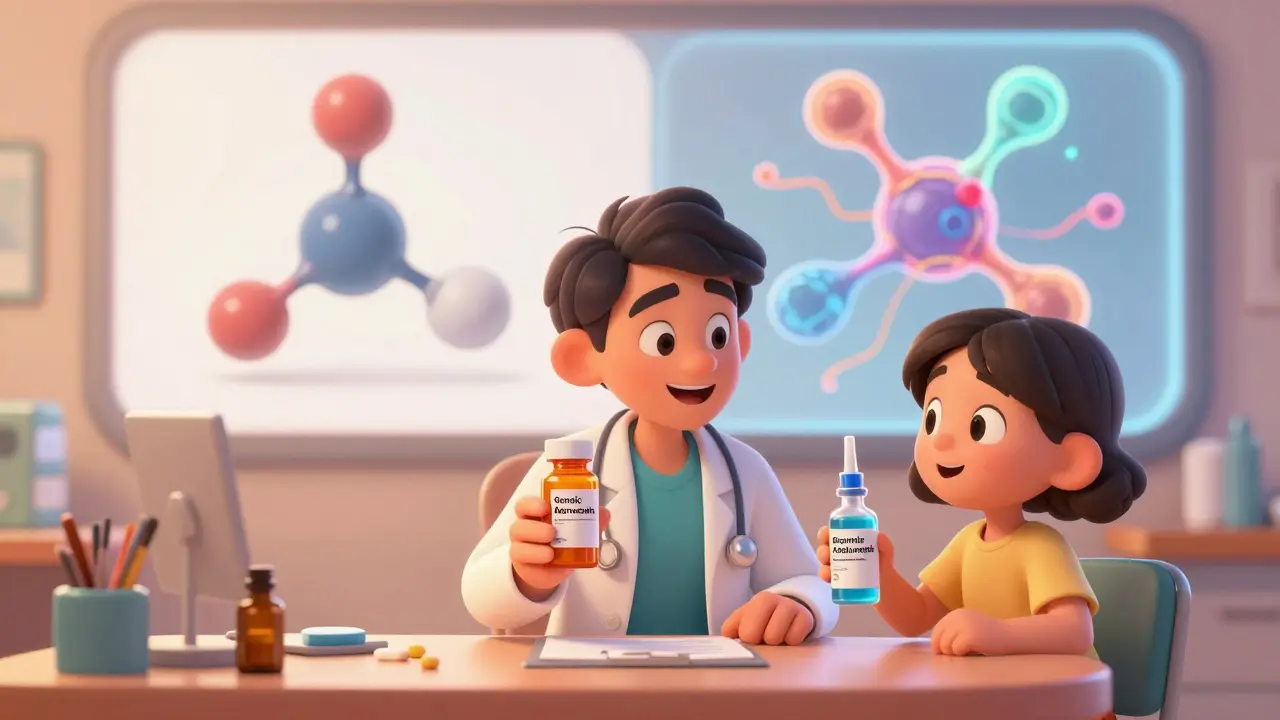
When you’re prescribed a new medication, you might hear your doctor or pharmacist mention biosimilar or generic. Both sound like cheaper alternatives to brand-name drugs-but they’re not the same thing. Choosing the wrong one could mean confusion, extra costs, or even unnecessary worry. The truth? You don’t need to be a scientist to understand the difference. You just need to know what matters for your health.
What’s the Real Difference Between Biosimilars and Generics?
Generics are exact copies of small-molecule drugs. Think of them like a photocopy of a simple drawing. If your doctor prescribes Lipitor for cholesterol, the generic version-atorvastatin-is chemically identical. It’s made in a lab using the same ingredients, in the same amounts, and works the same way in your body. The FDA requires generics to prove they’re bioequivalent: meaning your body absorbs them at the same rate and level as the brand-name drug. That’s why over 90% of prescriptions in the U.S. are filled with generics today.
Biosimilars are different. They’re copies of complex biological drugs-big, living molecules made from living cells. These aren’t made in a lab like generics. They’re grown in bioreactors using human or animal cells, like insulin or antibodies. Because they come from living systems, no two batches are ever 100% identical. That’s why biosimilars aren’t called “identical”-they’re called highly similar. The FDA requires extensive testing to prove they work the same way in the body, with no meaningful difference in safety or effectiveness. But they’re not exact copies.
So here’s the simple breakdown:
- Generics = exact chemical copies of small-molecule drugs
- Biosimilars = highly similar copies of large, complex biologic drugs
Why Cost Savings Are Very Different
Both save money-but not the same way.
Generics typically cost 80-85% less than the brand-name version. A pill that used to cost $150 a month might now be $20. That’s why you see generics everywhere-for blood pressure, thyroid meds, antidepressants, and more.
Biosimilars? They save less. Usually 15-20% off the price of the original biologic. Why? Because making them is expensive. A generic drug might cost $2-3 million to develop. A biosimilar? $100-250 million. That’s because of the complex manufacturing, the need for advanced lab testing, and years of clinical data. So while a biosimilar for Humira might drop the price from $2,500 to $2,000 per month, it’s still a lot more than a generic pill.
But here’s the catch: there are no generics for biologics. Ever. You can’t make a chemical copy of a protein made in living cells. So if you’re on a biologic like Humira, Enbrel, or Herceptin, a biosimilar is your only affordable option.
Which Conditions Use Which?
Not every drug has a generic or a biosimilar. And not every condition can use either.
Generics are everywhere: for high blood pressure (lisinopril), diabetes (metformin), depression (sertraline), and even heartburn (omeprazole). They’re the backbone of affordable medicine.
Biosimilars are focused on serious, chronic conditions where biologics are the only effective treatment:
- Rheumatoid arthritis: adalimumab (Humira), etanercept (Enbrel)
- Crohn’s disease and ulcerative colitis: infliximab (Remicade)
- Cancer: trastuzumab (Herceptin) for breast cancer, bevacizumab (Avastin) for colon cancer
- Diabetes: insulin glargine (Lantus)
If you’re on one of these, you’re likely being offered a biosimilar. And that’s a good thing. Clinical studies show they work just as well. A 2022 review of over 38,000 patients found no difference in effectiveness or safety between biosimilar and brand-name infliximab. That’s not a small sample-it’s real-world proof.
Can Pharmacists Switch Your Medication Without Asking?
This is where things get tricky.
With generics, pharmacists can usually substitute them automatically. In 49 states, if your prescription says “Lipitor,” the pharmacist can give you “atorvastatin” without checking with your doctor. It’s legal, safe, and common.
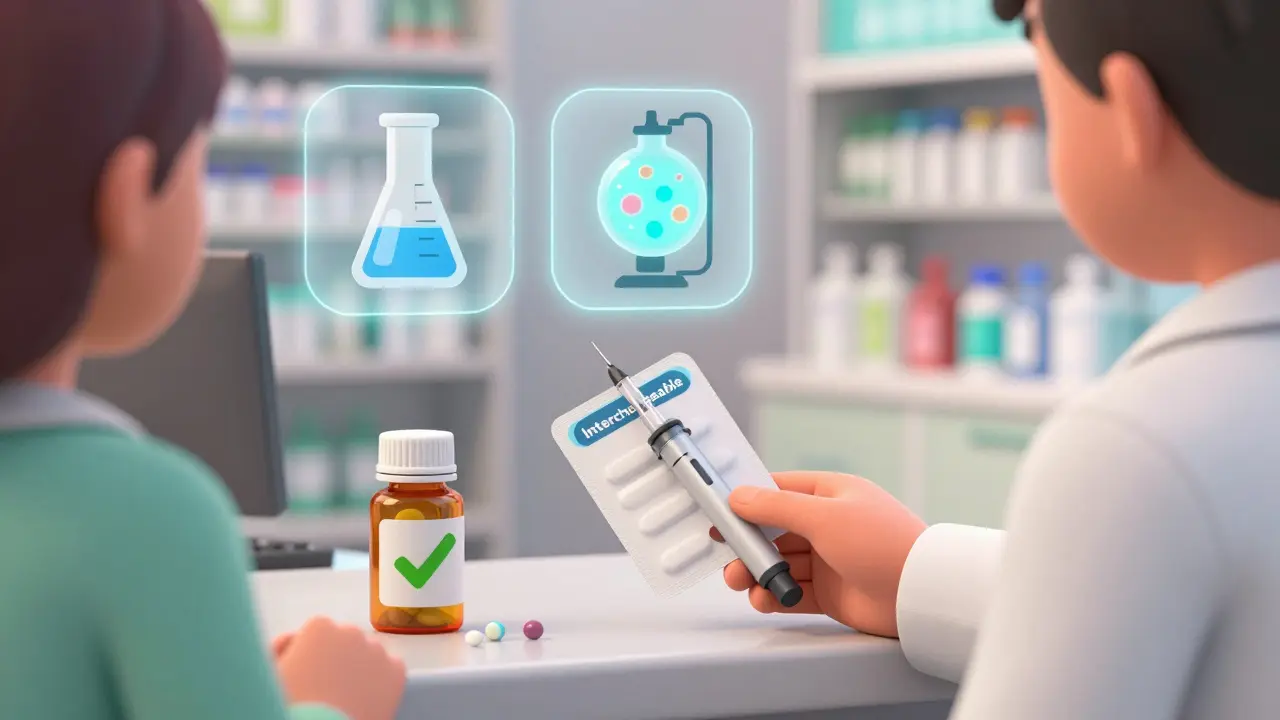
Biosimilars? Not so simple. Only biosimilars that are labeled “interchangeable” can be swapped at the pharmacy without the prescriber’s approval. And even then, 28 states require the pharmacist to notify your doctor within 72 hours. Why? Because biologics are more complex. Doctors want to track exactly what you’re getting.
So if you’re switched to a biosimilar, ask: “Is this interchangeable?” And always check your prescription label. Don’t assume it’s the same as before.
Are They Safe? What About Side Effects?
Some patients worry: “If it’s not the same, will it cause new side effects?”
For generics: no. Decades of data show they’re just as safe. A 2019 JAMA study looked at 47 trials on heart medications and found no difference in side effects between brand-name and generic versions.
For biosimilars: the data is newer but strong. The FDA’s safety database shows biosimilars have nearly identical rates of adverse events as their reference products. For example, biosimilar infliximab had 0.12 adverse events per 100 patient-years. The original had 0.15. Not statistically different.
One concern is immunogenicity-your body reacting to the drug as if it’s foreign. This can happen with biologics, but it’s rare and not more common with biosimilars. Studies in inflammatory bowel disease patients showed no increase in antibodies or flare-ups after switching.
Still, if you’ve been stable on a brand-name biologic for years, switching can feel scary. That’s normal. Talk to your doctor. Ask: “Has this been used by others like me? What’s the evidence?”
What About Insurance and Access?
Insurance companies love biosimilars and generics because they save money. But that doesn’t always mean easier access.
Generics are usually on the lowest tier-often $5-$10 co-pays. You rarely need prior authorization.
Biosimilars? Often require more paperwork. A 2022 study found 67% of biosimilar prescriptions needed extra documentation before approval. Some insurers still push you to try the brand-name first, even if the biosimilar is cheaper. And not all pharmacies stock them.
Also, some manufacturers offer patient support programs-like Amgen’s SupportPlus-that help with co-pays, delivery, and education. Ask your doctor or pharmacist if these are available.
What Should You Do If You’re Asked to Switch?
Here’s a practical checklist if your doctor suggests switching:
- Ask why. Is it because of cost? Because your insurance requires it? Or because the new option is better?
- Check the name. Is it a generic (like atorvastatin) or a biosimilar (like adalimumab-afzb)?
- Confirm interchangeability. For biosimilars, ask: “Is this FDA-approved as interchangeable?”
- Ask about monitoring. Will you need extra blood tests? Will your symptoms be tracked differently?
- Know your rights. You can refuse a switch. Your doctor can write “dispense as written” on the prescription.
One patient with rheumatoid arthritis told her story on a patient forum: “I saved over $8,000 a year after switching to the biosimilar. My rheumatologist explained the science. I felt confident. My pain didn’t come back.”
Another, with cancer, said: “My out-of-pocket dropped from $450 to $75 per infusion. My tumor markers stayed the same. I didn’t feel any different.”
But not everyone feels that way. Some patients, especially older adults, get confused by new pen devices or packaging. One Reddit user shared: “My mom switched to a biosimilar insulin. The pen looked different. She used the wrong dose. We had to go back.”
That’s why education matters-not just for doctors, but for patients too.
What’s Changing in 2026?
The landscape is shifting fast.
The first interchangeable biosimilar insulin (Semglee) came out in 2021. The first interchangeable biosimilar for Humira (Cyltezo) got approval in 2023. More are coming-like biosimilars for Stelara and Enbrel in 2024-2025.
The Inflation Reduction Act of 2022 removed financial penalties for doctors who use biosimilars in Medicare. That’s pushing hospitals and clinics to switch more patients.
By 2027, experts predict nearly half of all biologic prescriptions will be filled with biosimilars. That’s up from 22% in 2023.
But the road isn’t smooth. Patent lawsuits still delay entry. One drug had 144 patents blocking competitors. And many doctors still aren’t confident prescribing biosimilars-only 58% of non-specialists feel very comfortable with them.
Bottom Line: What You Need to Remember
You don’t need to memorize every regulation. Just remember this:
- If your drug is a pill you swallow daily-it’s likely a generic. Safe, cheap, proven.
- If your drug is an injection you get every few weeks-it’s probably a biologic. And if you’re being offered a cheaper version, it’s a biosimilar.
- Biosimilars aren’t inferior. They’re rigorously tested. They work.
- Cost savings are real, but different: generics cut prices by 80%. Biosimilars cut them by 15-20%.
- You have the right to ask questions. You have the right to refuse a switch.
The goal isn’t to pick the cheapest option. It’s to pick the right one-safe, effective, and affordable. Whether it’s a generic or a biosimilar, both are tools to help you get better without going broke.
Are biosimilars as safe as brand-name biologics?
Yes. Biosimilars undergo extensive testing-analytical studies, animal trials, and clinical trials-to prove they have no clinically meaningful differences in safety or effectiveness. The FDA requires the same high standards as the original biologic. Real-world data from tens of thousands of patients shows similar rates of side effects and treatment success.
Can I switch from a brand-name drug to a biosimilar without risk?
For most patients, yes. Studies show switching from a reference biologic to a biosimilar doesn’t increase the risk of flare-ups, side effects, or treatment failure. This is especially true for conditions like rheumatoid arthritis and Crohn’s disease. However, if you’ve had bad reactions in the past or have a complex medical history, talk to your doctor before switching.
Why are biosimilars more expensive to make than generics?
Generics are made through chemical synthesis-like mixing ingredients in a lab. Biosimilars are made from living cells, which requires complex bioreactors, precise temperature control, and advanced purification. A single batch can take months to produce and cost millions to test. That’s why development costs are 50-100 times higher than for generics.
Will my insurance cover a biosimilar if I’m on a brand-name drug?
Many insurers now require you to try the biosimilar first, especially for expensive biologics like Humira or Herceptin. Some even stop covering the brand-name version entirely. Check your plan’s formulary or call your insurer. If you’re denied, your doctor can file an appeal with clinical justification.
Do I need to get blood tests after switching to a biosimilar?
Not always, but your doctor may recommend it. For drugs that affect your immune system-like those used for arthritis or Crohn’s-your provider might check your disease activity markers a few weeks after switching to confirm it’s working. This isn’t because biosimilars are less safe-it’s just good monitoring practice.
Can I switch back to the brand-name drug if I don’t feel well on the biosimilar?
Yes. If you experience new side effects, worsening symptoms, or just feel uncomfortable, you can ask to switch back. Your doctor can write a new prescription. Most insurers will approve the return if there’s a documented medical reason. Don’t feel pressured to stay on something that doesn’t feel right.
Are there any drugs that can’t be replaced by biosimilars or generics?
Yes. Some drugs are too complex to have a copy yet. Others are still under patent protection. Also, some narrow therapeutic index drugs-like warfarin or lithium-require very precise dosing. While generics exist for these, switching requires extra care. Biosimilars are not approved for all biologics yet-only the ones with enough data to prove safety.
Next Steps: What to Do Today
If you’re on a biologic and haven’t been offered a biosimilar, ask your doctor: “Is there a biosimilar available for my drug?”
If you’re on a brand-name drug and your co-pay is high, ask your pharmacist: “Is there a generic version?”
Check your prescription label. If it says “biosimilar” or “interchangeable,” that’s intentional. If it says “generic,” that’s a different category.
Don’t let confusion stop you from saving money. But don’t let savings override your comfort. Ask questions. Get clear answers. Your health is worth it.
Heather Josey
January 2, 2026 AT 07:04Biosimilars have been a game-changer for my rheumatoid arthritis treatment. I switched last year and saved nearly $9,000 annually-without a single flare-up. My doctor walked me through the data, and the FDA’s safety records were reassuring. It’s not about cheap-it’s about smart.
I’ve seen older patients hesitate because the pen looks different or the packaging changed, but with proper education, the transition is smooth. Pharmacists should be required to offer a 5-minute consultation when switching to a biosimilar. It’s not just a substitution-it’s a care decision.
And yes, I asked if it was interchangeable. It was. That made all the difference.
Donna Peplinskie
January 3, 2026 AT 10:18Hi, I’m a nurse in Vancouver, and I’ve watched patients struggle with the cost of biologics for years-until biosimilars came along. I’ve seen people cry because they couldn’t afford their meds, then smile because now they can. It’s not magic-it’s science, and it’s working.
But I’ve also seen confusion. One patient thought ‘biosimilar’ meant ‘lesser,’ and refused it. We sat down, showed her the clinical studies, and she switched. Her joint pain improved. She didn’t know what ‘interchangeable’ meant until I explained it. We need more patient-friendly materials. Not just for doctors. For everyone.
Also-thank you for mentioning the insulin pen issue. My aunt had a near-miss because she thought the new pen worked the same. A simple label change can be dangerous if no one explains it. Please, always double-check the device.
And yes, I’m still using my brand-name Humira. But I’m not afraid of the biosimilar anymore. I’m just cautious. And that’s okay.
Paul Ong
January 3, 2026 AT 22:05Andy Heinlein
January 5, 2026 AT 11:21so i switched to the biosimilar for my crohn’s meds last year and honestly? no diff. i mean like, zero. same energy, same bowel habits, same sleep. i was scared af because the pen looked like a toy version of the original but my doc said the FDA tested it on like 10,000 people and it’s basically the same. turns out i was just scared of change.
also my co-pay dropped from $420 to $85. i bought a new guitar with that money. best decision ever.
ps: i spelled ‘biosimilar’ wrong 3 times in this comment. i’m not even sorry.
gerard najera
January 6, 2026 AT 17:25Generics are chemistry. Biosimilars are biology.
One is reproducible. The other is alive.
That’s the difference.
Stephen Gikuma
January 7, 2026 AT 16:44Who’s really behind this push for biosimilars? Big Pharma? The government? The WHO? They’ve been pushing ‘cheaper alternatives’ for decades. First it was generics, now biosimilars. Next it’ll be ‘AI-generated meds.’
Remember when they said generic aspirin was just as good? Then people started having heart attacks because the fillers were different. Now they’re doing the same thing with biologics. The FDA approves them fast because they’re under pressure to cut Medicare costs. But what about long-term effects? No one’s tracking that.
And don’t get me started on how they’re swapping insulin pens without telling patients. My cousin’s mom ended up in the ER because she thought the new pen had the same dial. It didn’t. They called it ‘user error.’
This isn’t progress. It’s cost-cutting disguised as innovation.
Bobby Collins
January 8, 2026 AT 03:17ok but what if the biosimilar is secretly made in china? i heard the FDA doesn’t inspect those factories. my friend’s mom got a biosimilar for her lupus and now she’s got this weird rash and her docs say it’s ‘idiopathic.’ yeah right. it’s the biosimilar. i saw a video on tiktok where a guy said the same thing. they’re testing it on us.
also why do all the biosimilar names sound like robot codes? adalimumab-afzb? what does that even mean? it’s not even a word. it’s a barcode.
if it’s so safe, why don’t they just call it ‘Humira 2.0’? because they don’t want you to know it’s a copy. it’s all a scam.
Layla Anna
January 8, 2026 AT 22:07Just wanted to say thank you for writing this. I’m from Nigeria and we don’t have access to most biologics here. When I moved to the US last year, I was shocked that people were even debating whether biosimilars are safe. Here, we’d kill for any version of Humira that costs less than $10,000 per dose.
I switched to a biosimilar for my psoriasis and it worked. My skin cleared up. My insurance didn’t even make me jump through hoops. I cried the first time I saw my reflection without patches.
Also-yes, the pen was different. I was confused. But my pharmacist sat with me for 15 minutes. Showed me the dose counter. Explained the click. That’s all I needed.
Don’t let fear silence your hope. You deserve to be healthy. And you deserve to afford it. 💙