
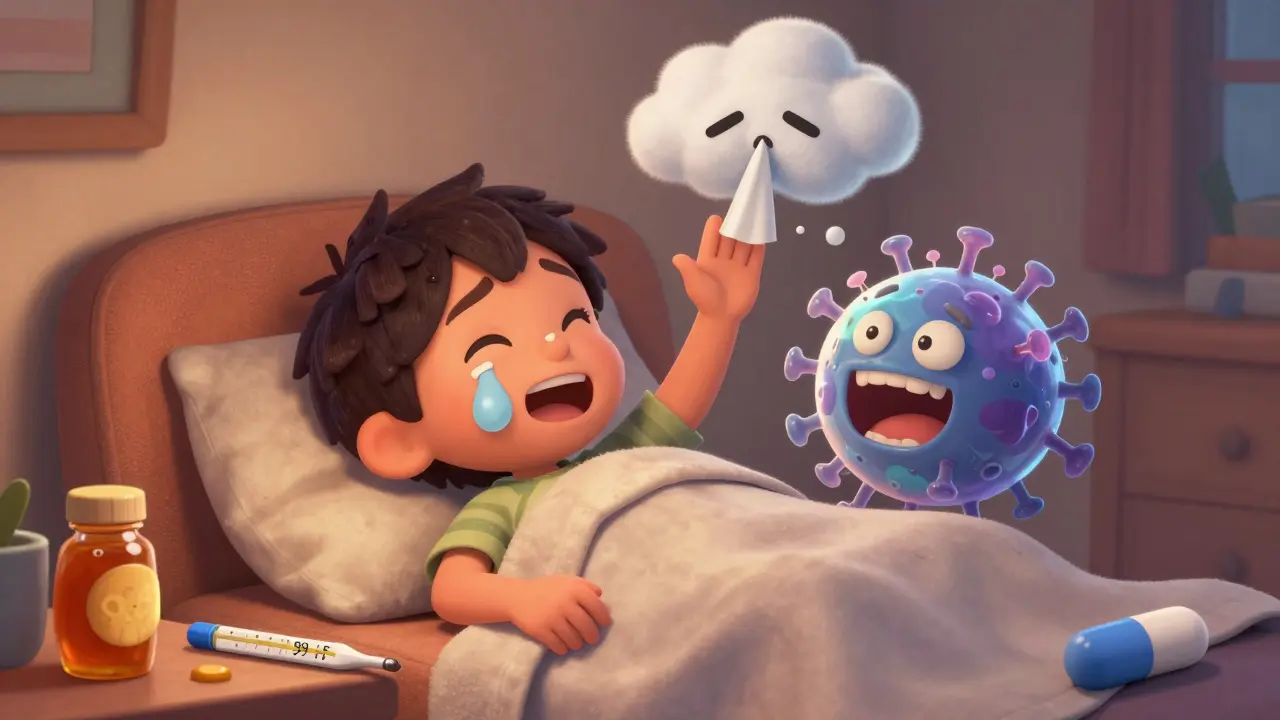
When you or your kid gets sick with a fever, sore throat, and cough, the big question isn’t just how bad it is-it’s whether it’s bacterial or viral. Because the answer changes everything. Take antibiotics for a virus? They won’t help. Skip antibiotics for a bacterial infection? It could get worse. And yet, most people don’t know the difference. A 2023 CDC survey found that 68% of adults in the U.S. think antibiotics work on viruses. That’s not just a misunderstanding-it’s a public health risk.
What’s the Real Difference Between Bacteria and Viruses?
Bacteria are alive. They’re single-celled organisms that can move, eat, and reproduce on their own-even in soil, water, or on your kitchen counter. Some are harmless. Some cause disease. Think of them like tiny, independent life forms. Strep throat, urinary tract infections, and tuberculosis? All bacterial.
Viruses aren’t alive in the way we think of life. They’re just genetic material wrapped in a protein coat. They can’t do anything on their own. They need to sneak into your cells and hijack them to multiply. That’s why you can’t catch a cold from a doorknob and then watch the virus grow there-it needs your body to survive. Flu, common colds, chickenpox, and COVID-19? All viral.
Size matters too. The biggest viruses are about 300 nanometers across. The smallest bacteria are around 200 nanometers. That’s so tiny that regular microscopes can’t even see viruses. You need electron microscopes. That’s why doctors couldn’t prove viruses caused disease until the 1930s. Bacteria? We’ve known about them since the 1800s.
Symptoms Overlap-So How Do You Know?
Both can cause fever, fatigue, cough, sore throat, and body aches. That’s why so many people assume antibiotics are the answer. But there are patterns.
Bacterial infections often come with:
- Fever above 101°F (38.3°C)
- Symptoms that last more than 10-14 days
- Worsening after initial improvement (like feeling better for a few days, then crashing again)
Viral infections usually look like:
- Lower fever, under 100.4°F (38°C)
- Runny nose, sneezing, mild cough
- Symptoms peak in 3-5 days and start fading by day 7
But here’s the catch: viral infections can lead to secondary bacterial infections. About half of people hospitalized with severe viral pneumonia-like from COVID-19-end up with a bacterial infection on top of it. That’s why doctors sometimes prescribe antibiotics even when the main problem is viral. It’s not because the virus needs it. It’s because the body’s defenses are down, and bacteria move in.
How Doctors Actually Diagnose the Difference
Guessing based on symptoms alone? Too risky. That’s why tests exist.
For strep throat, a rapid antigen test gives results in 10 minutes with 95% accuracy. If it’s negative but the doctor still suspects strep, they’ll send a throat culture. That’s the gold standard-98% accurate, though it takes a day or two.
For viruses like flu or COVID-19, PCR tests are the go-to. They detect viral genetic material. When done within the first 72 hours of symptoms, they’re 90-95% accurate. There’s also a newer tool called FebriDx, approved by the FDA in 2020. It checks two biomarkers in your blood-CRP and MxA-and tells you within 10 minutes whether the infection is likely bacterial or viral. It’s 94% sensitive and 92% specific. That means it’s right almost every time.
Doctors also use tools like the Centor Criteria for sore throats: if you have tonsil white spots, swollen neck glands, fever over 100.4°F, and no cough? That’s 4 points. Three or more points means you have a 50-55% chance of strep. That’s when testing makes sense.

What Treatments Actually Work
Antibiotics kill bacteria. They don’t touch viruses. That’s not opinion. That’s biology. Antibiotics target things viruses don’t have-like cell walls or protein-building machines. Viruses don’t have those. So giving amoxicillin for the flu is like using a hammer to fix a software bug.
For bacterial infections, antibiotics are life-saving. Penicillin for strep throat? 10 days. Doxycycline for a sinus infection? 5-7 days. Skip the full course? You risk the bacteria coming back stronger. That’s how antibiotic resistance starts.
For viral infections, the treatment is mostly rest, fluids, and symptom relief. Tylenol for fever. Saline spray for congestion. Honey for cough (if over 1 year old). But there are exceptions.
Antivirals exist for some viruses:
- Oseltamivir (Tamiflu) for flu-works best if taken within 48 hours of symptoms. Can shorten illness by 1-2 days.
- Acyclovir for chickenpox or shingles-reduces severity if started early.
- Remdesivir for severe COVID-19-given in hospitals to slow virus replication.
But these aren’t magic bullets. They don’t cure. They just help your body fight back faster.
Why Misusing Antibiotics Is a Global Crisis
Every time you take an antibiotic when you don’t need it, you’re helping superbugs grow. These are bacteria that no longer respond to the drugs we have.
In the U.S. alone, doctors write 47 million unnecessary antibiotic prescriptions every year-mostly for viral colds and coughs. That’s not just wasteful. It’s dangerous. Antibiotic-resistant infections already kill 35,900 Americans annually. Globally, they caused 1.27 million deaths in 2019. By 2050, that number could hit 10 million per year-more than cancer.
And it’s not just about death. Resistant infections mean longer hospital stays, more expensive treatments, and surgeries that become too risky. One of the most feared resistant bugs is MRSA. Another is drug-resistant tuberculosis, which now affects over 450,000 people worldwide each year.
Even worse, antibiotics can wipe out good bacteria in your gut. That’s linked to diarrhea, yeast infections, and even long-term immune problems. Clostridioides difficile (C. diff), a deadly gut infection caused by antibiotic overuse, leads to over 220,000 cases and 12,800 deaths in the U.S. every year.

What Patients Get Wrong (And What They Should Do Instead)
Parents often demand antibiotics for kids with runny noses or earaches. But 85% of acute bronchitis cases and 70% of sinus infections are viral. Antibiotics won’t help. And they might make things worse.
Studies show people who get antibiotics for viral infections are 65% more likely to come back for the same symptoms next time. Why? Because they expect a pill to fix it. When they don’t get one, they assume the doctor didn’t take them seriously.
Here’s what to do instead:
- If symptoms last more than 10 days, or you feel better then suddenly crash, see a doctor. You might have a bacterial infection.
- If you have a high fever, swollen glands, or white spots on tonsils-ask for a strep test.
- For flu-like symptoms in the first 48 hours, ask about Tamiflu if you’re at risk (elderly, pregnant, or with chronic illness).
- Never save antibiotics for next time. Never share them. Never take leftovers.
What’s Coming Next
Scientists are racing to find new ways to fight infections. One promising area is phage therapy-using viruses that only attack bacteria. Early trials in Europe show 85% success against resistant infections.
Researchers at the University of Queensland are testing two new compounds (IMB-001 and IMB-002) that target bacterial surfaces. They’re in Phase II trials as of late 2024.
Universal coronavirus vaccines are in Phase III trials. If they work, they could prevent future pandemics by targeting parts of the virus that don’t change.
And doctors are getting better at avoiding antibiotics. With tools like FebriDx, primary care clinics are cutting unnecessary prescriptions by half. That’s progress.
Bottom Line
Bacterial and viral infections look alike. But they’re not the same. One needs antibiotics. The other needs time and care. Getting it wrong doesn’t just waste money-it endangers lives. Every time you choose rest over antibiotics for a virus, you’re helping protect the next generation from untreatable infections. Don’t ask for antibiotics. Ask for the right test. Your body-and the world-will thank you.
Can antibiotics cure a cold or the flu?
No. Colds and the flu are caused by viruses. Antibiotics only work on bacteria. Taking them for a viral infection won’t shorten your illness, reduce symptoms, or prevent spreading it. Instead, it increases your risk of side effects and contributes to antibiotic resistance.
How do I know if my sore throat is strep or just a virus?
Strep throat usually comes with a sudden fever over 101°F, swollen tonsils with white patches, and painful swallowing-but no cough or runny nose. A viral sore throat often comes with a cough, hoarseness, and mild fever. The only way to be sure is a rapid strep test or throat culture. Don’t guess. Get tested.
Why do some doctors still prescribe antibiotics for viruses?
Sometimes, it’s because patients pressure them. Other times, it’s because symptoms are unclear and the doctor wants to cover all bases. But guidelines from the CDC and WHO clearly say antibiotics shouldn’t be used for viral upper respiratory infections. The rise of rapid tests like FebriDx is helping doctors make better choices without disappointing patients.
Can viral infections become bacterial?
Yes. After a viral infection weakens your immune system, bacteria can move in and cause a secondary infection. This is common with sinus infections, ear infections, and pneumonia. If your symptoms improve, then suddenly get worse after 5-7 days, you may have developed a bacterial infection. That’s when antibiotics might be needed.
Are there any natural remedies that kill viruses or bacteria?
No reliable natural remedy kills viruses or bacteria in the body the way medicine does. Honey can soothe a cough. Saltwater gargles ease throat pain. Steam helps with congestion. But none cure the infection. Relying on garlic, essential oils, or vitamin C to treat infections can delay proper care and lead to complications.
How long should I wait before seeing a doctor for a cold?
If symptoms last more than 10 days, or if you have a high fever (over 101°F) that doesn’t break after 3 days, see a doctor. Also seek care if you have trouble breathing, chest pain, confusion, or severe dehydration. Most viral colds improve within 7-10 days. If they don’t, it’s time to check for something else.
Angela Goree
January 4, 2026 AT 00:58Finally, someone breaks it down without the medical jargon. I used to beg my doctor for antibiotics when I had a cold-now I just drink tea and wait it out. My kid’s had three colds this winter and not one antibiotic. No regrets.
Our bodies are smarter than we give them credit for.
Tiffany Channell
January 5, 2026 AT 07:40Of course the CDC says antibiotics don’t work on viruses-what do you expect from an agency that told us masks were useless in 2020? They’re just trying to protect Big Pharma’s bottom line. If you think this is about science, you’re delusional. They don’t want you to know about the real cures-silver colloids, ozone therapy, herbal tinctures. But hey, keep swallowing those useless pills.
Shanahan Crowell
January 6, 2026 AT 18:56Man, I wish I’d known this five years ago. I gave my daughter amoxicillin for a runny nose-she got a yeast infection. Then I got one. Then my wife did. We were all stuck in that cycle because I thought ‘better safe than sorry.’ Turns out, ‘sorry’ is exactly what I should’ve been.
Stop guessing. Get tested. Your gut will thank you.
Kerry Howarth
January 7, 2026 AT 02:51Correct. Antibiotics target bacterial cell walls and ribosomes. Viruses lack both. Simple biology. No magic. No exceptions. Stop asking for them.
Joy F
January 8, 2026 AT 21:20Let’s be real-this whole system is a performance. The doctor has 7 minutes. You’re crying about your kid’s fever. They feel guilty. So they scribble a script. It’s not malice-it’s institutionalized burnout. We’ve turned healthcare into a transactional circus. The real villain isn’t the patient demanding antibiotics-it’s a system that rewards volume over wisdom.
And don’t even get me started on how FebriDx is being quietly suppressed by insurance companies who profit from unnecessary prescriptions.
Angela Fisher
January 9, 2026 AT 06:07They’re lying. All of it. The CDC, WHO, Big Pharma-they’re all connected. The real reason they don’t want you to know? Viral infections can be cured with frequency therapy and frequency-specific microcurrent devices. It’s been proven in Switzerland and Russia since the 80s. But you won’t hear about it because the FDA is owned by Pfizer. They’d rather you die slowly from antibiotic resistance than let you heal naturally with a $200 machine. They’re killing us with kindness. And they call it ‘evidence-based medicine.’
My cousin’s uncle’s neighbor’s dog got cured with a tuning fork. That’s science. You’re just too brainwashed to see it.
Philip Leth
January 10, 2026 AT 05:38Y’all in the US act like this is new info. In India, we’ve always known: if you’re sick, rest. Drink kadha. Eat ginger. Don’t rush to the pharmacy. Antibiotics? Only if the doctor says so-and even then, we ask twice.
Our grandparents didn’t have labs or tests. They had intuition. And they lived longer.
Neela Sharma
January 12, 2026 AT 04:56Back home in Kerala, our aunty makes garlic-turmeric milk for every sniffle. It doesn’t kill viruses-but it calms the fire inside. Maybe science hasn’t caught up to wisdom yet. Not everything that heals needs a patent.
And yes, I’ve seen people recover from flu with just rest, honey, and prayer. No pills. No panic. Just patience.
Brittany Wallace
January 13, 2026 AT 18:06Thank you for this. I’m a nurse, and I’ve watched too many parents cry because they were told ‘it’s just a virus’ and felt like they failed. We need to reframe this. It’s not failure-it’s trust. Trusting your body. Trusting time. Trusting science that says ‘wait and watch’ isn’t lazy-it’s wise.
Also, honey for cough? 100% yes. And no, it’s not ‘just a myth.’
Michael Burgess
January 13, 2026 AT 20:04Just got my kid’s FebriDx test done last week. Took 8 minutes. Result: viral. Doctor didn’t even flinch. No antibiotics. Just a pat on the back and a ‘you got this.’
Best doctor visit ever. No pressure. No guilt. Just facts.
And yes, I cried. Not from sadness-from relief. We’ve been so scared of being ‘weak’ for asking for help. Turns out, the real strength is knowing when not to take a pill.
JUNE OHM
January 15, 2026 AT 06:03Why are they pushing this ‘antibiotics don’t work’ narrative? Because they’re hiding the truth: the government is using antibiotics to control the population’s microbiome. That’s why they’re pushing probiotics too-it’s all connected. They want to weaken our immune systems so we’re easier to track with microchips. You think the flu shot is harmless? Think again. It’s the first step. Read the fine print. It says ‘may alter gut flora.’ That’s not a side effect. That’s the goal.
Haley Parizo
January 16, 2026 AT 13:12Let me be clear: if you’re still taking antibiotics for a cold, you’re not just ignorant-you’re dangerous. You’re part of the problem. You’re the reason we’re heading toward a post-antibiotic world where a scraped knee can kill you. You think you’re helping your kid? You’re dooming theirs.
Stop being emotionally manipulative with doctors. Stop treating healthcare like a vending machine. You want a pill? Go to a gas station. Medicine isn’t candy.
Lori Jackson
January 16, 2026 AT 16:51While the article is superficially compelling, it fails to interrogate the epistemological hegemony of Western biomedical paradigms. The reductionist binary of ‘bacterial vs. viral’ obscures the microbiome’s emergent phenomenology. We are not hosts-we are ecosystems. To pathologize microbial presence is to perpetuate Cartesian dualism. The real crisis isn’t antibiotic resistance-it’s the ontological violence of diagnostic categorization. Until we decenter the human as the locus of pathology, we remain complicit in the colonial architecture of medicine.
Ian Detrick
January 18, 2026 AT 00:42It’s funny how we treat illness like a puzzle to be solved with the right key. But what if it’s not about fixing? What if it’s about listening? The body doesn’t lie. Fever isn’t the enemy-it’s the messenger. Cough isn’t the problem-it’s the cleanup crew.
Maybe the real cure isn’t a pill. Maybe it’s quiet. Maybe it’s rest. Maybe it’s admitting we don’t have to control everything.
Wren Hamley
January 19, 2026 AT 09:09Wait-so if FebriDx is 94% sensitive, why aren’t all ERs using it? Is it cost? Training? Or is it just that doctors still trust their gut over data? I’ve seen ER docs guess wrong three times in one shift. We need this tech everywhere. Not just for antibiotics-but for triage, for speed, for equity. Why are we still using 1980s logic in a 2025 world?