
SSRI and 5-HTP Safety Checker
This tool helps you understand your risk of serotonin syndrome when combining SSRIs and 5-HTP. Remember: combining these can be life-threatening.
Risk Assessment
Please complete the form to see your risk level.
It sounds simple: you’re on an SSRI for depression, and you hear that 5-HTP is a natural way to boost serotonin even more. Maybe you’re tired of side effects, or you think "natural" means "safe." But here’s the hard truth - combining 5-HTP with SSRIs isn’t just risky. It can land you in the emergency room.
What’s Actually Happening in Your Brain?
SSRIs like fluoxetine (Prozac), sertraline (Zoloft), or escitalopram (Lexapro) work by blocking the reabsorption of serotonin. That means more serotonin stays around in your brain, helping lift your mood. Simple enough.
Now add 5-HTP. This supplement is a direct building block your body uses to make serotonin. Unlike tryptophan (which has to go through several steps), 5-HTP skips the slowest part of the process and gets turned into serotonin almost immediately. So while your SSRI is holding onto the serotonin you already have, 5-HTP is flooding your system with new serotonin - fast.
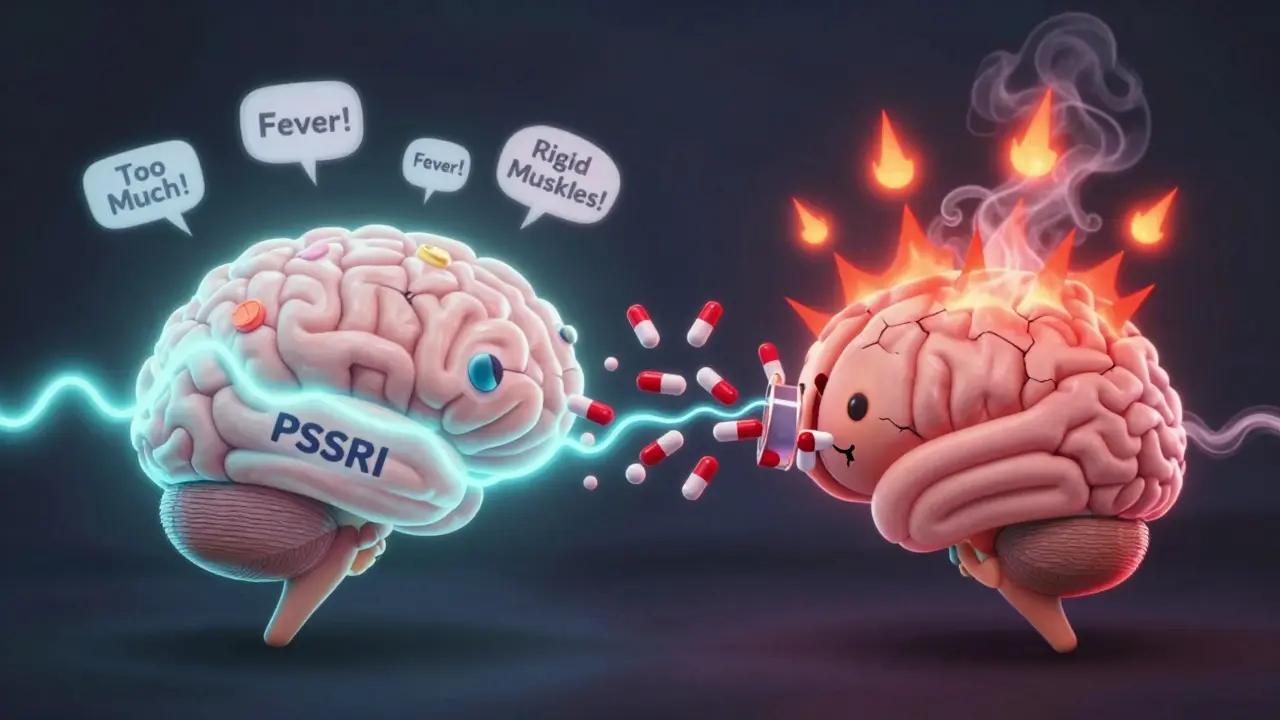
This isn’t a double boost. It’s a perfect storm. Your brain ends up with way more serotonin than it can handle. And when serotonin levels spike past 300-400 ng/mL (normal is 101-283 ng/mL), it overstimulates receptors, especially the 5-HT2A ones. That’s when things go wrong.
Serotonin Syndrome: It’s Not Just "Feeling Off"
Serotonin syndrome isn’t a mild side effect. It’s a medical emergency. And it happens faster than most people expect.
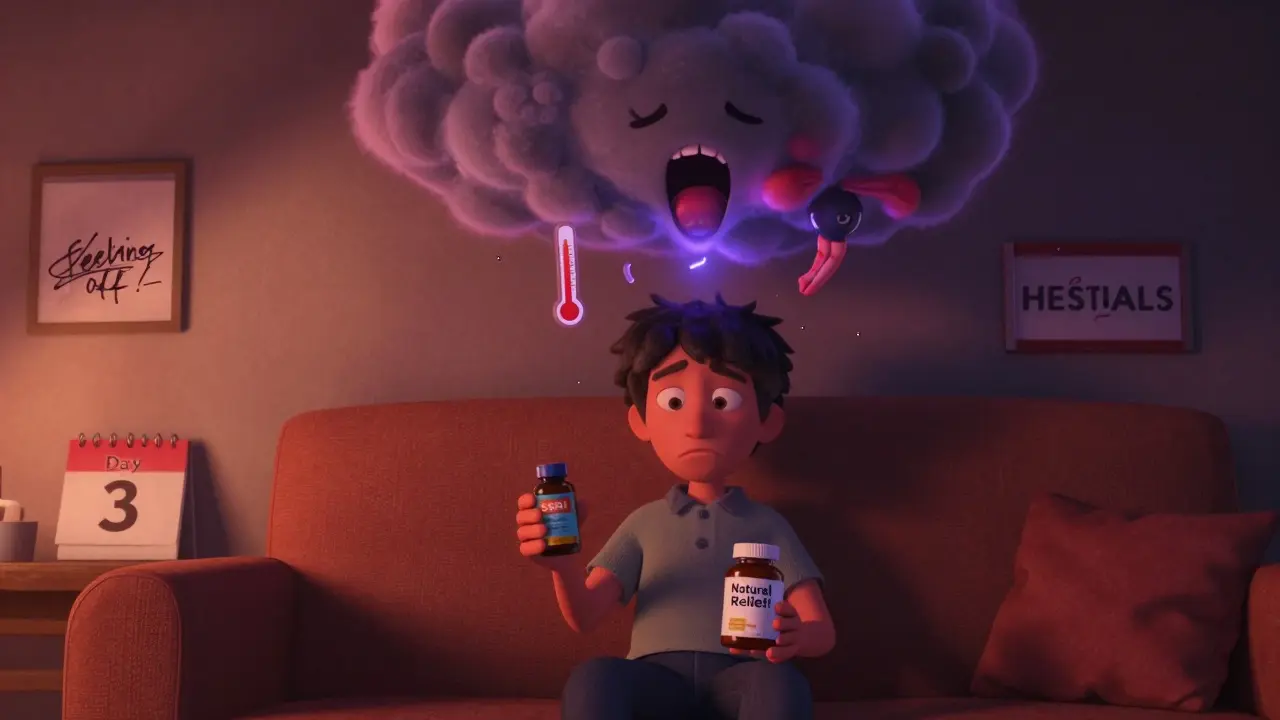
Early signs? Shivering, sweating, diarrhea, restlessness, or a twitchy muscle - like your leg jumping without you telling it to. These are easy to ignore. You might think it’s anxiety, a cold, or just stress.
But if it keeps going? You could develop:
- High fever (over 106°F / 41.1°C)
- Stiff muscles that won’t relax
- Rapid heartbeat, high blood pressure
- Confusion, hallucinations
- Seizures
Severe cases can lead to organ failure. Studies show 2-12% of hospitalized serotonin syndrome cases end in death. And here’s the scary part: 5-HTP is one of the most common supplements involved.
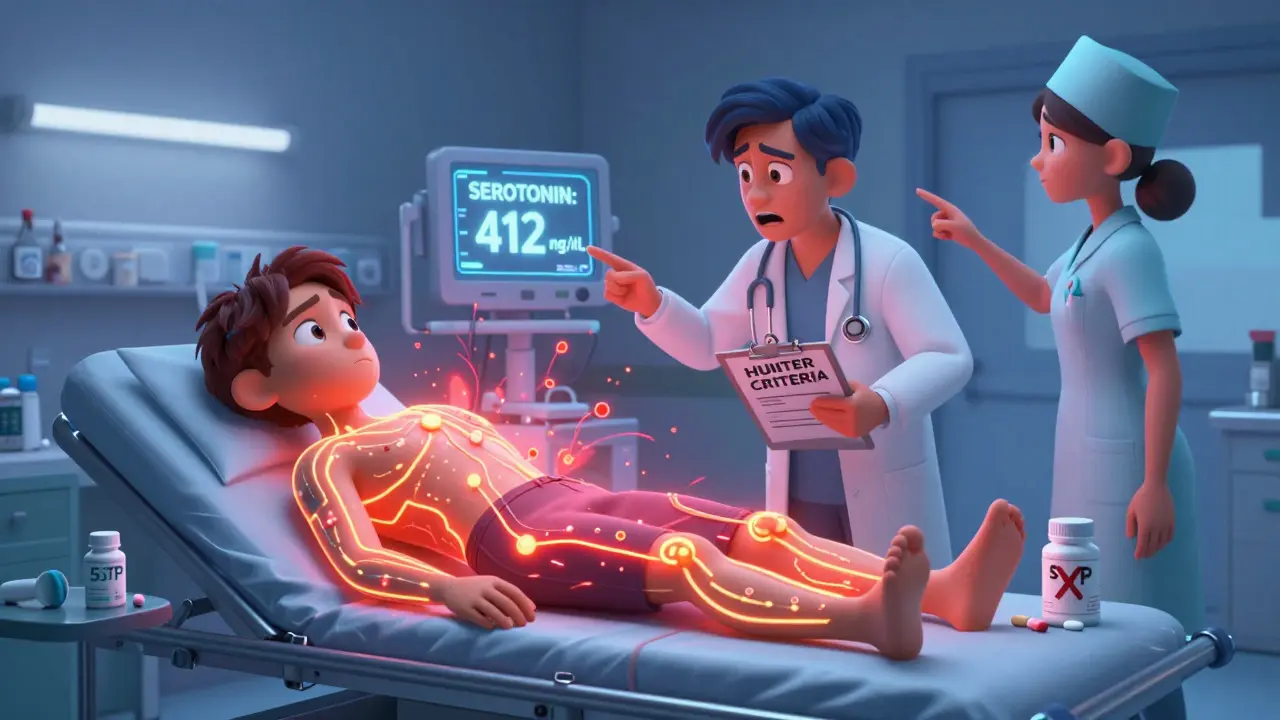
The Hunter Criteria - the most accurate diagnostic tool doctors use - says you have serotonin syndrome if you have one of these: muscle twitching + fever, or rigid muscles + hyperreflexia. If you’re on an SSRI and start having these symptoms after taking 5-HTP, you need help now.
Why This Combination Is Worse Than You Think
Let’s compare the risks:
| Combination | Estimated Risk | Notes |
|---|---|---|
| SSRI alone | 0.08-0.52 per 1,000 person-years | Very rare without other triggers |
| SSRI + 5-HTP | Comparable to SSRI + MAOI | MAOIs are known to be extremely dangerous with SSRIs |
| SSRI + Tramadol | 4.6% | Strong painkiller with serotonergic effects |
| SSRI + St. John’s Wort | 2.3% | Another popular herbal supplement |
That’s right - combining 5-HTP with an SSRI puts you in the same danger zone as mixing an SSRI with an MAOI. And MAOIs are the ones doctors warn you about never to combine with SSRIs.
And here’s the kicker: 5-HTP supplements aren’t regulated like drugs. ConsumerLab.com found that 31% of 5-HTP products in 2022 had doses that were 28% too high or 28% too low. You think you’re taking 100 mg? You could be getting 128 mg - or 72 mg. No way to know. That unpredictability makes this combo a lottery you never wanted to play.
Who’s at Risk? And Why Don’t They Know?
Most people who combine these don’t realize they’re putting themselves in danger.
A 2022 Healthline survey found that 41% of supplement users believe "natural" means "can’t cause dangerous interactions." That’s not just wrong - it’s deadly.
On Reddit’s r/SSRI community, over 60% of users who mentioned 5-HTP were self-medicating without telling their doctor. One user wrote: "Added 100mg 5-HTP to my 20mg fluoxetine. Fever hit 104°F. Thought I was having a panic attack. Ended up in ER."
And doctors? A 2020 study found only 38% of primary care physicians even know 5-HTP is a serotonin syndrome risk. Many don’t ask about supplements. Patients don’t think to mention them. It’s a gap in communication that’s costing lives.
The FDA and Experts Say: Don’t Do It
The American College of Medical Toxicology doesn’t mince words: "Concurrent use of 5-HTP with serotonergic medications is contraindicated." That means they say it’s unsafe and should never be done.
The FDA issued a warning in 2020 after collecting 127 reports of adverse events - including 9 deaths - from 5-HTP and SSRI combinations between 2015 and 2019.
Even the supplement industry is starting to wake up. The FDA has sent 14 warning letters to manufacturers for illegally claiming 5-HTP can "treat depression" or "replace antidepressants." But enforcement is slow. You can still buy it at any vitamin store.
And while some alternative practitioners claim you can "safely taper" off SSRIs using 5-HTP, there’s zero high-quality evidence for this. A 2023 pilot study with 42 people suggested it might be possible under strict monitoring - but the researchers themselves called it "highly experimental." Not a recommendation. A footnote.
What Should You Do Instead?
If you’re on an SSRI and thinking about 5-HTP - stop. Don’t take it. Period.
If you’re already taking both and feel off - stop the 5-HTP immediately. Call your doctor. Go to the ER if you have muscle stiffness, fever, or confusion.
If you want to reduce your SSRI dose? Talk to your psychiatrist. There are safe, proven ways to adjust medication - not through unregulated supplements.
If you’re trying to get off SSRIs? Work with a professional. A 2-week washout period is standard before starting 5-HTP - but for some SSRIs like paroxetine (which lingers in your system for weeks), you might need 4 to 6 weeks. Your doctor can help you figure that out.
And if you’re considering 5-HTP for anxiety or sleep? There are safer options. Melatonin, magnesium, or cognitive behavioral therapy have solid evidence. None of them come with a 1-in-10 chance of sending you to the ICU.
What’s Changing? What Should You Watch For?
The FDA is pushing to require "serotonin syndrome risk" warnings on all SSRI packaging by mid-2025. That’s a step forward.
The American Psychiatric Association now recommends doctors specifically ask patients: "Are you taking 5-HTP, tryptophan, or any other serotonin-boosting supplement?" That’s new. And it’s critical.
But until those changes fully roll out - and until more people understand that "natural" doesn’t mean "safe" - the risk stays real.
Supplements aren’t harmless. They’re chemicals. And when you mix them with prescription drugs, you’re playing with your nervous system. You don’t need to risk your life for a supplement that might help - if it even works at all.
Can I take 5-HTP if I stop my SSRI first?
Yes - but only after a full washout period. For most SSRIs, you need to wait at least 2 weeks after stopping before starting 5-HTP. For paroxetine or fluoxetine (which stay in your body longer), wait 4 to 6 weeks. Never start 5-HTP while still taking an SSRI, even if you’ve missed a dose. The risk of serotonin syndrome remains high during this transition.
Are there any safe supplements to take with SSRIs?
Some supplements are generally considered safe with SSRIs when used appropriately, including omega-3 fatty acids, vitamin D, and magnesium. But always check with your doctor. Even "safe" supplements can interact - for example, St. John’s Wort has a 2.3% risk of serotonin syndrome with SSRIs. Avoid all serotonin-boosting herbs unless your prescriber approves them.
What should I do if I think I have serotonin syndrome?
Call emergency services or go to the nearest ER immediately. Do not wait. Symptoms like high fever, muscle rigidity, confusion, or seizures are life-threatening. Tell medical staff you’re taking an SSRI and 5-HTP - this helps them act fast. The antidote, cyproheptadine, works best when given early.
Why don’t supplement labels warn about SSRI interactions?
Because under the Dietary Supplement Health and Education Act of 1994, supplement makers don’t need FDA approval before selling their products. They’re not required to test for drug interactions or include warnings. That’s why you’ll often see no mention of SSRIs on 5-HTP bottles - even though the risk is well-documented. The burden is on you to know the danger.
Is 5-HTP effective for depression on its own?
Some small studies suggest 5-HTP may help with mild depression, but the evidence is weak and inconsistent. A 2016 Cochrane review found only a handful of low-quality trials. It’s not a proven treatment. And if you’re already on an SSRI, the risk of combining them far outweighs any possible benefit. Don’t use it as a replacement without medical supervision.
Final Thought
You don’t need to take 5-HTP to feel better. If your SSRI isn’t working, talk to your doctor. There are other medications, therapies, and lifestyle changes that can help - without putting you at risk of a medical emergency.
Supplements aren’t magic. They’re chemicals. And when you mix them with prescription drugs, you’re not being smart - you’re being vulnerable. Protect your brain. Don’t gamble with serotonin.
Dinesh Dawn
February 22, 2026 AT 19:36Man, I read this and just felt my shoulders drop. I’ve been on sertraline for years and thought 5-HTP was just a gentle boost. Turns out it’s like pouring gasoline on a candle. Thanks for laying it out so clear. I’m deleting my supplement bottle tonight.
Vanessa Drummond
February 23, 2026 AT 18:41So let me get this straight - you’re telling me my "natural mood enhancer" is basically a chemical grenade with my SSRI? Wow. I’ve been taking this for 8 months. I’m not even mad, I’m just impressed by how stupid I was.
Christopher Wiedenhaupt
February 24, 2026 AT 11:44While the clinical data presented is compelling, I’d caution against overgeneralization. Not all 5-HTP formulations are created equal, and individual metabolic differences play a significant role. The risk profile is real, but not uniformly catastrophic across all users. Context matters.
John Smith
February 24, 2026 AT 19:32Of course the FDA doesn’t regulate supplements - because they’re too busy regulating the price of avocado toast. Natural doesn’t mean safe? What’s next, "air doesn’t mean breathable"?
Shalini Gautam
February 24, 2026 AT 23:59As an Indian woman who’s seen her auntie take ashwagandha with blood pressure meds - this isn’t new. We’ve been doing "mix and match" for centuries. But yeah, if you’re on SSRIs? Don’t be that person. Stay safe.
Natanya Green
February 25, 2026 AT 17:47OH MY GOD. I JUST REALIZED I’VE BEEN TAKING 5-HTP FOR 3 WEEKS WITH MY CITALOPRAM. I’VE BEEN HAVING NIGHT SWEATS AND TINGLING HANDS. I THINK I’M DIIIIIIIIING. I’M CALLING 911. BRB.
Steven Pam
February 25, 2026 AT 21:10Big love to whoever wrote this. This isn’t fearmongering - it’s a lifeline. I’ve been stuck in this loop of "I’ll just try one thing" and it’s been a mess. This gave me the clarity to stop. I’m scheduling a talk with my psych. You saved me from a nightmare.
Timothy Haroutunian
February 26, 2026 AT 10:54Let’s be real - the entire supplement industry is a pyramid scheme built on placebo and ignorance. People think because it’s in a bottle labeled "natural" it’s somehow exempt from chemistry. Serotonin isn’t a mood ring. It’s a neurotransmitter. You don’t get to hack it with herbal magic. And yes, I’ve seen three people in my circle end up in the ER over this exact combo. It’s not a rumor. It’s a pattern. And yet, the comments section is already full of people saying "but my cousin took it and felt great."
Erin Pinheiro
February 27, 2026 AT 08:27Ugh. I hate when people act like supplements are dangerous. I took 5-HTP for 2 years with Lexapro and I’m fine. I’m happier than ever. Maybe you’re just weak? Or maybe you need to stop being so scared of everything. Not everyone’s a liability.
Michael FItzpatrick
February 28, 2026 AT 17:13This is the kind of post that makes me believe in Reddit again. You didn’t just drop facts - you dropped a grenade on the myth of "natural = safe." I’ve been in the mental health space for a decade, and I’ve seen too many people get lured in by Instagram influencers selling serotonin crystals. The real tragedy? It’s not the supplement. It’s the silence. No one’s teaching us how to ask the right questions. This should be required reading in high school bio. And yes, I’m printing it out for my niece.
Brandice Valentino
March 1, 2026 AT 08:02I mean like… if you’re gonna be a serotonin mess, at least do it with style. Like, maybe try a little L-theanine with your SSRI? Or maybe just… cry into a journal? I’m just sayin’.
Larry Zerpa
March 1, 2026 AT 13:27Interesting. So you’re saying the FDA is right? That’s surprising. I assumed this was just another case of Big Pharma silencing natural alternatives. But now I’m realizing - maybe the supplement industry is the real villain. No testing. No oversight. Just profit. And people like me - who actually care about science - get blamed for being "anti-natural."
Gwen Vincent
March 1, 2026 AT 15:11I appreciate the depth here. I’ve been on an SSRI for 5 years and have been curious about alternatives. This didn’t scare me - it educated me. I’m going to talk to my doctor about CBT and omega-3s instead. Thanks for the clarity.
Nandini Wagh
March 3, 2026 AT 12:29My mom’s been taking 5-HTP since 2017. She says it "fixed her anxiety." I told her this article. She said, "You don’t understand Indian wisdom." I’m not sure who’s more dangerous - the supplement or the belief system.
Holley T
March 5, 2026 AT 02:26Let me just say - I read this and immediately went to my cabinet and threw out my 5-HTP. But I also think this whole thing is overblown. I mean, if you’re taking 100mg and your SSRI is low dose, and you’re not having symptoms - what’s the harm? People are scared of everything now. It’s not a chemical war. It’s a lifestyle. And sometimes, you gotta experiment. Not everything has to be a clinical trial.